English pronunciation for Spanish speakers
The sounds, rhythm, and spelling traps that give Spanish speakers the most trouble, explained using the Spanish you already speak.


The essentials
The hardest part of English for a Spanish speaker is the vowels. Spanish has five, and American English uses more than ten, which is why ship and sheep, or cap and cup, sound almost the same to you. After that come weak syllables, which English shrinks dramatically; pairs of sounds Spanish doesn't separate, like b and v; the puff of air that comes with p, t, and k; and consonants at the start and end of words.
Your Spanish also gives you some head starts. The soft d in “nada” (nothing) is close to the th in this, the n in “tengo” (I have) is already the ng in sing, the s in “mismo” (same) sounds almost like /z/ as long as you don't turn it into an h, and the “shhh” you make to ask for quiet is exactly the English sh.
This guide uses General American English as its model and explains the reason behind each rule. But knowing a rule isn't the same as hearing your own mistake: when you speak, your ear is still listening in Spanish. That's where Slay Speech comes in.
The 12 sounds that cause the most trouble
They're ranked by how much they affect how well people understand you, so start at the top, with the ones that cause the most confusion. Th comes last because, although it's very noticeable, it rarely changes the meaning. For each one, you'll see where the trap is and what to do with your mouth.
Sheep and ship: English has two i sounds
Spanish has only one i, so most Spanish speakers use that same vowel for both sheep and ship. As a result, live sounds like leave, sit like seat, and it like eat. And when you try to fix it, it's easy to overshoot: your ear often files the vowel in ship as an e, so sit ends up sounding like set.
The /i/ in sheep is close to your Spanish i, just tenser, with your lips spread. The /ɪ/ in ship doesn't exist in Spanish: lower your tongue slightly, relax your face, and open your jaw a little. It lands between your i and your e, without quite becoming an e.
Words to practice
- ship
- sit
- livethe verb
- big
- businessspelled with u, but that vowel is /ɪ/
- womenspelled with o, but that vowel is /ɪ/
Tip: Use a mirror: for sheep your lips spread as if you're smiling, and for ship they stay relaxed. Don't just shorten the vowel, because what really changes is its quality. Then say seat, sit, and set in a row. Sit belongs in the middle, without sounding like either of the other two.
Because your ear barely separates these two vowels, Slay Speech tells you which word came out with /i/ where /ɪ/ belonged and shows you the exact mix-up.
Cap, cup, and cop: one Spanish a can't cover all three
Where Spanish has a single a, American English has three different vowels: /æ/ in cap and cat, /ʌ/ in cup and cut, and /ɑ/ in cop and hot. If you use your Spanish a for all of them, they sound the same, and since your a is closest to the vowel in hot, cap and cup can both come out as cop. Spelling makes it harder: the u in cup, bus, or much isn't your u, and the o in hot, job, or doctor isn't your o.
For /æ/, open your jaw as you would for your a, push your tongue forward, and spread your lips a little, like an a with a smile, but stop before it turns into an e: bad isn't bed. For /ʌ/, keep your mouth relaxed and half open and make a short vowel in the center, like a loose, lazy a. For /ɑ/, your Spanish a works fine, wide open and with no lip rounding. In hot, stop, or doctor, that o is closer to your a than to your o.
Words to practice
- cat
- cap
- man
- baddon't let it become bed
- apple
- happy
Tip: Practice in sets of three: cap, cop, cup and cat, cot, cut. For the first word in each set, use a smiling a; for the second, your wide-open a; for the third, a loose mouth and a short vowel.
If you say cup with the vowel in cap, Slay Speech catches that mix-up in the exact word and shows you in a video how to shape your mouth.
Schwa /ə/: the vowel Spanish doesn't have
In Spanish, every vowel keeps its sound whether it's stressed or not: the three a's in Spanish “banana” all sound the same. In English, a huge number of unstressed vowels shrink into a short, neutral vowel called schwa. In banana, only the middle vowel is clear: /bəˈnænə/.
To make it, relax your whole mouth, let your tongue rest in the center, and make a short, muffled sound without shaping it. Not every unstressed vowel reduces, though: the last vowel in happy, window, or menu stays clear. That's why it pays to learn each word with its full rhythm.
Words to practice
- about
- today
- banana
- support
- problem
Tip: Hit the strong syllable clearly and say the rest quickly, without shaping them: a-BOUT, ba-NA-na, PROB-lem. Saying them more quietly isn't enough. The weak vowel has to turn into that neutral /ə/ and be clearly shorter.
Slay Speech scores every word you say, and when you tap a word like banana, you see how it splits into syllables and hear the audio, so you can tell which vowels weaken.

Why practice with Slay Speech
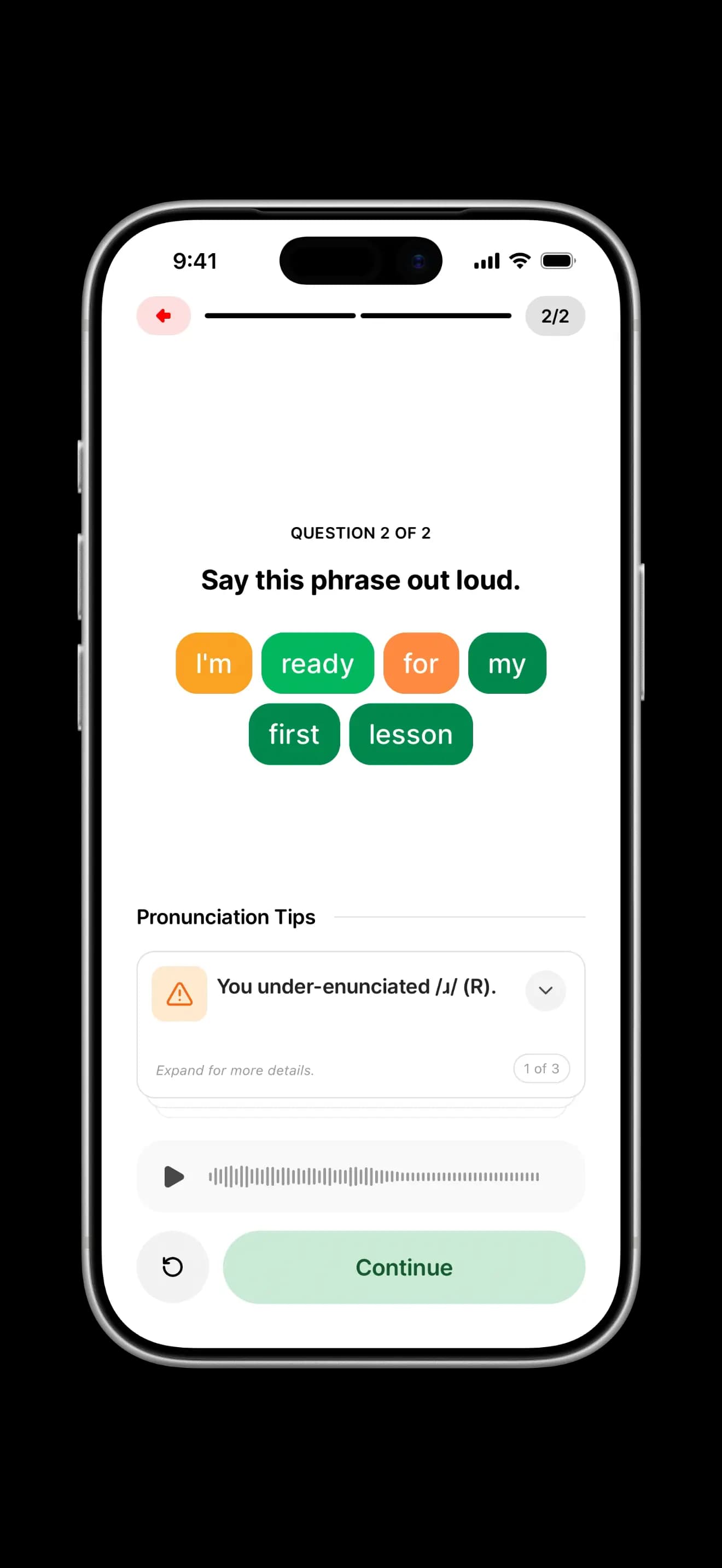
When you speak, your ear accepts the vowel you think you said. Slay Speech listens to you word by word and points out what's very hard to notice on your own.
Know which word was off
Say a sentence out loud and every word gets a score. The words light up as you speak.
See the exact mix-up
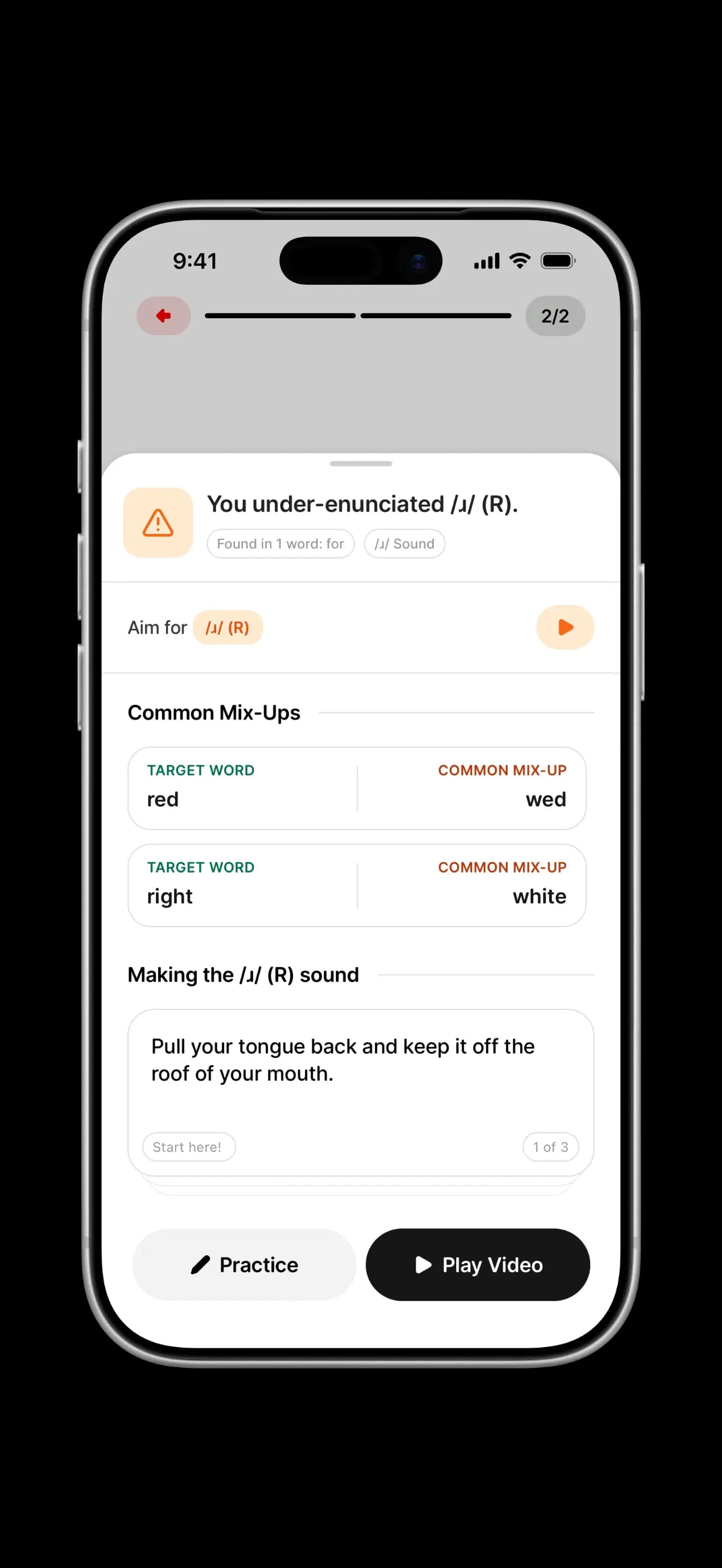
If your ship comes out as sheep or your very as berry, it shows you that mix-up, the words where it happened, and a video of how to place your mouth and tongue.
It remembers what you struggle with
It keeps track of the sounds that trip you up across all your practice and builds your reviews around them.
Practice the way people really talk
Video stories and situations like ordering food, making a phone call, or going to a job interview, with guidance and corrections in Spanish.
P, T, and K: the puff of air Spanish leaves out
In Spanish, the p in “papá” (dad), the t in “tela” (cloth), and the c in “casa” (house) come out with no air behind them. In English, at the start of a stressed syllable, p, t, and k are followed by a puff of air, like a very soft h. Without that puff, an American listener tends to hear them as b, d, and g: pat sounds like bat, pie like buy, time like dime, and coat like goat.
Hardly anyone notices this mistake in their own speech, because in Spanish the puff doesn't change anything. To make it, form the consonant as usual (lips closed for p, tongue up for t, the back of your tongue against the roof of your mouth for k), and as you release it, let a burst of air escape before the vowel, as if you were blowing out a candle. For t, also rest the tip of your tongue on the gum ridge just behind your upper teeth, not against the teeth as in Spanish. After s there's no puff: in spin, stop, and sky, p, t, and k sound almost the way they do in Spanish.
Words to practice
- piecompare it with buy
- people
- park
- timecompare it with dime
- coffee
- comecompare it with gum
Tip: Hold your palm or a sheet of paper in front of your mouth. With pie, time, and come, it should move; with buy, dime, and gum, it shouldn't. Then say spin: almost no air should come out.
When your pat sounds like bat, Slay Speech shows you that mix-up in the exact word, even if you felt you said it right.
B and V: two different sounds in English
In Spanish, “votar” (to vote) and “botar” (to throw away) sound identical; the difference is only in the spelling. In English, b and v are different sounds, and they change the meaning: berry and very, ban and van, best and vest.
At the start of a word, your very comes out with the firm b in “boca” (mouth) and sounds like berry. Between vowels, something else happens: your b softens, as in “lobo” (wolf), where your lips barely close. That in-between sound is neither the English b nor the English v, so river, seven, and even baby end up ambiguous. For /v/, rest your upper teeth on your lower lip and push air out with your voice on, so it buzzes. For /b/, close both lips completely and pop them open, between vowels too.
Words to practice
- verycompare it with berry
- voice
- seven
- river
- havedon't let it end in f
- love
Tip: Use a mirror: in very, river, and seven, you should see your upper teeth on your lip, and in berry or baby, your lips fully closed. Don't test yourself by checking whether you can stretch the sound, because the soft b in “lobo” can be stretched too.
Slay Speech catches it when your very slips into berry and shows you in a video where your teeth and lip go.
/z/: the buzz Spanish skips
In Latin America, the letter z sounds just like s, and /z/ doesn't exist as a sound of its own. That's why zoo comes out sounding like “su.” In English, that difference separates words: sip and zip, ice and eyes, price and prize, bus and buzz.
You may already be halfway there without noticing: as long as you don't turn your s into an h, the s in “mismo” (same) or “desde” (since) often sounds almost like z. And many written s's in English are actually /z/, as in is, because, and plurals like dogs. At the end of a word, English gives one more clue: the vowel gets longer before /z/, so eyes lasts longer than ice, and prize longer than price.
Words to practice
- zero
- zoo
- easy
- music
- because
- eyescompare it with ice
Tip: Hold a long s and, without moving your tongue, switch on your voice: sssszzzz. With your fingers on your throat, you should feel the vibration only on the z. At the end of a word, stretch the vowel too: eyes, prize.
When the /z/ in zoo or easy comes out as s, Slay Speech shows you that mix-up in the exact word and builds your reviews around that sound.
M, N, and NG at the end: some, sin, and sing
Almost no Spanish words end in m, which is why some ends up sounding like sun and team like teen. In English, the three final nasal sounds tell words apart, and the difference is where your mouth closes: with your lips for /m/; with the tip of your tongue on the gum ridge just behind your upper teeth for /n/; and with the back of your tongue against the back of the roof of your mouth for /ŋ/.
In the Caribbean, Central America, Venezuela, and the Andes, it's common to say a final n farther back, with the tongue against the back of the roof of the mouth, as in “pan” (bread) or “corazón” (heart). In English, that's already /ŋ/: sin sounds like sing, thin like thing, and ban like bang. If your final n doesn't sound like that, the risk runs the other way: saying sing like sin, or adding a g at the end.
Words to practice
- sing
- thing
- long
- morningthe -ing ends in /ŋ/, with no g
- young
- someend with your lips closed
Tip: Say “tengo” slowly and stop right before the g: that's the ng in sing. Then alternate sin and sing, thin and thing. For n, raise the tip of your tongue; for ng, raise the back. And in some or team, finish with your lips closed.
If your sin sounds like sing, or your sing like sin, Slay Speech shows you that mix-up and the words where it happened.
Sh and ch: ship isn't chip
Most Spanish speakers have ch but not sh, so she comes out as “chi” and shop as chop. Others swap it for s, and she sounds like see. Borrowed words reinforce the habit: shampoo became “champú” in Spanish, and show is often said “chou.” In Argentina and Uruguay, the ll in “calle” (street) is often very close to sh, and in parts of northern Mexico, Panama, and Chile, ch relaxes toward that sound. If that's how you speak, the challenge is keeping the two apart.
Sh is the sound you make to ask for quiet: lips slightly rounded, tongue not touching the roof of your mouth, and a steady stream of air. Ch, on the other hand, starts with your tongue pressed against the roof of your mouth, like a t, and releases all at once.
Words to practice
- she
- shop
- shoe
- wash
- nation-tion sounds like /ʃən/
- surehere the s sounds like /ʃ/
Tip: Alternate chip and ship, chop and shop, watch and wash. If you can stretch the sound, it's sh; if it cuts off on its own, it's ch.
Slay Speech can tell when you said ch instead of sh, shows you that mix-up, and adds the sound to your reviews.
The English J isn't your j, and it isn't your y either
The /dʒ/ in jet has nothing to do with the j in “jamón” (ham). It's closer to the y many people use in “inyectar” (to inject) or in an emphatic “¡yo!” (me!), though this varies a lot by region. That's why jet and yet get mixed up so easily: yes sounds like Jess and year like jeer. Borrowed words show the flip side: blue jeans became “bluyín,” with a y. And in the Río de la Plata region (Argentina and Uruguay), yes can come out as “shes.”
For /dʒ/, the front of your tongue touches the roof of your mouth, stops the air, and releases it with your voice on. It's like a ch with vibration. For the /j/ in yes, your tongue comes close without touching, almost like the i in “tiene” (has) or “siete” (seven).
Words to practice
- jet
- job
- just
- jump
- agespelled with a g
- judgethe sound appears twice
Tip: Think of yes as a quick i followed by “es.” For jet, make sure your tongue touches the roof of your mouth before you release the sound.
Whatever your region's y sounds like, Slay Speech tells you when your jet drifts toward yet and in which words it happened.
H: not silent, and not the j in “jamón”
In Spanish, h is silent, and that habit slips into English: hungry comes out as “ungry,” his as is, hate as eight, and hold as old. In English, h is pronounced, and if you drop it, you may end up saying a different word. Only a few words have a silent h, like hour and honest.
The English /h/ is just air flowing out with your mouth open, without your tongue scraping the back of the roof of your mouth. If the j where you're from is soft, as in much of the Caribbean, Central America, and Colombia, your j in “jamón” is already the English h. If your j is harsher, with friction at the back of your mouth, as in much of Mexico, the Andes, or the Southern Cone, soften it. It won't stop people from understanding you, but hello isn't “jelou.”
Words to practice
- house
- hungry
- hello
- hiscompare it with is
- hatecompare it with eight
- behind
Tip: Fog up a mirror with your breath, as if you were about to wipe it clean. That warm air, with no scraping, is the h in house and hello. Then alternate his and is, hate and eight, hold and old.
Because Slay Speech scores every word, if you drop the h in hungry or house, you see it in that exact word and can practice it on its own.
Voiceless TH /θ/: think, three, thanks
It's the sound of the z in “zapato” (shoe) as it's said in most of Spain. In Latin America, z sounds like s, so /θ/ is a new sound and often turns into s or t: think sounds like sink or tink. It stands out, but it's almost always understood from context, so don't let it worry you more than your vowels.
Stick the tip of your tongue out just slightly between your teeth, or rest it against the edge of your upper teeth, and blow without using your voice. Don't bite down hard: the air needs to keep flowing.
Words to practice
- think
- three
- thanks
- mouth
- birthday
- math
Tip: Use a mirror: in think, the tip of your tongue should peek out, and in sink, it shouldn't. Then stretch the sound for a few seconds. A t wouldn't let you do that.
If your think comes out as sink, Slay Speech points out that mix-up and the words where it happened, even when it sounds fine to you.
Voiced TH /ð/: the, this, they
This sound is in the, this, that, and they, so you'll hear it all the time. At the start of a word, Spanish speakers tend to use a firm d, with the tongue pressed against the teeth: they sounds like day and this like “dis.” Between vowels, though, it sometimes comes out as a soft r, so together, weather, or another end up with the r in “pero” (but). The mistake also gets more common when you speak quickly and off the cuff, without a script in front of you.
The d in “nada” is fairly close, but in English your tongue sits a bit farther forward, touches your teeth, and the sound buzzes more strongly. Place your tongue as you would for /θ/ and add your voice, without blocking the air.
Words to practice
- the
- this
- they
- mother
- brother
- weather
Tip: Say “nada” (nothing) or “todo” (everything) carefully, without swallowing the d. Then hold that d and stretch it, pushing your tongue out a little. Now start words with that same sound: this, they, that.
Slay Speech catches it when your they turns into day and shows you in a video how to place your tongue against your teeth.
Beyond single sounds: stress, rhythm, and spelling
Even with every sound in place, people may still struggle to understand you if your stress or rhythm is off.
Stress in cognates
Words that look like Spanish are the trickiest, because it's natural to keep their Spanish stress. It's HOS-pi-tal, not hos-pi-TAL; AN-i-mal, not a-ni-MAL; DOC-tor, not doc-TOR; POP-u-lar, not po-pu-LAR. And chocolate usually has just two syllables: CHOC-late. Moving the stress isn't enough, either. The syllables left weak change their vowels too, so hospital sounds like /ˈhɑspɪtəl/ and animal like /ˈænəməl/.
Stress can also shift with a word's job in the sentence: REC-ord is the noun and re-CORD is the verb. Whenever you learn a new word, check which syllable is the strong one.
Strong words and weak words
In Spanish, unstressed vowels are pronounced in full, and small words keep their vowels. English alternates strong and weak syllables: nouns, verbs, and adjectives stand out, while small words shrink. So to sounds like /tə/, for like /fər/, of like /əv/, and the word and like /ən/.
This matters a lot with can and can't. In I can go, can shrinks to /kən/; in I can't go, the vowel is a full /æ/. If you say can with a clear a, people can easily hear the opposite of what you meant.
The word that matters stands out
In Spanish, the main stress of a sentence usually falls on the last word, and to highlight something, Spanish speakers often change the word order: “el azul es el que quiero” (the blue one is the one I want). In English, the word order barely moves; the stress moves instead. The new or contrasting word is said louder, longer, and with a change in pitch, and whatever comes after it flattens out.
That's why you say I don't want the red one, I want the BLUE one, not the blue ONE. And if someone asks Do you like coffee?, the natural answer is I LOVE coffee, with coffee unstressed because it was already mentioned. If you always hit the last word, your listener has to guess what's important.
Consonant clusters and final consonants
No Spanish word starts with s plus a consonant, so your ear wants to add an e: “eschool,” “espanish,” “estudent.” Sometimes this even changes the word, as with state and estate. Borrowed words reinforce the habit, because “estrés,” “esnob,” and “eslogan” have that e, but stress, snob, and slogan don't. Start with a long s and no vowel in front: sss-chool, sss-tudent. Be especially careful after a consonant, as in this school or it's Spanish, and don't trust your ear, which “hears” that e even when you don't say it.
At the end of a word, Spanish allows only a few consonants, so English ones tend to get lost: next becomes “nex,” first becomes “firs,” and asked becomes “as.” And if people where you're from soften a final s to an h or drop it, as in much of the Caribbean, watch your plurals and the -s in he works, which carry meaning in English.
Here your Spanish gives you an advantage. Just as “los otros” (the others) sounds like lo-so-tros, in English you can carry a final consonant over to the vowel that follows. An apple sounds like a-napple, and pick it up like pi-ki-tup. Use this to hold on to your word endings.
English isn't read the way it's written
Spanish is read almost exactly as it's written, and that habit gets in the way in English. The final e in make or name is silent, so they have just one syllable, and their a sounds like the “ei” in “rey” (king). Many letters are silent: knife, island, hour. Vowels don't always sound the same either: the i in time or bike sounds like the “ai” in “hay” (there is), and the u in bus or cup isn't your u. And some words get shorter in real speech, like Wednesday (/ˈwɛnzdeɪ/), comfortable (/ˈkʌmftərbəl/), and vegetable (/ˈvɛdʒtəbəl/).
Borrowed words are another trap. Spanish has adapted many English words to its own sounds, and that Spanish version slips in when you speak English. You've already seen it with “champú,” “estrés,” and “bluyín,” which don't tell you how shampoo, stress, and jeans really sound. Something similar happens with w: in Spanish, that u sound at the start of a word often begins with a soft g, as in “huevo” (egg) or “güisqui” (whiskey). In English it doesn't: would, wood, and woman start with a quick u and rounded lips, not with “gu.”
Your 15-minute routine in Slay Speech
Each day, the home screen shows you the phrase of the day and one section of your learning path: three activities that build on each other. Altogether it takes about 15 minutes, and you're speaking out loud the whole time.
The phrase of the day (1 minute)
Say the phrase of the day out loud. Every word gets a score, and the card explains what the phrase means and when you'd actually say it.
The story video (about 6 minutes)
Today's section starts with a story told in short clips. After each clip, you answer a question and say a sentence out loud. A story can't be saved halfway through, so watch it in one sitting.
Topic phrases (3 minutes)
Say three phrases on the section's topic, like ordering at a restaurant or checking into a hotel, and notice which words need polishing.
A conversation or a sound review (3 to 5 minutes)
Depending on the section, you either practice a real situation (choosing replies and saying them, typing, or talking on a live call) or review your weakest sound with a few words. For many Spanish speakers, that's b and v.
The word you missed (1 minute)
Tap a low-scoring word to practice it on its own: listen to it, see its meaning in Spanish and how it splits into syllables, and record it again.