English pronunciation for Arabic speakers
What actually goes on when Arabic speakers speak English: the sounds Arabic doesn't have, the ones your dialect swaps for something else, and how to position your mouth and tongue to get them right.


Where the trouble comes from
Most of the pronunciation trouble Arabic speakers have in English comes down to three things. First, sounds that Modern Standard Arabic doesn't have, above all /p/. Second, vowels: English has far more of them than Arabic does. Third, consonant clusters, where it's tempting to slip in a vowel between the consonants or in front of them.
Standard Arabic has three short vowels and three long ones. English has many more, and changing the vowel changes the word. That's why an Arabic ear often hears sit and set as the same word: it files both under kasra (the short "i" vowel). It lumps cat and cut together under fatha (the short "a" vowel), or moves cut over to damma (the short "u" vowel) because it's spelled with a u.
Your dialect plays a part too, especially with th, j, ch, and consonant clusters. This guide uses General American pronunciation and points out where Arabic dialects differ. But knowing a rule is one thing; hearing your own mistake while you speak is another. That's what Slay Speech is built for.
The sounds that need attention
They're ranked by how much they affect how easily people understand you. Start at the top, and don't try to fix them all at once.
/p/ and /b/: the sound Arabic doesn't have
Standard Arabic has no /p/. The closest sound you have is ب (b), which is voiced: your vocal cords vibrate when you say it. That's how park turns into bark and people into something like beeble. Just think of how Arabic writes Pepsi: بيبسي (bibsi). The mix-up runs the other way too: bad can come out close to pad. That one starts in the ear rather than the mouth: an English b at the start of a word has almost no vibration before the lips open, so to an Arabic ear it sounds close to /p/.
Close your lips the way you do for ب, keep your throat silent, then open them with a clear puff of air. The puff is strongest at the start of a word and in a stressed syllable, as in pen and appear. After s, as in speak, sport, and spring, there's no puff, but /p/ is still voiceless, with no vibration, so don't say sbeak. At the end of a word, as in stop and hope, keep your throat silent too, or cap starts to sound like cab.
Words to practice
- peopleTwo /p/ sounds, and neither one is b.
- parkWith a b, it becomes bark.
- pen
- happyThe double p is still one short /p/.
- paper
- stopNo vibration on the final /p/.
Tip: Hold a tissue in front of your mouth. It should move when you say pen and barely move when you say Ben. This test doesn't work after s: the tissue won't move for speak even when you say it perfectly.
If a ب sneaks into people or park, Slay Speech points to the exact word and the exact mix-up, and shows you a video of how to shape /p/.
/ɪ/ and /ɛ/: one kasra for two sounds
Arabic has only one kasra, and depending on the dialect and the word, it ranges from /i/ to something close to /e/. English has two separate sounds here, and swapping them changes the meaning. Which way the mix-up goes depends on your dialect. In Saudi Arabia, for example, learners tend to say set when they mean sit, and pen when they mean pin. In Egypt it's more often the reverse, so next comes out close to nixt and best close to bist.
For /ɪ/, your tongue is high and forward, your jaw is almost closed, and your muscles are relaxed. For /ɛ/, your jaw and tongue both drop a little. And the difference between ship and sheep isn't just length: sheep has a tense /i/, while ship has a relaxed vowel with the tongue a little lower.
Words to practice
- sit
- setThe jaw drops a little more than for sit.
- pin
- pen
- didPast tense of do.
- deadSpelled with ea, but it's the /ɛ/ of set.
Tip: Put a finger under your chin and say sit, then set. You should feel your jaw drop slightly for set.
Your ear may hear pin and pen as one word, but Slay Speech shows you which of the two sounds you actually said, and in which words.
/oʊ/ and /eɪ/: a vowel that glides, not one that holds still
In most Arabic dialects, بيت (bēt, "house") and يوم (yōm, "day") are said with a long, steady vowel, and learners put those two vowels in place of /eɪ/ in say and /oʊ/ in go. The vowel often opens up as well, so late drifts toward let and pain toward pen, while coat drifts toward cot and note toward not, since an open o sounds close to the American vowel in hot. Learners rarely notice this mistake, because they think they've said it right.
Start from the vowel in بيت or يوم the way your dialect says it, but don't stay there. For /eɪ/, lift your tongue toward a y position at the end of the sound. For /oʊ/, round and tighten your lips at the end toward a w position. Each of these is a vowel that glides from one position to another, not a single vowel you stretch out.
Words to practice
- go
- coatDon't let it drift toward cot.
- noteDon't let it drift toward not.
- say
- lateDon't let it drift toward let.
- okayBoth sounds in one word.
Tip: Say go in front of a mirror. You should see your lips tighten and round more before the sound ends. If they stay the same from start to finish, you said the steady vowel of يوم, not /oʊ/.
You probably won't notice on your own that the vowel stayed flat, but Slay Speech scores every word, so you can see when go or late needs work, and a video shows you how the vowel glides.

Why practice in Slay Speech?
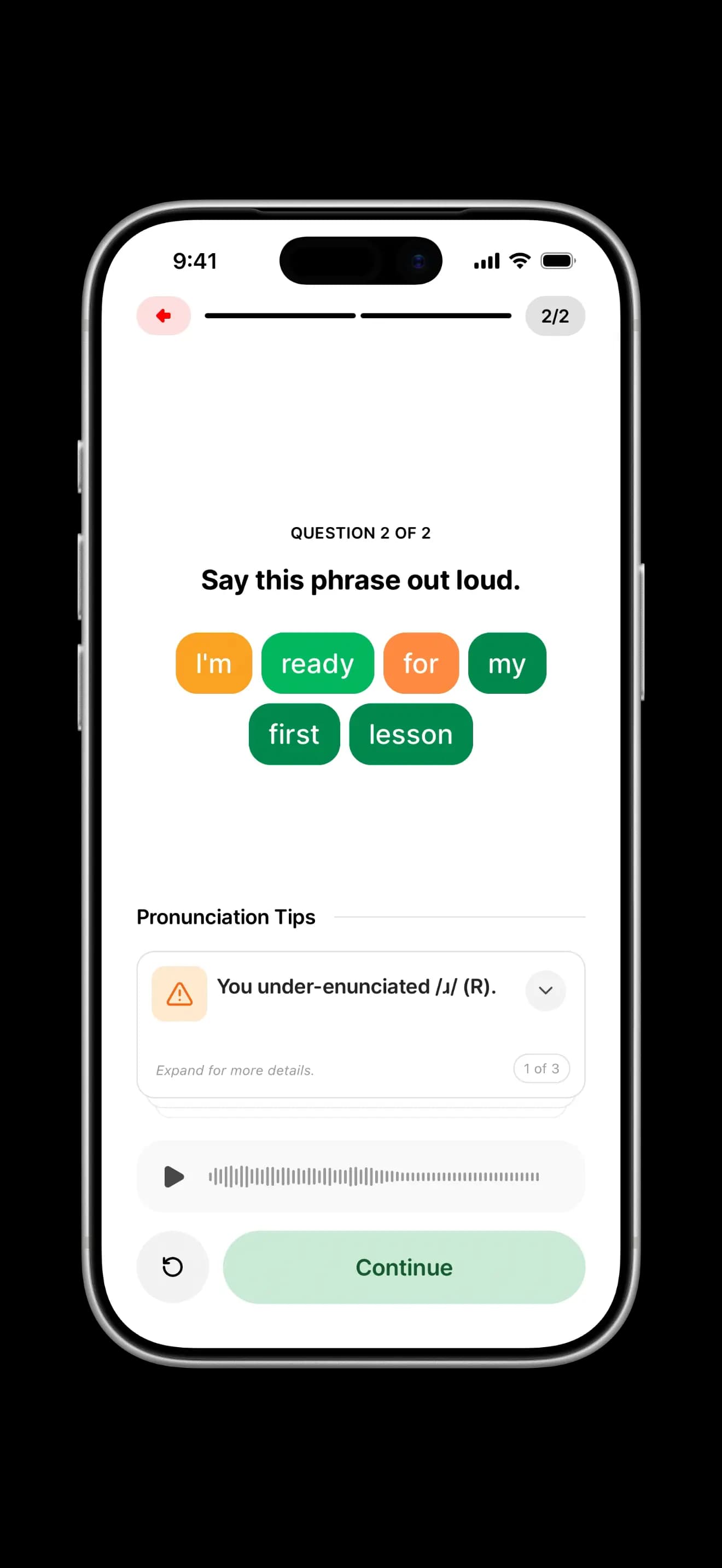
The hardest part of pronunciation is that an ear that's used to filing two sounds as one won't warn you when you mix them up. In Slay Speech, you speak, and the app shows you what you actually said.
A score for every word
Say the phrase out loud. The words light up as you speak, and each word gets its own score.
The exact mix-up, not just "wrong"
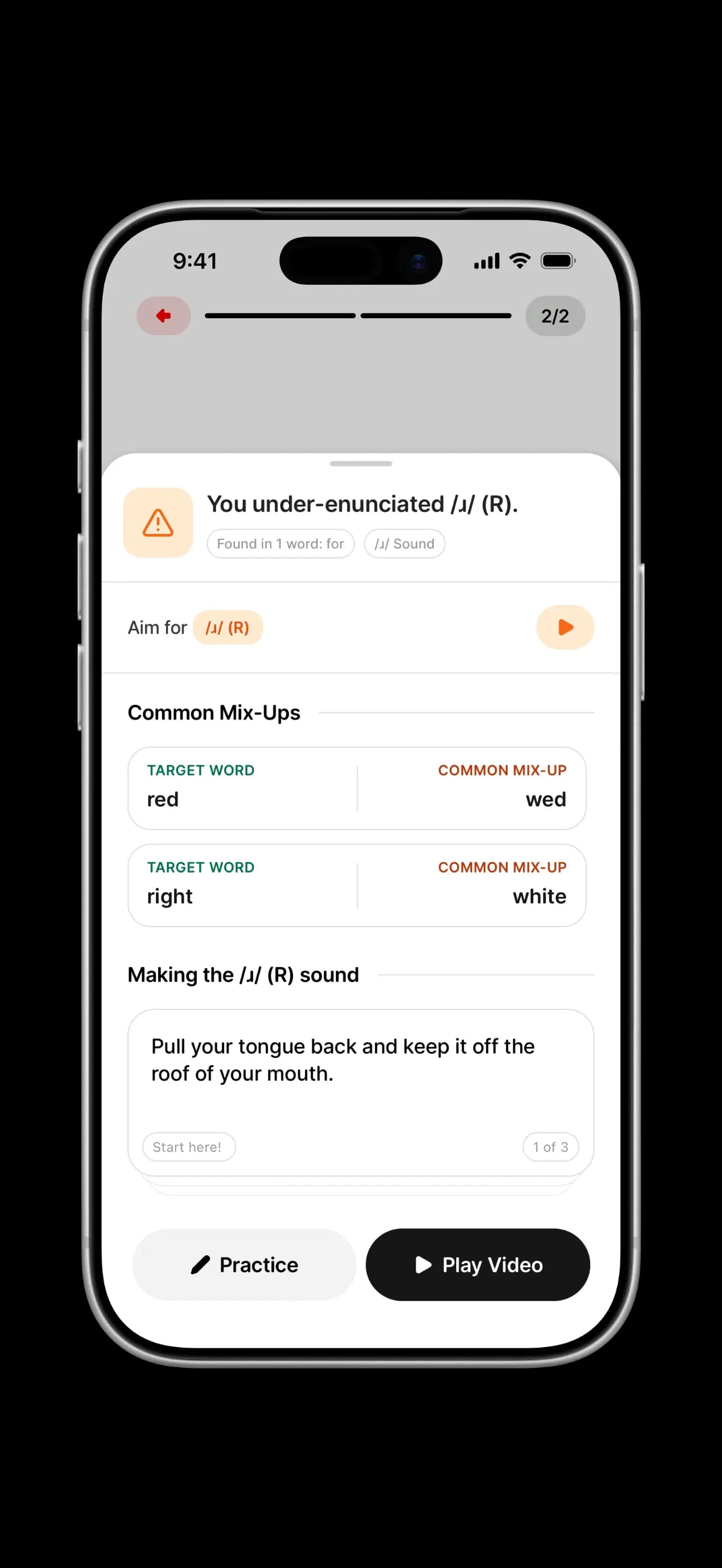
If pin comes out as pen, you see that exact mix-up and the words where it showed up, with a video of how to shape the sound with your mouth and tongue.
Review built around your sounds
The app tracks the sounds you stumble on across all your practice and builds your review around them.
In Arabic, with real-life situations
Guidance and feedback come in Arabic, and you practice situations like ordering food, making a phone call, or going to a job interview.
/ʌ/ and /æ/: neither fatha nor damma
Arabic speakers shift the sound of fatha without noticing. It's light (thin and forward) next to letters like ك (k) and س (s), and heavy (deeper, further back) next to the emphatic consonants ص (ṣ), ط (ṭ), ض (ḍ), and ظ (ẓ). But you think of all of these as one sound, so cat and cut can sound alike to you, and cap and cup, or bag and bug, get mixed up.
The second mistake comes from spelling. When /ʌ/ is spelled with o or u, many people read it as damma, so love, come, money, and mother come out with rounded lips, and luck drifts toward lock. Meanwhile, the o in hot, job, and not is a different, open sound: /ɑ/. The closest thing Arabic has is the heavy fatha in طار (ṭār, "it flew") and قال (qāl, "he said"), not damma.
For /æ/, your jaw opens wide and your tongue stays low at the front of your mouth. It's roughly like the light fatha in كلب (kalb, "dog"), but wider. /ʌ/ is a short sound in the middle of the mouth, with a relaxed face, the jaw half open, and no lip rounding at all, even when the spelling says o.
Words to practice
- cap
- cup
- bag
- bug
- comeThe o is /ʌ/, so no rounded lips.
- moneyThe o is /ʌ/, so no rounded lips.
Tip: Say cap while watching your mouth in a mirror. Your jaw should open clearly. Then say cup with your jaw much less open, as if the sound took no effort. After that, say come and money and watch your lips: they shouldn't round.
When cup comes out as cap, Slay Speech catches the mix-up in the phrase you just said and shows you in a video where your jaw and tongue go.
/v/ and /f/: an f with your voice switched on
Arabic has ف (f) but no /v/, which is why Arabic writes video as فيديو (fīdyo). So very comes out close to fairy, have close to half, and leave close to leaf.
Your mouth does the same thing for both sounds: your top teeth rest lightly on your lower lip, just as for ف. The whole difference is in your throat, like the difference between س (s) and ز (z): /f/ is just air, and /v/ is air plus vibration. The vibration gets lost most often at the end of a word, as in have, love, and five. There, listeners rely on the length of the vowel before it, which is longer before /v/ than before /f/. So make the vowel in leave a little longer than in leaf.
Words to practice
- veryWith an f, it sounds like fairy.
- haveWith an f, it sounds like half.
- love
- fiveTwo different sounds: f first, v last.
- seven
- videoNot the f of فيديو.
Tip: Say a long f sound, then add your voice from your throat without moving your lip or your teeth. You'll hear it turn into /v/, and you'll feel the vibration if you put your fingers on your throat.
When the v in very or have turns into an f, Slay Speech shows you the mix-up along with the words where it happened.
/z/ at the end of a word: not every s sounds like s
Arabic has ز (z), so the problem here is the letter, not the sound: you read s as س wherever it appears. But it's pronounced /z/ in very common words like is, was, has, and because, and at the end of plurals and verbs after a vowel or a voiced sound, as in dogs, plays, and goes. Say it as س and rise drifts toward rice, plays toward place, and prize toward price.
Keep the vibration in your throat until the end of the sound, just as you do for ز. And make the vowel before it a little longer, because that's one of the clearest ways a listener tells rise from rice: the vowel is longer before /z/ than before /s/.
Words to practice
- isThe s is /z/.
- wasThe s is /z/.
- becauseThe s is /z/.
- riseWith an s sound, it becomes rice.
- playsWith an s sound, it becomes place.
- dogsThe plural s is /z/.
Tip: Put your fingers on your throat, say is, and stretch out the last sound. The vibration should keep going, like a long "zzzz," not turn into the hiss of س.
If rise comes out as rice, Slay Speech shows you the mix-up and the words where it happened.
/tʃ/ and /dʒ/: a stop before sh and j
Standard Arabic has no /tʃ/, but it's familiar in Iraq, Kuwait, and parts of the Gulf, as in چاي (chāy, "tea"). Where the local dialect lacks it, as in Egypt and many cities of the Levant, it often turns into /ʃ/. Then chair sounds like share, chip like ship, and watch like wash, and those are real changes in meaning.
ج (jīm) itself isn't pronounced the same way everywhere either. It's close to the /dʒ/ of job for many speakers in Iraq, Najd (central Saudi Arabia), and Sudan, and in formal Quran recitation. In the Levant and much of North Africa it's closer to the /ʒ/ in measure, so job and just come out with no stop at the start. Egyptians usually do the same: their ج is /ɡ/, but they say job with /ʒ/, as in بيج (bēzh, "beige") and جراج (garāzh, "garage"). Even people who read ج as /dʒ/ may soften it in everyday speech.
Both sounds are a stop followed by friction in one movement. Press the front of your tongue against the back of the ridge behind your top teeth until the air is completely blocked, then release it into sh for /tʃ/, and into the Levantine ج (/ʒ/), with your voice on, for /dʒ/.
Words to practice
- chairWithout the stop, it becomes share.
- watchWithout the stop, it becomes wash.
- jobStart with a stop, not the soft ج.
- just
- largeThe g at the end is /dʒ/.
- ageThe g is /dʒ/.
Tip: Say ت (t) and then ش (sh) together, fast, until they come out as one burst: that's the /tʃ/ in chair. In the same way, put a light د (d) in front of the Levantine ج (/ʒ/) and you get the /dʒ/ in job. If you're unsure, say ج the way it's read in formal Quran recitation.
If chair comes out as share, or your dialect's ج takes the place of /dʒ/ in job, Slay Speech shows you the word and how to shape the sound.
/θ/ and /ð/: you already have ث and ذ, so use them
These two sounds are ث (th) and ذ (dh) as they're pronounced in Standard Arabic. If your dialect keeps them, as in Iraq, the Gulf, and Tunisia, you're already set. In Egypt, the cities of the Levant, and elsewhere, everyday speech turns ث into /t/ or /s/ and ذ into /d/ or /z/, and in English, speakers usually reach for s and z, so think sounds like sink and this like zis. In Morocco and Algeria they usually become /t/ and /d/, so three drifts toward tree and this toward dis.
Even if you have both sounds, you're not quite in the clear: English spells both of them th, and many people default to ث everywhere. The practical rule: small, very common words like the, this, that, they, and there, along with mother, other, and clothes, all use ذ, not ث.
Bring the tip of your tongue slightly out between your teeth or just behind them, and let the air pass gently. /θ/ is just air, and /ð/ comes with voice from your throat. And watch out for ظ (ẓ): it's emphatic, and it isn't the sound you want here.
Words to practice
- thinkWith an s, it becomes sink.
- thank
- threeWith a t, it drifts toward tree.
- thisUses ذ, not ث.
- motherUses ذ, not ث.
- thoseUses ذ, not ث.
Tip: Read ثلاثة (thalātha, "three") and هذا (hādhā, "this") in front of a mirror, the way they're said on the news or in Quran recitation, and make sure the tip of your tongue shows. Then carry the same position over to think and this.
You might get think right on its own, then slip back to sink in the middle of a sentence. Slay Speech catches the exact word where your dialect habit took over.
/ɹ/: an r where the tip of your tongue touches nothing
For the Arabic ر (r), the tip of your tongue taps the ridge behind your top teeth once or several times. In the American /ɹ/, the tip of your tongue doesn't touch anything. An Arabic ر in red or right usually doesn't change the meaning, but it does catch the listener's ear. In American English, a written r is pronounced almost everywhere, even at the end of a word, as in car and water. If you learned British pronunciation at school, you may drop it at the end of a word and before a consonant.
Pull your tongue back and lift it slightly without touching the roof of your mouth, let its sides touch your upper back teeth, and round your lips a little. Your tongue stays pulled back through the whole /ɜ˞/ in bird, work, and first. Don't let the spelling fool you: the o in work and word doesn't mean damma, and if you round your lips for it, work drifts toward walk. And the i in first and thirty doesn't mean kasra.
Words to practice
- redNo tap of the tongue.
- right
- carSay the final r.
- waterSay the final r.
- bird
- workWith rounded lips, it drifts toward walk.
Tip: Hold a long "aaa" sound, then slowly pull your tongue back without letting it touch anything until you hear the sound change. Then try red, and remember: no tap.
It's hard to tell on your own where your tongue ended up, so Slay Speech scores every word with an r and shows you a video of how the tongue moves.
/ŋ/: an n from the back of the tongue, with no g after it
Arabic has no separate letter for /ŋ/, but you already say something close to it before ك (k), as in بنك (bank). The problem is adding a g that isn't there, so sing and morning end with a clear /ɡ/. Sometimes a /k/ shows up instead, and then the meaning changes: thing drifts toward think, and sing toward sink.
Raise the back of your tongue until it touches your soft palate, keep the tip down, and let the air come out through your nose. You only hear a /ɡ/ after it in certain words, like finger and English.
Words to practice
- singNo g at the end.
- thingWith a k, it becomes think.
- long
- morningNo g at the end.
- young
- EnglishHere the g really is pronounced.
Tip: Say بنك and stop just before the ك, keeping your tongue where it is, and hold the sound. That's close to the position you need. Now say sing and finish without moving your tongue.
If a g shows up after sing, or thing drifts toward think, Slay Speech points out the word where it happened and shows you in a video where the back of your tongue goes.
/ʊ/ and /u/: damma isn't enough
Standard Arabic has a short damma and a long و (ū), and in the dialects damma ranges from /u/ to something close to /o/. If you say pull and pool with the same long و, the difference disappears, and full drifts toward fool.
Just making the vowel shorter isn't enough. In pool, your lips round and tighten, and your tongue rises high. In pull, your lips round less, your muscles relax, and your tongue sits a little lower. The spelling won't help you either: oo gives /ʊ/ in book and /u/ in food.
Words to practice
- pull
- pool
- fullWith a tense vowel, it sounds like fool.
- fool
- lookoo here is the relaxed /ʊ/.
- foodoo here is the tense /u/.
Tip: Say pool and push your lips forward as if you're about to whistle, then say pull and let your mouth relax completely. The second vowel should come out much more relaxed.
If you say pull with the vowel of pool, Slay Speech flags that exact mix-up and shows you the difference in your lips and tongue.
Beyond individual sounds
You can say every sound correctly and still be hard to understand if you ignore these four things.
Stress and weak vowels
In Arabic, syllable weight largely decides where the stress goes, and vowels mostly keep their full sound. In English, you have to learn the stress along with the word, and it can move between words built from the same root: PHOtograph, but phoTOgraphy. Arabic speakers most often slip on long or unfamiliar words that end in a heavy syllable, moving the stress to the end the way Arabic would: they say substiTUTE and teleSCOPE instead of SUBstitute and TELescope. In compound nouns, the stress falls on the first part: GREENhouse, PHONE number.
Even more important, unstressed vowels weaken into a very light sound, /ə/, as in about /əˈbaʊt/ and banana /bəˈnænə/. Many Arabic speakers pronounce these syllables in full, the way they're spelled, so about starts with a clear fatha, today gets a full damma, and presentation ends in a full "shan" instead of /ʃən/. Your speech loses its rhythm, and the listener can't easily tell which syllable is stressed. If you speak Levantine Arabic or North African Darija (the everyday Arabic of Morocco, Algeria, and Tunisia), your dialect has a short, faint vowel close to /ə/, so put it to work.
The same thing happens with small words inside a sentence, like to, for, at, can, of, and and. In normal speech they weaken to /ə/, so can in I can go sounds close to /kən/, and to in want to go sounds close to /tə/.
Consonant clusters
A word in Standard Arabic never starts with two consonants, so Arabic speakers add a vowel without noticing. Where it goes depends on the dialect and the cluster. Egyptian speakers, for example, put it between the consonants in floor and plastic, which come out close to filoor and bilastic, but put it before the s in study, stand, and spring, which come out close to istudy and istand, just like إستاد (istād, "stadium") and إستايل (istāyl, "style"). In other dialects, such as Iraqi, the vowel may come before the whole cluster, so floor drifts toward ifloor. Darija is full of back-to-back consonants, so its speakers usually find clusters easier.
The same thing happens in the middle and at the end of words, as in asked, texts, and months. Move from one sound to the next without opening your mouth for a vowel in between: s, then st, then str, then the whole word street. Start right on the hiss of the s, with no glottal stop or vowel in front of it.
Spelling is not a pronunciation guide
Arabic spelling mostly matches how words sound, so you're used to pronouncing every written letter. English is full of silent letters, as in knife, listen, walk, comb, and hour.
The -ed ending is another trap: it only adds a syllable after /t/ or /d/, as in wanted. Looked is /lʊkt/, played is /pleɪd/, and changed is /tʃeɪndʒd/, all one syllable.
A double letter in English isn't a shadda (the Arabic mark that doubles a consonant): happy, coffee, sorry, summer, and collect all have a single short consonant. If you hold it the way you hold a shadda in درّس (darras, "he taught a class") or علّم (ʿallam, "he taught"), the rhythm of the word is thrown off.
Linking words together
An Arabic syllable can't start with a vowel, so Arabic speakers put a glottal stop (a hamza) in front of English words that start with a vowel, and the sentence comes out choppy. English speakers link a final consonant to the vowel that follows, so an apple sounds like a-napple, and pick it up like pi-ki-tup.
This is close to what Arabic does with hamzat al-wasl, the "connecting" hamza at the start of words like al- ("the"): it drops out in connected speech, so the words on either side run together, as in في البيت ("in the house"), which you say as fil-bēt.
Fifteen minutes a day in Slay Speech
Every day, the home screen shows you the phrase of the day and one section of your learning path: three activities that build on each other. The whole thing takes about fifteen minutes, and you practice out loud.
1 minute: phrase of the day
Say the phrase of the day out loud to see a score for every word. The card explains what it means and when people actually say it.
About 6 minutes: story video
Today's section starts with a story split into short clips. After each clip, you answer a question and then say a sentence out loud. Your progress isn't saved if you stop halfway, so watch it from start to finish in one sitting.
3 minutes: topic phrases
Say three phrases from the section's topic, like ordering food or checking into a hotel, and see which words need practice.
3 to 5 minutes: conversation or sound review
Depending on the section, you either practice a real-life situation (picking replies and saying them out loud, typing, or talking on a live voice call) or review your weakest sounds, like /p/ or /v/, in a few words.
1 minute: the word you stumbled on
Tap a low-scoring word to practice it on its own: listen to it, see what it means in Arabic and how it breaks into syllables, then record it again.