English pronunciation for Hindi speakers
The sounds, rhythm, and spelling traps that trip up Hindi speakers most, explained through sounds you already know from Hindi.


What matters most
These are the habits that most affect how easily people understand a Hindi speaker's English: merging v and w, dropping the puff of air on p, t, and k at the start of a word, giving unstressed syllables a full vowel, and marking word stress differently from Americans. Next come vowels like the ones in bad and bed, the American r, and z. The Indian versions of th and t get noticed the most, but they rarely change the meaning.
You already have many of these sounds in Hindi. The vowel in cup is close to Hindi अ (a), and if you say that same अ short and relaxed, you get schwa. The vowel in American hot is close to आ (ā). इ (i) and ई (ī) give you the difference between ship and sheep, and उ (u) and ऊ (ū) the difference between pull and pool. श (sha), ज़ (za), and फ़ (fa) are nearly the same as English sh, z, and f, and your र (ra) is like the t in the middle of American water. Hindi also lets words end in g, d, and b, as in आग (āg, fire), याद (yād, memory), and जवाब (javāb, answer), something speakers of many other languages struggle with.
Most Hindi speakers learned English at school, the British way. Indian English is a valid variety of English in its own right, not a mistake; this guide simply shows where General American English differs from it, and why. English written in Devanagari, the script used for Hindi (टाइम for time, डॉक्टर for doctor, थैंक यू for thank you), reinforces these habits too, so in several places that's where we'll start. But knowing the rules is one thing, and hearing your own mistakes is another: while you speak, your ear is still listening the Hindi way. That's where Slay Speech comes in.
The ten sounds that trip you up most
They're ranked by how much they affect how well people understand you, so start at the top: those cause the most misunderstandings. Th and t come last because, even though people notice them a lot, they rarely change the meaning. The comparisons with Hindi sounds are just a starting point: in most cases the sounds are similar, not identical.
W and v: wine and vine are different words
Hindi has a single sound, व (va), that comes out sometimes like v and sometimes like w, and the meaning never changes. That's why so many Hindi speakers use the same in-between व for both English /v/ and /w/. To an American ear, wine and vine, west and vest, and wet and vet then sound the same. The difference is also very hard to hear for yourself, so it doesn't go away on its own, even after years of listening to English or living in the US.
For /w/, your teeth don't touch your lip at all. Round your lips tightly, as for ऊ (ū), push them forward, then open them straight into the next vowel: say ऊ-एट (ū-et) quickly and you get wet. You already make this sound: the व after a consonant in स्वागत (svāgat, welcome), स्वर (svar, voice), and द्वार (dvār, door) is very close to w. For /v/, it's the opposite: rest your upper teeth lightly on the inside of your lower lip and let your voice come through, so your lip buzzes a little. It's the same position as फ़ (fa), just with voice added.
Words to practice
- we
- wineNot vine
- westNot vest
- wouldThe l is silent
- world
- twelveLips stay rounded after the t
Tip: In front of a mirror, alternate wine and vine. For wine, your lips should form a small circle with your teeth hidden; for vine, your upper teeth should rest visibly on your lower lip. Then say very, voice, and video with a finger on your lip to feel the buzz.
Since your ear can barely tell these two sounds apart, Slay Speech shows you the exact word where your wine turned into vine, and names the mix-up.
P, t, k: a light puff of air at the start
Hindi keeps प (pa) and फ (pha) apart, yet most Hindi speakers say English p, t, and k with no puff of air, like प, ट (ṭa), and क (ka). Hindi spellings like टैक्सी (ṭaiksī, taxi) and कार (kār, car) reflect the same habit. In American English, though, p, t, and k at the start of a stressed syllable come with a light puff of air. Without it, an American listener may hear b, d, and g instead: bat for pat, Ben for pen, dime for time, and gold for cold.
The good news is that you already know how to add breath to a consonant. The English puff is just lighter than Hindi फ (pha) or ख (kha): think of it as halfway between प and फ, or between क and ख, with clearly more air than प and क but less than फ and ख. (Here फ means the one that bursts from the lips, not फ़ (fa), which uses your lip and teeth.) For t, put the tip of your tongue on the ridge just behind your upper teeth; more on that below. And remember that there's no puff after s: in spin, stop, and sky, the p, t, and k have almost no air.
Words to practice
- penShouldn't sound like Ben
- people
- park
- timeNot dime
- come
- coldNot gold
Tip: Hold your palm or a thin strip of paper in front of your mouth. It should move on pen, time, and come, but not on Ben, dime, and gum. Then say spin: almost no air should come out.
When your pat sounds like bat, Slay Speech points out the mix-up in the exact word, even if it felt right to you.
Schwa /ə/: the weak vowel in unstressed syllables
In Hindi, a vowel is either said in full or, like the silent अ (a) after म (m) in कमरा (kamrā, room), dropped completely. English has a third option: the vowel in an unstressed syllable weakens into a short, relaxed sound called schwa. In banana, only the middle a is said clearly: /bəˈnænə/. Because many people learn English from its spelling, they give problem a full ए (e), today a full उ (u), and computer a full ओ (o), so every syllable ends up with the same weight.
You already have the sound: Hindi अ (a), said very short and relaxed, is schwa. The only new part is using it in unstressed syllables. Not every unstressed vowel weakens, though: the last vowel in happy, window, and menu stays clear. So learn each word together with its rhythm.
Words to practice
- about
- todayNot टुडे (ṭuḍe), but tə-DAY
- banana
- problemNo clear e in the second syllable
- computerThe first o is weak
- support
Tip: Say the stressed syllable clearly and a little longer, and the rest quickly and loosely: a-BOUT, ba-NA-na, PROB-lem, tə-DAY. Just saying the rest more quietly isn't enough; the weak vowel really has to become a short, relaxed अ.
Slay Speech scores every word, and you can tap a word like banana to see its syllables and hear it spoken, so you know which vowels to weaken.

Why practice with Slay Speech
When you speak, your ear hears what you meant to say. Slay Speech listens to you word by word and shows you what's very hard to catch on your own.
See which word went wrong
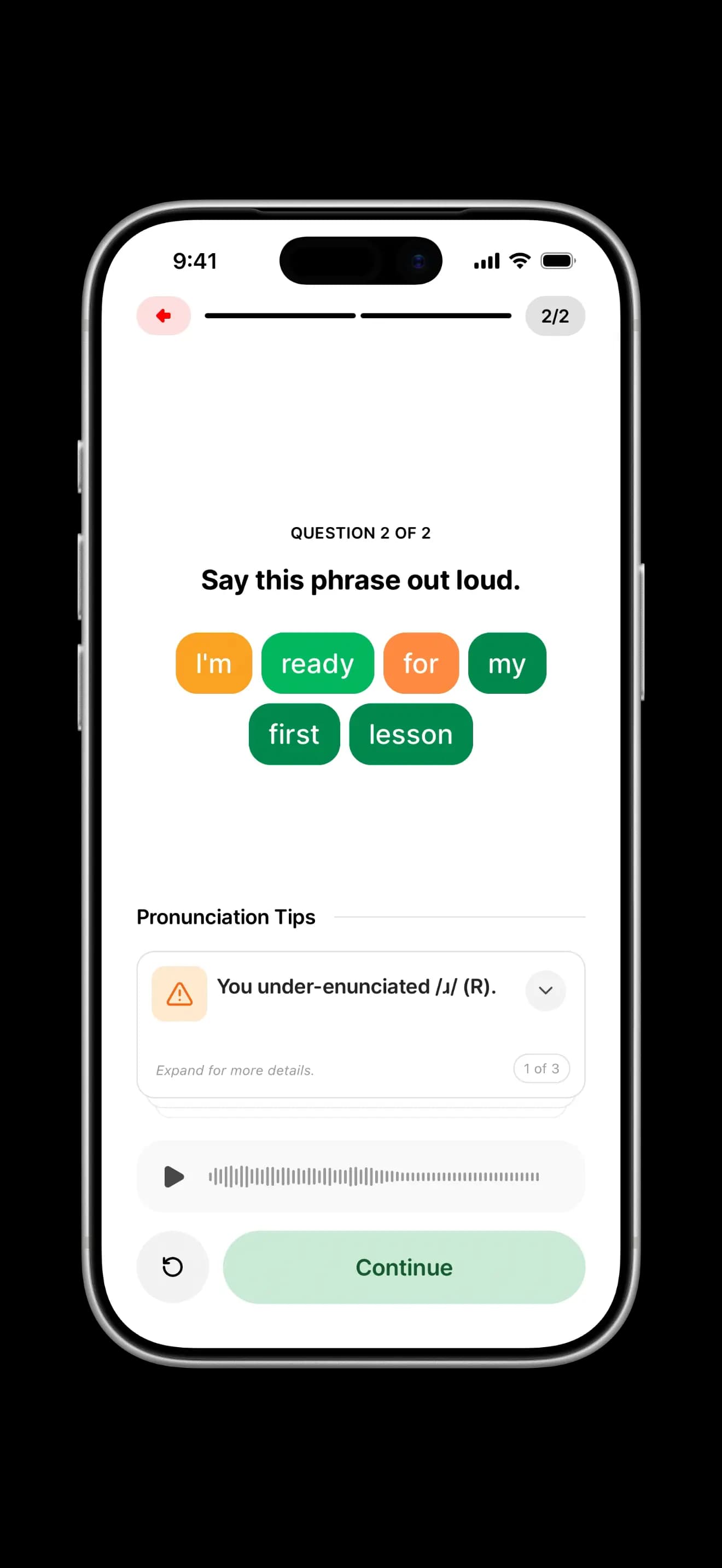
You say a phrase out loud and every word gets a score. Words light up as you speak.
See the exact mix-up
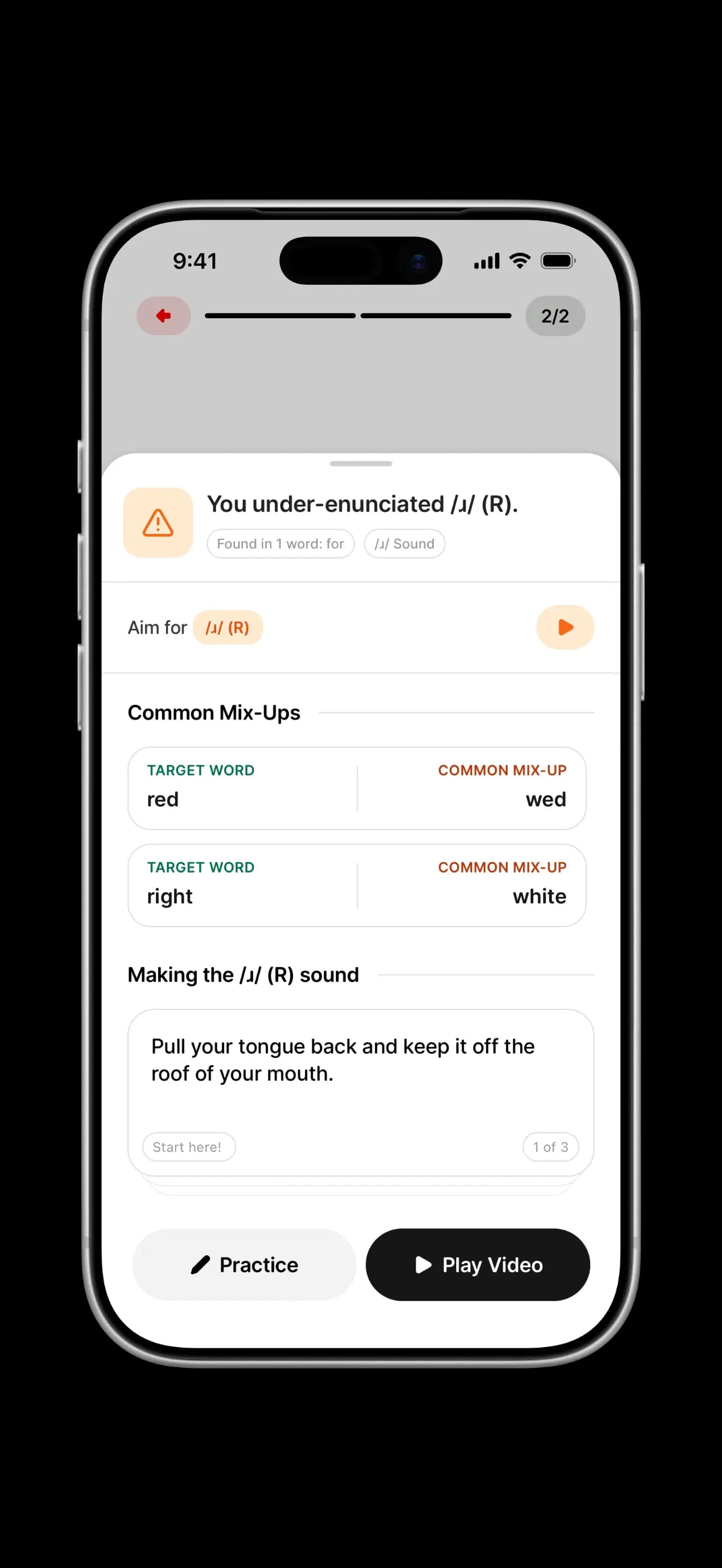
If your wine sounds like vine or your pat like bat, the app shows you the mix-up, the words where it happened, and a video of the right mouth and tongue position.
It remembers what's hard for you
Across all your practice, the app tracks which sounds keep tripping you up and builds your reviews around them.
Practice that feels like real life
Video stories and situations like ordering food, making a phone call, or going to a job interview, with guidance and corrections in Hindi.
Bad and bed: open wider for /æ/
Many people from North India say bad and bed, man and men, and sad and said with the same or nearly the same vowel, somewhere around Hindi ऐ (ai) or ए (e). Bank is written बैंक (baink) and cat कैट (kaiṭ), but Hindi ऐ isn't as open as American /æ/. So the two English vowels end up in the same place, and a listener may hear bed when you mean bad.
The /ɛ/ in bed is close to the ऐ in है (hai, is), just shorter. For the /æ/ in bad, drop your jaw even lower, almost as far as for आ (ā), but keep your tongue forward and spread your lips slightly: it's a sound between ऐ and आ. One more thing: in the British-style English taught in school, class, after, can't, ask, and dance are said with आ, but American English uses /æ/ in all of them.
Words to practice
- badNot bed
- manNot men
- happy
- black
- classNo आ (ā) in American English
- can'tNo आ (ā) in American English
Tip: Watch yourself in a mirror as you say bed, bad, bed, bad: your jaw should clearly drop on bad, but not on bed. Then practice the pairs man and men, and sad and said.
If your bad comes out like bed, Slay Speech catches the mix-up in the exact word and shows you a video of how to shape your mouth.
The American r: your tongue doesn't touch anything
For Hindi र (ra), the tip of your tongue taps once, or trills, against the ridge just behind your upper teeth, and most Hindi speakers use the same र in English. To an American ear, it's one of the strongest signs of an accent. In the American /ɹ/, the tip of the tongue doesn't touch anything, and the sound flows without a break.
Pull your tongue back a little and bunch it up, or curl the tip up and back as for ड़ (ṛa, as in सड़क, saṛak, road), but don't let it touch anything, and round your lips slightly. In work, bird, and teacher, the r blends into the vowel: not a vowel followed by र, but the whole vowel colored by r. In car, you start with an open आ (ā), then your tongue glides toward r without tapping. If you learned in school to drop a final r and say car like का (kā), note that in American English it's always pronounced. And your tapped र doesn't go to waste: it's the right sound for the t in the middle of water and city.
Words to practice
- red
- right
- sorry
- carPronounce the final r
- work
- teacherThe r blends into the last syllable
Tip: First say र and notice where your tongue taps. Now do the same thing, but stop your tongue before it gets there and stretch out the sound: rrrred. If you hear any tap or trill, it's still the Hindi र.
Slay Speech scores every word, so if the r in red, car, or work isn't right, you see it in that exact word and can practice it on its own.
Hot and doctor: आ, not ऑ
Hindi even has a special vowel sign, ऑ (ŏ), just for writing English words: डॉक्टर (ḍŏkṭar, doctor), कॉलेज (kŏlej, college), हॉट (hŏṭ, hot). It stands for the rounded vowel of British English. In American English, your lips don't round for hot, job, stop, not, and doctor, and the vowel is very close to Hindi आ (ā): American hot is almost हाट (hāṭ), just a bit shorter, and doctor is almost डाक्टर (ḍākṭar). People will still understand you with a rounded ऑ, but to an American ear it sounds British or foreign.
Hindi gives you a big head start here, too. The difference between cut and cot is much like the one between कट (kaṭ) and काट (kāṭ): अ (a) in cut, cup, love, and money, and आ (ā) in cot, hot, and stop. Just watch out for spelling: money, love, come, son, mother, month, and nothing are spelled with o but said with अ, not ऑ or ओ.
Words to practice
- hotNot हॉट (hŏṭ), closer to हाट (hāṭ)
- job
- stop
- not
- doctorCloser to डाक्टर (ḍākṭar)
- father
Tip: Say them in pairs: cut and cot, cup and cop, luck and lock. Use a short, relaxed अ in the first word and an open आ in the second. Check in a mirror that your lips don't round on cot and lock.
If your cut comes out like cot, or your cot like cut, Slay Speech shows the mix-up in the exact word and adds the sound to your reviews.
Z: zero, not “jero”
Hindi has two separate sounds, ज़ (za) and ज (ja), but the dot underneath, called the nukta, often gets dropped in both speech and writing. People who say ज़रूर (zarūr, of course) as जरूर (jarūr) often say zero as जीरो (jīro) and easy as ईजी (ījī) in English too, and then zone can sound like Joan. The other common habit comes from spelling: in English, s is often pronounced /z/, as in is, was, because, and music, and in plurals like dogs and plays, but Hindi speakers often say स (sa) there instead.
If you say a clear ज़ in ज़रूर (zarūr, of course), ज़मीन (zamīn, land), or ज़िंदगी (zindagī, life), you already have English /z/. For ज़, your tongue doesn't press against the roof of your mouth; buzzing air just keeps flowing from behind your teeth. For ज, your tongue first presses against the roof of your mouth, then lets go. The rule for -s is simple: after a vowel or a voiced sound (one where your throat vibrates), it's /z/ (dogs, plays, is, has); after a voiceless sound (no vibration), it's /s/ (cats, books); and after s, z, sh, ch, or j, it adds a syllable, /ɪz/ (buses, watches). The middle sound in measure, usually, and television belongs to the same family: say श (sha) and add voice from your throat.
Words to practice
- zeroWith ज़ (za), not जीरो (jīro)
- zoo
- easy
- music
- isEnds in a z sound
- dogsEnds in a z sound
Tip: Make a long zzzz like a bee and feel the vibration with a finger on your throat. If your tongue touches the roof of your mouth at the start, that's ज, not ज़. Then alternate sip and zip, and ice and eyes.
If the /z/ in zoo or easy comes out as स (sa), Slay Speech shows the mix-up in the exact word and adds the sound to your reviews.
Voiceless th /θ/: think, three, thank you
Hindi doesn't have /θ/, so Hindi speakers usually use थ (tha) instead; thank you is even written थैंक यू (thaink yū). To a Hindi speaker, थ and ट (ṭa) are clearly different, so thin said with थ and tin said with ट sound different. But an American ear can't hear the difference between the dental थ (tongue against the teeth) and the retroflex ट (tongue curled back): both sound like t, so thin sounds like tin and three like tree. It stands out a lot, but context usually makes the meaning clear, so don't prioritize it over the sounds above.
The tongue position isn't new: for त (ta) and थ, the front of your tongue already touches your upper teeth. Just bring the tip a few millimeters further forward, lightly between your teeth, without pressing, and let the air flow without stopping. With थ, the air stops for a moment and then bursts out; with /θ/, it hisses steadily from start to finish.
Words to practice
- think
- threeNot tree
- thank you
- both
- month
- Thursday
Tip: Try stretching the sound for three seconds: /θ/ stretches, थ doesn't. In a mirror, the tip of your tongue should show slightly between your teeth when you say think.
If your thin sounds like tin, Slay Speech shows the mix-up and the words where it happened, even if your pronunciation feels fine to you.
Voiced th /ð/: the, this, they
Words like the, this, that, and they are some of the most common in English, so this sound shows up in almost every sentence. Hindi speakers usually say it with द (da), or sometimes with ध (dha) because of the spelling, and then they sounds like day and then like den.
Put your tongue where it goes for /θ/ and add voice from your throat, so you feel a buzz at the tip of your tongue. Don't block the airflow. In fast speech, the is very short and light, and your tongue just brushes your teeth on the way past; don't hit it hard like द or ध.
Words to practice
- the
- this
- theyNot day
- mother
- brother
- weather
Tip: Start with a long /θ/, then add voice from your throat without stopping the air: that's /ð/. Now start words with that sound: this, they, that, then.
When your they turns into day, Slay Speech catches it and shows you a video of how to place your tongue against your teeth.
T and d: neither त (ta) nor ट (ṭa)
Hindi has dental त and द (ta, da) and retroflex ट and ड (ṭa, ḍa), but English t and d are made in between. A Hindi speaker's ear files them under ट and ड, and that's how they're written in Hindi too: टाइम (ṭāim, time), टेबल (ṭebal, table), डॉक्टर (ḍŏkṭar, doctor). That's why time, today, and doctor get a heavy sound that American listeners easily recognize as an Indian accent. It doesn't change the meaning, which is why it's at the end of the list, even though it gets noticed a lot.
Put the tip of your tongue on the ridge just behind your upper teeth: not on the teeth as for त, and not curled back as for ट. You don't need a big change, just a small move forward from ट. And one thing that's special to American English: between two vowels, after a stressed syllable, t and d become a light tap, almost like Hindi र (ra). That's what happens in water, city, better, and getting. It doesn't happen in attack or return, though, because there the stress falls on the next syllable.
Words to practice
- time
- today
- ten
- doctor
- waterThe middle t is like a light र (ra)
- cityThe middle t is like a light र (ra)
Tip: Find the ridge behind your upper teeth with your tongue and say ta ta ta, da da da right there, without curling the tip back. Then try a light र in place of the middle t in water and city.
Slay Speech scores every word, and you can tap any word to hear it spoken, see its syllables, and record it again.
Beyond single sounds: stress, rhythm, and spelling
Even when every sound is right, listeners may have to work to understand you if your stress and rhythm don't help them.
Where the stress goes, and how
In Hindi, word stress is light and doesn't change the meaning. In English, stress is part of a word's identity. Most Hindi speakers put the stress on the right syllable but mark it differently: the pitch often stays low on the stressed syllable and rises on the next one. An American ear recognizes stress by higher pitch, more volume, and more length, so to an American listener your stress may sound misplaced, or missing altogether. Make the stressed syllable higher, louder, and longer all at once, and keep the rest short and low.
In some words the stress really does shift, and that's where real misunderstandings happen. Saying development as DEV-lop-ment changes the whole shape of the word; the right version is de-VEL-op-ment, with no syllable dropped. Pay special attention to words stressed on the second syllable: ho-TEL, be-GIN, po-LICE, ma-CHINE, pre-FER. In some pairs, stress changes the meaning: PRE-sent (a gift) and pre-SENT (to show or give), RE-cord (the noun) and re-CORD (the verb). Words ending in -tion, -sion, and -ic are usually stressed on the syllable just before the ending: edu-CA-tion, dra-MA-tic.
Small words go weak
In Hindi, even small words like का (kā, of), को (ko, to), and से (se, from) keep their full vowel. In English, nouns, verbs, and adjectives stand out, while the small words shrink: to becomes /tə/, for becomes /fɚ/, of becomes /əv/, and the word and becomes /ən/. In a cup of tea, of is about as short as अव (av), and it ends in v, not f. If you give every word the same weight, the meaning still comes through, but your speech sounds choppy and robotic.
This matters a lot with can and can't. In I can go, can shrinks to /kən/; in I can't go, the vowel is a full /æ/. If you say can with a clear, full vowel, the listener may hear the opposite: can't.
Make one word stand out in a sentence
In Hindi, almost every important word in a sentence gets a slight rise in pitch, and the voice falls at the end. If you carry that habit into English, every word stands out equally, and the listener can't tell what your main point is. American English usually highlights one main word: the one that brings new information or marks a contrast. It's said higher, louder, and longer, and the voice drops after it.
That's why you'd say “I don't want the red one, I want the BLUE one.” And if someone asks “Do you like coffee?” the natural answer is “I LOVE coffee,” with coffee kept low, because it's already been mentioned. Ordinary statements, and questions starting with what, where, or why, fall at the end: “Where do you work↘”
Consonants at the start and end: from “iskool” to school
In everyday Hindi, school becomes इस्कूल (iskūl) and station becomes इस्टेशन (isṭeshan), and some people carry that extra इ (i) before s into English too. In English, there's no vowel before school, station, speak, or street. And it isn't hard, because you already do it in स्थान (sthān, place), स्नान (snān, bath), and स्पष्ट (spaṣṭ, clear): start directly with a long s and join it to the next consonant, sss-chool. In the same way, there's no vowel between p and l in please, or between f and r in fruit: please, not पलीज़ (palīz).
At the end of a word, spelling plays tricks. The -ed ending isn't always “ed”: worked and stopped end in /t/, played and called end in /d/, and -ed only adds a syllable after t or d (wanted, needed). The rule for -s is in the Z section above: z in dogs, s in cats. And some good news: Hindi is comfortable ending words in g, d, and b, so the difference between bag and back, or cab and cap, is easy for you.
The traps of English written in Devanagari
Most Hindi speakers have read and written English words in Devanagari since childhood: टाइम (time), डॉक्टर (doctor), थैंक यू (thank you), नेम (name), होम (home). These spellings mirror the habits in this guide: t and d as ट and ड, hot with ऑ, th as थ. Most of those are covered above, but one is left. Say, day, and name are written and said as से (se), डे (ḍe), and नेम (nem), and go, home, and phone as गो (go), होम (hom), and फ़ोन (fon). In American English, these vowels don't stay in one place: /eɪ/ starts at ए (e) and glides toward इ (i) at the end (सेइ, sei), and /oʊ/ starts at ओ (o) and glides toward उ (u), with the lips rounding a bit more (गोउ, gou). The glide is small, but it should be audible.
Pronouncing words the way they're spelled causes trouble in a few other places too. The first d in Wednesday is silent (/ˈwɛnzdeɪ/), as are the l in walk and talk and the h in hour and honest. Comfortable usually shrinks to three syllables (/ˈkʌmftɚbəl/), and so does vegetable (/ˈvɛdʒtəbəl/). The ng spelling is another trap: sing, long, and thing end in just the ङ (ṅa) sound, the one right before ग (ga) in रंग (rang, color), with no g after it. There's no g in singer and singing either, but there is in finger and longer. When you learn a new word, listen to how it's pronounced, not just how it's spelled.
Your 15-minute routine in Slay Speech
Every day, the home screen gives you the Phrase of the Day and one section of your learning path: three activities, each building on the one before. Altogether it takes about 15 minutes, and you speak out loud the whole time.
Phrase of the Day (1 minute)
Say today's phrase out loud. Every word gets its own score, and the card tells you what it means and when you'd use it in real life.
Story video (about 6 minutes)
Today's section starts with a story split into short clips. After each clip, you answer a question and say a sentence out loud. The story doesn't save your progress partway through, so watch it all in one go.
Topic phrases (3 minutes)
Say three phrases tied to the section's topic, like ordering at a restaurant or checking in at a hotel, and see which words need more work.
Conversation or sound review (3 to 5 minutes)
Depending on the section, you either practice a real-life situation (by picking a reply and saying it, typing, or talking on a live voice call) or review your weakest sound with a handful of words. For many Hindi speakers, that's v and w.
The word that tripped you up (1 minute)
Tap a low-scoring word to practice it on its own: listen to it, see its meaning in Hindi and its syllables, and record it again.