English pronunciation for Bengali speakers: where it goes wrong and how to fix it
Find out where the habit of saying ভ (bh) for v, থ (th) for th, and জ (j) for z comes from, then learn, step by step, exactly where your tongue, lips, and teeth go to make each English sound.


What matters most
To improve your English pronunciation, start with the sounds that change a word's meaning when you mix them up: /v/ (so very doesn't turn into berry), s and sh, the vowels in ship and sheep, the vowel in cup (so it doesn't sound like cop), the American vowel in bird, and the puff of air after p, t, and k at the start of a word. Next come /θ/ and /ð/, which don't exist in Bengali at all, and /z/, which standard Bengali barely has. Along the way, learn to stress the right syllable in each word and to keep unstressed vowels light.
A big part of the problem is the Bengali script. Since childhood, you've been writing and reading English words in Bengali letters: ভিডিও (bhiḍio, video), ফোন (phon, phone), জিরো (jiro, zero), থ্যাংক ইউ (thængk iu, thank you). Your mouth says what your eyes have learned, so vote turns into ভোট (bhoṭ) and three turns into থ্রি (thri).
A note on the romanizations in this guide: an h after b, p, t, ṭ, or k (bh, ph, th, ṭh, kh) marks a puff of breath, so Bengali th is a breathy t, not English th. A dot under t or d (ṭ, ḍ) marks the Bengali sound made with the tongue tip further back. ā is the open a of father, o is the Bengali vowel অ, and æ is the a of cat.
This guide follows American English (General American). Where the Bengali of Bangladesh and the Bengali of West Bengal differ, it points that out. But knowing the rules isn't the same as hearing your own mistakes. That's exactly what Slay Speech is for: you speak out loud, and the app shows you which sound got mixed up in which word.
The sounds that matter most for Bengali speakers
They're ranked by how much each one affects how easily people understand you, starting with the ones that change a word's meaning. The comparisons with Bengali sounds are only a starting point: most are close matches, not exact ones.
/v/: not ব (b) or ভ (bh), but teeth on lip
Standard Bengali has no /v/ sound. Bengali spells English v with ভ, as in ভিডিও (bhiḍio) and ভোট (bhoṭ), but ভ is really /bʱ/: both lips close, then open with a puff of breath. Many people simply say ব (b) instead, and in many spoken varieties, such as those of Sylhet, Chittagong, and Noakhali, ভ and ব are nearly the same sound to begin with. So very comes out exactly like berry, and vote like boat. And because the spelling ভিডিও looks so familiar, you'll hardly ever catch the mistake with your own ears.
To make /v/, rest your upper teeth lightly on the inside of your lower lip, keep the air flowing, and let your voice buzz (put your fingers on your throat and you'll feel the vibration). Your lips never close completely. The same sound comes at the end of love, five, and have, where many people slip into ব (b) or ফ (ph).
Many people also mix up v and w, blurring both into one soft, in-between sound, so vine and wine sound alike. For w, your teeth don't touch your lip at all. Your lips round and push forward as if you were saying উ (u), then open into the next vowel, just like the ওয়া (wā) in হাওয়া (hāwā, air).
Words to practice
- veryNot berry
- voice
- video
- seven
- loveEnds in /v/ too
- have
Tip: Say very in front of a mirror. If your lips close at the start, stop and try again: you should be able to see your upper teeth resting on your lower lip. If you make your ফ (ph) with your teeth and lip (as in ফ্যান, phæn, fan), hold that ফ and add your voice. The tingly buzz you feel on your lip is /v/.
If you mean very and berry comes out, Slay Speech flags that word and shows you the exact mix-up, along with a video of where your teeth and lips go.
s and sh: so see doesn't turn into she
In the standard Bengali of West Bengal, the three letters শ, ষ, and স are usually all pronounced /ʃ/ (sh) before a vowel. So see becomes শি (shi), seat sounds like sheet, and even office and glass pick up a sh at the end (অফিশ, ophish; গ্লাশ, glāsh). That changes the meaning outright: see/she, sip/ship, save/shave, sort/short. The tricky part is that an ear used to this habit barely notices the difference.
In the standard Bengali of Bangladesh, স (s) and শ (sh) are separate sounds, as in বাস (bās, bus) and বাঁশ (bā̃sh, bamboo), so see usually isn't a problem. But between two vowels, শ tends to take over there too, so watch for sh creeping into words like city, lesson, and basic.
For /s/, put the tip of your tongue near the gum ridge behind your upper teeth, keep your lips relaxed, and let out a thin, hissing stream of air. For /ʃ/, your tongue pulls back a little, your lips round slightly, and the air comes out wider. The good news is that you already make a proper /s/: the স in clusters, as in রাস্তা (rāstā, road), আস্তে (āste, slowly), and স্নান (snān, bath), is really /s/.
Words to practice
- see
- sitSaid with sh, it becomes a rude word
- seat
- city/s/ between vowels too
- she
- shop
Tip: Say রাস্তা (rāstā) and stretch out the স in the middle: rāsss-tā. That hiss is English s. Now, without moving your tongue, say see. Then, without stopping, slide from sssss to shhhhh and back again. You'll feel which way your tongue moves and how your lips change.
If your see sounds like she, Slay Speech flags that word and shows that s and sh got mixed up, even if it sounded fine to your own ear.
Sheep and ship: Bengali has one i sound, English has two
ই (i) and ঈ (ī) are different letters, but Bengali pronounces them the same. That's why ship and sheep, or live and leave, come out nearly identical when Bengali speakers say them. Mixing up this pair can even produce embarrassing words: if the vowel in sheet or beach turns short and lax, both sound rude.
English /i/ (sheep) is close to Bengali ই (i): tongue high, lips slightly spread, muscles tense. /ɪ/ (ship) doesn't exist in Bengali: your tongue drops a little, your muscles stay relaxed, and the sound falls roughly between ই (i) and এ (e). So it's not enough to make the vowel shorter or longer; you have to change the shape of your mouth too.
উ (u) and ঊ (ū) work the same way, which affects pull and pool; that pair has its own section below.
Words to practice
- ship
- fillNot feel
- liveShort and relaxed, not leave
- sheep
- leaveLong and tense, not live
- beach
Tip: When you say ship, let your cheeks and lips go completely slack. When you say sheep, spread your lips to the sides as if you were smiling a little. Say the two back to back and you'll feel the difference in your mouth.
If you mean live and leave comes out, Slay Speech flags that word and shows which two sounds got mixed up.

Why practice with Slay Speech
Even when you know the rules, it's hard to catch your own mistakes by ear, because an ear trained on Bengali hears ভ and v as nearly the same. In Slay Speech, you speak out loud and see exactly what happened in each word.
A score for every word
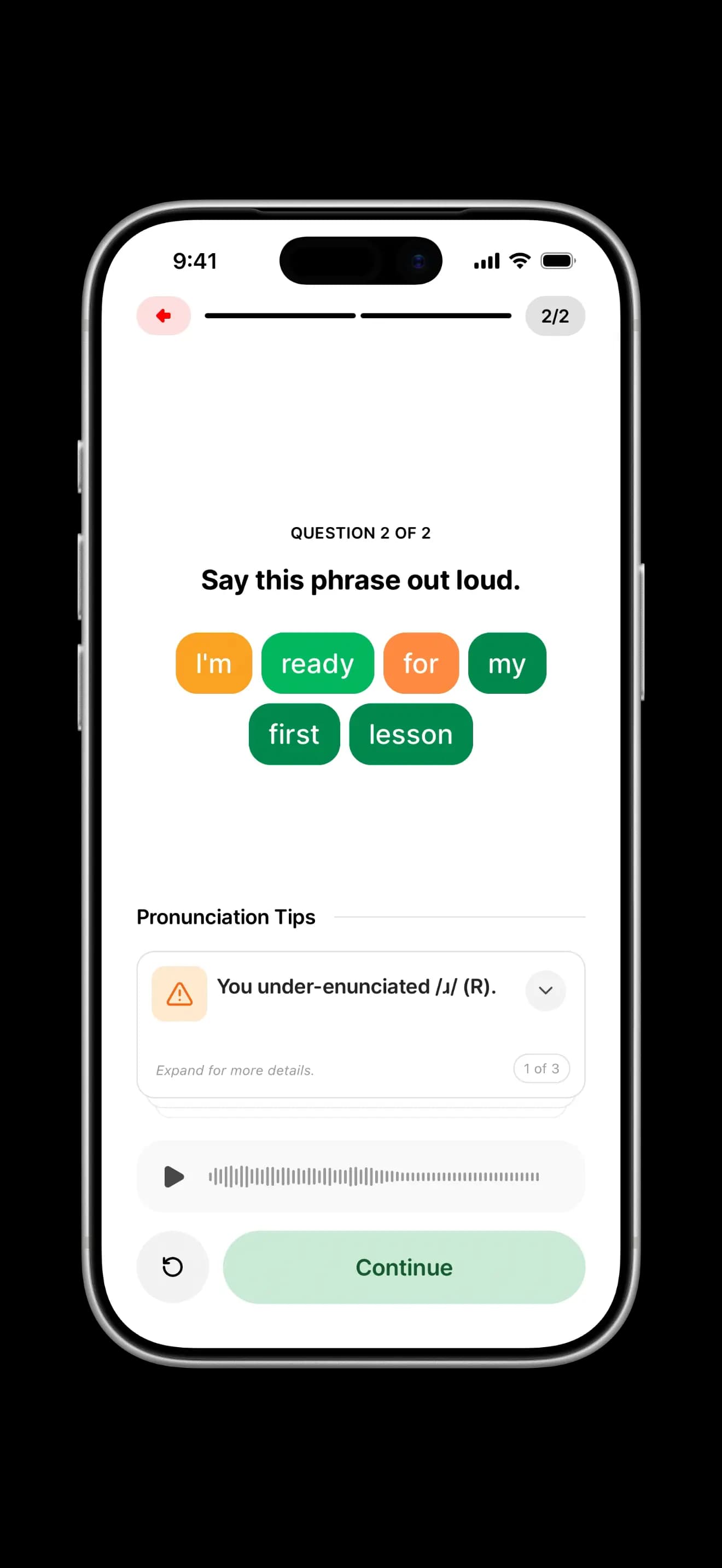
Say a sentence out loud and the words light up one by one, each with its own score. You can see exactly which word tripped you up.
Exactly where it went wrong
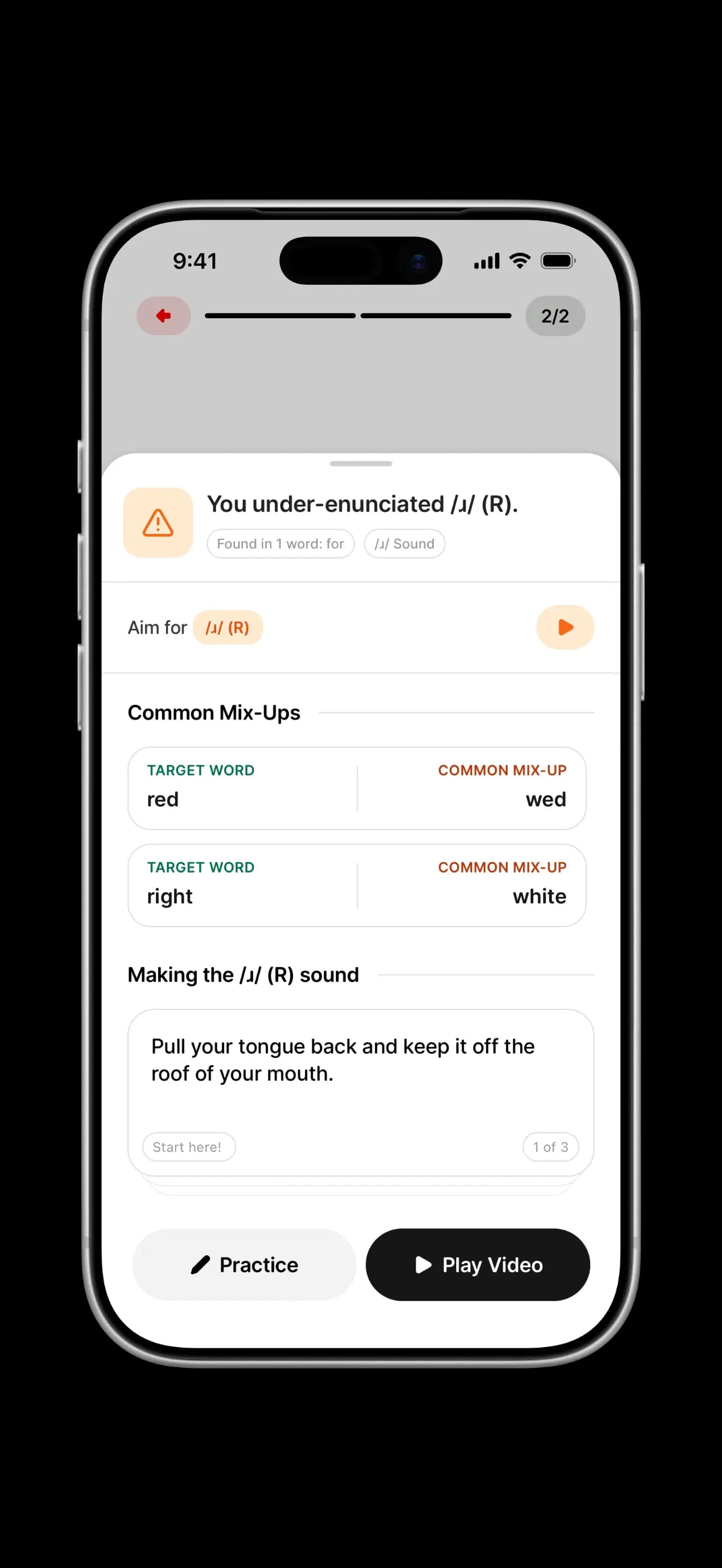
If see comes out as she, or very as berry, the app shows you that exact mix-up and which words it happened in, along with a video of the mouth and tongue position.
Reviews built around your weak sounds
The app keeps track of which sounds keep tripping you up across all your practice and builds your reviews around them.
Instructions in Bengali
You get instructions, captions, and feedback in Bengali, so it's always clear what you need to fix.
p, t, k: a puff of air at the start
Bengali spells English words with plain প (p), ট (ṭ), and ক (k), as in পেন (pen), টাইম (ṭāim), and ক্যাপ (kæp), and they're said that way too, with no extra air. But in English, p, t, and k at the start of a stressed syllable come with a puff of air. Without it, American ears often hear them as b, d, and g: pat can sound like bat, pen like Ben, time like dime, and cold like gold. Yet to you, it all feels perfectly fine while you're saying it.
The good news is that this puff already exists in Bengali: it's in ঠ (ṭh) and খ (kh). So for t and k at the start of a stressed syllable, you can begin practicing with ঠ and খ (time is close to ঠাইম, ṭhāim, and key is close to খি, khi). Just make sure the air is a small puff, not a strong burst. Don't use ফ (ph) for p, though, or pull can turn into full. Close both lips for প and let out a light puff as you open them. After s, there's no puff at all: in spin, stop, and sky, plain Bengali প, ট, and ক are just fine.
Where your tongue goes for t and d matters less. In English, the tip of your tongue touches the gum ridge just behind your upper teeth, which is quite close to Bengali ট (ṭ) and ড (ḍ). Just don't curl your tongue back, and don't touch your teeth the way you do for ত (t) and দ (d). Also, in American English, a t between two vowels, right after a stressed vowel, often turns into a very light tap: the tip of your tongue touches the ridge once and pulls away. In water, city, and better, that tap sounds a lot like a Bengali র (r) made with a single flick of the tongue (like the র in বারো, bāro, twelve, or পরে, pore, later), so there's no need for a strong t like ট (ṭ) or ঠ (ṭh) here.
Words to practice
- penNot Ben
- park
- timeNot dime
- tenNot den
- comeNot gum
- waterIn American English, the t here is a light tap
Tip: Hold a tissue or your palm in front of your mouth. When you say pen, time, and come, the tissue should move a little; with Ben, dime, and gum, it shouldn't. Then say spin: almost no air should come out.
If your pat sounds like bat, Slay Speech flags the mix-up in that exact word, something that's almost impossible to catch by ear on your own.
/ɜ˞/: there's no আ (ā) in bird, work, or first
Bengali spells these words with the vowel sign for আ (ā) followed by র (r): নার্স (nārs), শার্ট (shārṭ), ফার্স্ট (phārsṭ), ওয়ার্ক (wārk), বার্থডে (bārthḍe). Your mouth follows the spelling and says আ, so bird sounds like bard, heard like hard, and work drifts toward walk. And because নার্স feels so natural to say, the mistake doesn't even register.
In American English, there's nothing of আ in this vowel; the whole vowel is one long r. Keep your jaw only slightly open, pull your tongue back without letting the tip touch anything, round your lips slightly, and hold the vowel in that position: bird is b, then a long r, then d. The ending of teacher and doctor (-er, -or) is a lighter, shorter version of the same sound.
Words to practice
- birdNot bard
- workNot walk
- firstNo আ (ā) here, unlike Bengali ফার্স্ট
- heard
- girl
- nurseNot like Bengali নার্স (nārs)
Tip: In front of a mirror, say hard and heard back to back. On hard, your jaw drops; on heard, it barely opens, and only your tongue pulls back. If you see your jaw drop on heard, an আ has crept in.
If an আ slips into bird or work, it shows up in that word's score in Slay Speech, and you can watch a video of where your tongue and lips go.
/θ/: not থ (th), but air between your tongue and teeth
For Bengali থ (th), your tongue presses against your teeth and blocks the air completely, then lets it out in a burst. So three becomes থ্রি (thri) and think becomes থিংক (thingk). To English speakers this often sounds like t, so thin and tin can get mixed up.
/θ/ doesn't exist in Bengali, and with this sound the air never stops. The upside is that your tongue already touches your teeth when you say থ. The position is right; you just need to stop blocking the air. Rest the tip of your tongue lightly on the edge of your upper teeth or between your top and bottom teeth, without pressing, and keep air flowing through the gap. Your voice doesn't buzz.
Words to practice
- think
- three
- thank
- birthday
- math
- mouth
Tip: Put the tip of your tongue on your teeth as if you were saying থ, but lightly, without pressing. Now let the air out and hold the sound for two or three seconds. If you can hold it, that's /θ/: a থ or a t can never be held.
If the air gets blocked on th and thin sounds like tin, Slay Speech catches that word and shows you, and you can watch a video of where your tongue goes.
/ð/: the, this, and they don't start with দ (d)
This sound shows up in some of the most common words in English, like the, this, that, and they, so it comes up in almost every sentence. Bengali speakers usually say দ (d) instead, as in দ্য (do), দিস (dis), and দে (de), because দ is also made with the tongue against the teeth. But দ blocks the air, and /ð/ doesn't.
Your mouth is in the same position as for /θ/. The only difference is that this time your voice buzzes. Put your fingers on your throat and you'll feel the vibration.
Words to practice
- this
- that
- they
- motherSame sound in the middle of a word
- brother
- breatheEnds in /ð/; breath ends in /θ/
Tip: Touch the tip of your tongue lightly to your teeth and hum for a second before you say the, then add the vowel. Little by little, make the hum shorter.
If দ slips into the or they, Slay Speech shows exactly which words it happened in, and since these words turn up in almost every sentence, you get plenty of chances to practice.
/ʌ/: no long আ (ā) in cup, bus, or luck
Bengali spells these words with the vowel sign for আ (ā): কাপ (kāp), বাস (bās), লাঞ্চ (lānch), ক্লাব (klāb), মানি (māni). But in American English, the open, আ-like vowel is actually the one in hot, job, and stop. So if you say a full আ in cup, an American listener may hear cop. In the same way, cut can sound like cot, luck like lock, and bus like boss.
/ʌ/ doesn't exist in Bengali. It's shorter and more relaxed than আ: your jaw opens only halfway, your tongue rests in the middle of your mouth, your lips don't round, and the vowel stops short. Notice that it works the other way around in hot, job, and doctor: Americans use an open vowel very close to Bengali আ, while you'd probably say অ (o) there, as in হট (hoṭ) and ডক্টর (ḍokṭor). So drop your jaw for আ in hot, and use a short, relaxed /ʌ/ in cup.
Bengali gives you an easy starting point: অ. Say কম (kom, less), then say it again without rounding your lips at all, keeping them relaxed. The vowel that comes out sits between অ and আ, and it's very close to /ʌ/: English come sounds very much like that. Use this relaxed অ in cup, bus, luck, and money too, not আ.
Words to practice
- cupNot cop
- cutNot cot
- bus
- luckNot lock
- money
- but
Tip: Say cut and cot back to back. For cot, drop your jaw all the way and stretch the আ a little. For cut, open your jaw halfway and keep the vowel short and relaxed, like a quick অ with unrounded lips. Check in the mirror: if your lips round on cut, that's Bengali অ, and if your jaw drops all the way, that's আ.
If cup comes out sounding like cop, Slay Speech flags that word and shows which two vowels got mixed up, with a video of how far your jaw should open.
/z/: not জ (j), but a steady buzz
Bengali জ (j) is usually /dʒ/: your tongue blocks the air first, then lets it go. So zoo becomes জু (ju) and zero becomes জিরো (jiro), a habit that's very common in both Bangladesh and West Bengal. For many people from Sylhet, Chittagong, and nearby areas, spoken জ already sounds like /z/, so zoo comes easily. For them, the mistake runs the other way: job turns into something like zob, and just into zust.
For /z/, put your tongue exactly where it goes for /s/, but this time let your voice buzz. Your tongue doesn't block anything. The /dʒ/ in job and just works the other way around: your tongue presses against the gum ridge to stop the air first, then releases it. Spelling is a trap too, because /z/ is often written with an s: is, his, has, was, easy, music, and the plural -s in words like dogs and boys.
If you say words like নামাজ (nāmāz, prayer), রোজা (rozā, fasting), or আজান (āzān, call to prayer) with a z, you already have this sound. Just use that same sound in English zoo and zero.
Bengali also lacks a closely related sound: /ʒ/, as in television, usually, measure, and decision. Bengali spells these words with শ (sh), as in টেলিভিশন (ṭelibhishon) and ডিসিশন (ḍisishon), so a sh comes out, and some people say জ instead. /ʒ/ is simply a voiced sh: while you're saying shhhh, keep your tongue and lips still and let your voice buzz. Getting it wrong usually doesn't make you harder to understand, so it's fine to work on it once your z is solid.
Words to practice
- zero
- zoo
- easy
- music
- isSpelled with s, but the sound is /z/
- because
Tip: While you're saying sssss, keep your tongue still and let your voice buzz. The bee-like hum that comes out is /z/.
Whether জ slips into zoo or your job sounds like zob, Slay Speech shows you both what the mix-up is and which word it happened in.
/æ/: no আ (ā) in class or after
Bengali does have this sound: the vowel in ব্যাগ (bæg, bag) or এক (æk, one) is close to /æ/. The problem is that an আ has settled into many English words borrowed into Bengali: ক্লাস (klās), গ্লাস (glās), হাফ (hāph), লাস্ট (lāsṭ), আফটার (āphṭār), প্লাস্টিক (plāsṭik). When you speak English, your mouth says the Bengali version, even though American English uses /æ/ in every one of these words.
For /æ/, drop your jaw quite a bit, keep your tongue low and forward, and spread your lips slightly. Stretch the vowel a little in words like bad, man, and bag. Many people in Dhaka say the vowel in ব্যাগ a bit higher, almost toward এ (e). If that's you, drop your jaw a little more, or bad may sound like bed.
Words to practice
- classNot like Bengali ক্লাস (klās)
- after
- half
- last
- plastic
- man
Tip: Say ব্যাগ (bæg) in Bengali, then hold that mouth position and say class. If an আ creeps in, start over from ব্যাগ.
If a Bengali আ slips into class or after, it shows up in that word's score in Slay Speech, and you can watch a video of how far your jaw should drop.
/f/: air between your teeth and lip, not between both lips
Bengali ফ (ph) is traditionally an aspirated p (/pʰ/), but many people now say it like /f/, while others make it by bringing both lips close together and blowing. If your ফ already sounds like /f/, English f will be easy. The trouble is for everyone else, whose ফ doesn't involve the teeth at all.
There's also a mix-up in the other direction. In Sylheti and nearby spoken varieties, প (p) itself sounds like a soft, breathy ফ, so for many people from that area, pen sounds like fen and pull like full. For /f/, rest your upper teeth on your lower lip just as you do for /v/, but don't let your voice buzz; only air comes out. For p, close both lips fully, then open them.
Words to practice
- fine
- phoneph is /f/ too
- family
- coffee
- life
- laughThe gh here is pronounced /f/
Tip: Say full and pull back to back. For full, your teeth stay on your lip; for pull, both lips close and then open with a small puff of air.
If blowing through both lips makes your f and p blur together, Slay Speech shows which word went wrong and how, with a video of where your teeth and lips go.
/ʊ/: no long উ (u) in book, good, or pull
Just like ই and ঈ, Bengali উ and ঊ are pronounced the same. So pull and pool, or full and fool, sound nearly identical when Bengali speakers say them. And because you're used to writing and reading বুক (buk), গুড (guḍ), and পুট (puṭ), a full, tightly rounded উ slips into book, good, and put.
/ʊ/ doesn't exist in Bengali. It's a short, relaxed vowel that sounds roughly halfway between উ (u) and ও (o): your tongue sits a little lower than for উ, your lips are lightly rounded but not pushed forward, and your cheeks stay relaxed. /u/ (pool, food, school) is close to Bengali উ; just push your lips further forward and round them tightly. As with ship and sheep, the real difference is the shape of your mouth, not just the length of the vowel.
This vowel keeps coming up in some very common words: good, look, book, put, could, would, should. In could, would, and should, the l is written but not pronounced.
Words to practice
- book
- good
- pullNot pool
- fullNot fool
- look
- couldThe l is silent
Tip: First say pool: lips pushed forward and tightly rounded. Now relax your lips and cheeks, drop your jaw slightly, and say a short pull. If the vowel sounds halfway between উ and ও, you're on the right track.
If pull comes out sounding like pool, Slay Speech flags that word and shows which two vowels got mixed up, with a video of how round your lips should be.
Beyond individual sounds
Even when every sound is right, English spoken with a Bengali rhythm can sound unfamiliar to English-speaking ears. Pay special attention to these five things.
Stress isn't always on the first syllable
In Bengali, stress is light and usually falls near the start of a word. Out of habit, English words end up stressed on the first syllable too, but hotel, police, machine, begin, and about are stressed on the second. There's a subtler point as well: in Bengali, your pitch usually stays low on the stressed syllable and rises after it. In English, the pitch rises on the stressed syllable itself. If you speak with Bengali habits, an American listener may miss the stress even when you've picked the right syllable, or hear it on the next one.
In English, where the stress falls is part of the word, and it can even change the meaning: REcord (a record or document) vs. reCORD (to record), PREsent (a gift) vs. preSENT (to show or hand over). Words ending in -tion, -sion, and -ic usually stress the syllable right before the ending: eduCAtion, inforMAtion, draMAtic. Make the stressed syllable a little longer, a little louder, and a little higher in pitch, and keep the syllables around it short.
Not every vowel is equal: the light /ə/
In Bengali, almost every vowel gets its full value. In English, the vowel in an unstressed syllable usually weakens to /ə/: the a in about, the first and last a in banana. The ending of teacher is just as weak in American English, only with an r blended in.
The same rule applies to whole sentences. Short words like to, of, and, for, and can usually go light: in I want to go, the vowel in to is a tiny /ə/. If you say every word separately and with the same force, the meaning still comes through, but it sounds robotic.
Pronunciations written in Bengali script lock this mistake in even more. In Bengali letters, about becomes অ্যাবাউট (æbāuṭ), important becomes ইমপোর্ট্যান্ট (imporṭænṭ), and assistant becomes অ্যাসিস্ট্যান্ট (æsisṭænṭ), and as you read them, your mouth says a full অ্যা (æ). The vowel in -ant and -ent isn't অ্যা; it's a tiny /ə/. In some words, an unstressed syllable nearly disappears, so don't read out every vowel in the spelling: chocolate has two syllables (choc·late), vegetable and comfortable have three (veg·ta·ble, comf·ter·ble), and all three are stressed on the first syllable.
Yes/no questions rise at the end
Say তুমি কাল আসবে? (tumi kāl āsbe, Will you come tomorrow?) out loud: on the last word, your pitch rises once and then falls again. That's the normal tune for a yes/no question in Bengali. Put that tune on an English question, and Are you coming? can sound like a statement instead, or even a slightly blunt command.
In American English, the pitch at the end of a yes/no question usually rises and stays up: Are you coming↗, Is this your bag↗. Questions that start with what, where, why, or how, on the other hand, fall at the end, just as they do in Bengali: Where do you live↘. That rising finish is especially important when you're asking for something politely (Could you help me↗).
Consonant clusters: from ইস্কুল (iskul) to school
Spoken Bengali tends to break up s-clusters at the start of a word by putting an ই (i) in front; ইস্কুল (iskul) and ইস্টিশন (isṭishon) come from that habit. In English, there's no vowel before school, station, speak, or street: start straight from the s. A related habit is slipping an extra vowel between two consonants, as in গেলাস (gelās, glass) and ফিলিম (philim, film). In glass, please, and from, the first two consonants sit right next to each other, and at the end of film, there's no vowel between the l and the m either.
Clusters at the end of a word are a trap too: the final sounds in asked, texts, months, and world often get dropped. And -ed isn't always “ed.” After a voiceless sound (one where your voice doesn't buzz), as in worked and stopped, it ends in /t/. After a vowel or a voiced sound, as in played and called, it's /d/. Only after t or d does -ed become a separate syllable (wanted, needed).
The trap of Bengali-script pronunciations
Many dictionaries and spoken English books give pronunciations in Bengali script. That helps at first, but /v/, /z/, /θ/, and /ð/ simply can't be written in Bengali letters. And there are two more places where these spellings lead you astray.
The vowel in say, day, and name becomes এ (e) in Bengali, as in ডে (ḍe) and নেম (nem), and the vowel in go, home, and note becomes ও (o), as in গো (go) and হোম (hom). In English, these are diphthongs, like ঐ (oi) and ঔ (ou): /eɪ/ glides a little toward ই at the end, and /oʊ/ glides a little toward উ. Bengali already has familiar examples: the vowel in সেই (sei, that) is very close to the vowel in day, and the vowel in বউ (bou, wife) is close to the one in go. In the same way, boy is close to বই (boi), my to মাই (māi), and now to নাউ (nāu); here, the Bengali spelling points you in the right direction.
Bengali র (r) isn't the same as English r either. In West Bengal, র is a tap of the tongue; for many people in Bangladesh, the tongue barely touches anything on র, which is a good head start for the American r. For American /ɹ/, the tip of your tongue doesn't touch anything, your tongue pulls back, and your lips round slightly. The r at the end of car, more, and teacher is clearly heard in American English too. So whatever you pick up from Bengali-script pronunciations, it isn't enough once you actually start speaking.
15 minutes a day in Slay Speech
Every day, your home screen gives you the phrase of the day and one part of your learning path, made up of three steps in a row. It takes about 15 minutes in all, and you say everything out loud.
Phrase of the day (1 minute)
Say today's phrase out loud. Every word gets a score, and the card shows what the phrase means and when you'd actually use it.
Story video (about 6 minutes)
Today's part starts with a story split into short clips. After each clip, answer a question, then say a sentence out loud. Stories don't save partway through, so finish in one sitting.
Topic phrases (3 minutes)
Say three phrases from the part's topic, such as ordering food or checking in at a hotel, and see which words need more practice.
Conversation or sound review (3–5 minutes)
Depending on the part, you'll either practice a real-life situation (choosing a reply and saying it, typing, or talking on a live voice call) or review your weakest sound, such as v, th, or s-sh, across a few words.
The word you missed (1 minute)
Tap a low-scoring word to practice it on its own: listen, see its meaning in Bengali and how it splits into syllables, then record it again.