Common English pronunciation mistakes for Chinese speakers, and how to fix them
From th, v and final consonants to stress and intonation, this guide focuses on the spots where Chinese speakers trip up most. For each sound, you'll see what usually goes wrong and exactly where your lips and tongue should go.


Where the trouble really is
When Chinese speakers learn English pronunciation, the problems fall into three groups. First, sounds Mandarin doesn't have, like /v/, /θ/, /ð/, /æ/, /ʌ/, /ɪ/ and /ʊ/. Second, final consonants, because a Mandarin syllable can only end in a vowel, n or ng. Third, rhythm: most Chinese syllables carry a tone and get roughly equal weight, while English builds its sentences on stress and weak forms.
You don't have to fix everything at once. Start with what makes you hardest to understand: final consonants (especially the voiced vs. voiceless difference in bag and back), word stress, v and w, and a few vowel pairs that are easy to mix up. If your dialect doesn't separate n and l, move that up the list too. Th is the most noticeable, but it matters less for being understood than you might think. This guide uses General American as its model. Dialects vary a lot across China, so problems that are common only in some regions are called out separately.
Knowing the rules and hearing your own mistakes are two different things, though. Your ear often can't tell apart sounds that Chinese doesn't have. And the Chinese classmates and teachers around you are so used to a Chinese accent that they understand you fine even when you drop a final consonant, so nobody ever points it out. That's where Slay Speech comes in: you speak, and it tells you which word went wrong.
The 12 sounds that need the most practice
They're listed in order of how much they affect whether people understand you, starting with the biggest. Th is the easiest part of an accent to notice, but on its own it rarely causes real misunderstandings, so it isn't at the top. Each item covers what Chinese is missing, what the sound usually turns into, and exactly how to make it. Whenever the guide compares an English sound to a Chinese character or to pinyin, treat it as a rough match, not the same sound.
Voiced final consonants: bag, not back
Mandarin syllables never end in consonants like b, d or g, so voiced consonants at the end of English words cause the most trouble: bag comes out as back, bed as bet, eyes as ice. When native speakers mishear a final consonant in Chinese-accented English, it's usually a voicing mistake. The difference isn't only in your vocal cords, though. It's mostly in the vowel before it: before a voiced ending, the vowel is clearly longer, and that length is what native ears listen for. /z/ works the same way: is, was and bags all end in /z/. Pinyin z is really [ts], so zoo shouldn't sound like 组 (zǔ, "group").
The start of a word is less of a problem. Pinyin b, d and g are actually voiceless and unaspirated; Chinese tells these consonants apart only by aspiration (the puff of air). Luckily, American /b/, /d/ and /ɡ/ at the start of a word have weak voicing anyway, and /p/, /t/ and /k/ are aspirated, so your pinyin habits mostly work here. One more thing: p, t and k after s have no puff of air, so the p in speak is closer to pinyin b.
Words to practice
- bagCut the vowel short and it turns into back
- bedDon't let it turn into bet
- dog
- eyesStretch the vowel and voice the ending, or it sounds like ice
- zoo
- cabStretch the vowel and voice the ending, or it sounds like cap
Tip: Stretch out the vowel in bag and press your fingers to your throat: you should still feel a buzz while the back of your tongue presses against your soft palate. Don't tack an extra syllable like 格 (gé) onto the g to make it louder. Practice phrases like bag of and good idea first, so the final consonant runs straight into the next vowel.
Voicing mistakes at the ends of words keep coming back, so Slay Speech tracks the sounds you miss across all your practice and builds your review around them.
/v/ and /w/: very, not wery
Mandarin doesn't treat these as separate sounds. In words like 万 (wàn, "ten thousand") and 微 (wēi, "tiny"), plenty of speakers, especially in the north, actually let their lower lip touch their teeth a little, but it never changes the meaning, so your ear doesn't hear two different sounds. The most common mistakes are very coming out as wery and vine as wine, though some people go the other way and turn west into vest. Of the friction sounds f, v and th, /v/ is the one native speakers most often mishear in Chinese-accented English.
/v/: rest your top teeth lightly on your lower lip and turn on your voice. You can hold it as long as you like. The key is the friction. Even when your lip and teeth touch at the start of 万 or 微, it's only a light brush, with no audible hiss of air. For /v/, push the air out between your lip and teeth to make a steady buzz. /w/: round your lips and push them forward, keep your teeth completely off your lips, then glide quickly into the next vowel. A final /v/ (five, love, have) needs voicing too. Don't turn it into f or drop it.
Words to practice
- very
- voice
- vest
- westRound your lips and keep your teeth off them
- wine
- over
- fiveVoice the /v/ at the end
Tip: Watch the first move in a mirror: for vine, your top teeth press on your lower lip; for wine, your lips round and you can't see your teeth.
When you slip both ways, as with very and west, Slay Speech shows which sound you swapped for which, and in which words.
/l/: finish the l in feel, and say light, not night
Mandarin l only appears at the start of a syllable, so the trouble comes at the end of a word and before another consonant. If your tongue never lifts, feel becomes "fee-oh" and school becomes something like 斯酷 (sī kù, "skoo"). Others finish with a curled-tongue 儿 (ér), so school and cool sound like they end in r. Drop the /l/ and people can hear the wrong word: fee and feel, I and I'll start to sound the same. For a final /l/, press the tip of your tongue to the ridge behind your top teeth and hold it there while the back of your tongue lifts. Only then is the word finished. Start with phrases where a vowel follows, like feel it and call us, so the next vowel carries your tongue up naturally.
Some dialects in southwest China, the middle and lower Yangtze region, Fujian, Guangdong and Guangxi don't distinguish n from l, so night and light or no and low get mixed up. This is one of the mistakes most likely to cause real misunderstandings. Some people use only n, others only l, but in English it's usually /l/ that goes wrong. Words where n and l sit side by side, like only and online, are the hardest, and often only one of the two survives. For both sounds, the tip of your tongue touches the ridge behind your top teeth. The difference is the airflow: /n/ goes out through your nose, while /l/ flows around the sides of your tongue.
Words to practice
- feel
- school
- people
- milk
- well
- light
- onlySay both the n and the l
Tip: Pinch your nose and say no and low: /n/ gets blocked, but /l/ doesn't change.
A dropped final /l/ is hard to notice in your own speech. Slay Speech scores every word on its own, and you can tap feel or school to see the syllables and hear the model pronunciation.

Why practice in Slay Speech
Understanding the rules is only the first step. The hard part is knowing whether you actually got it right when you speak. That's the gap Slay Speech fills.
Feedback on every word
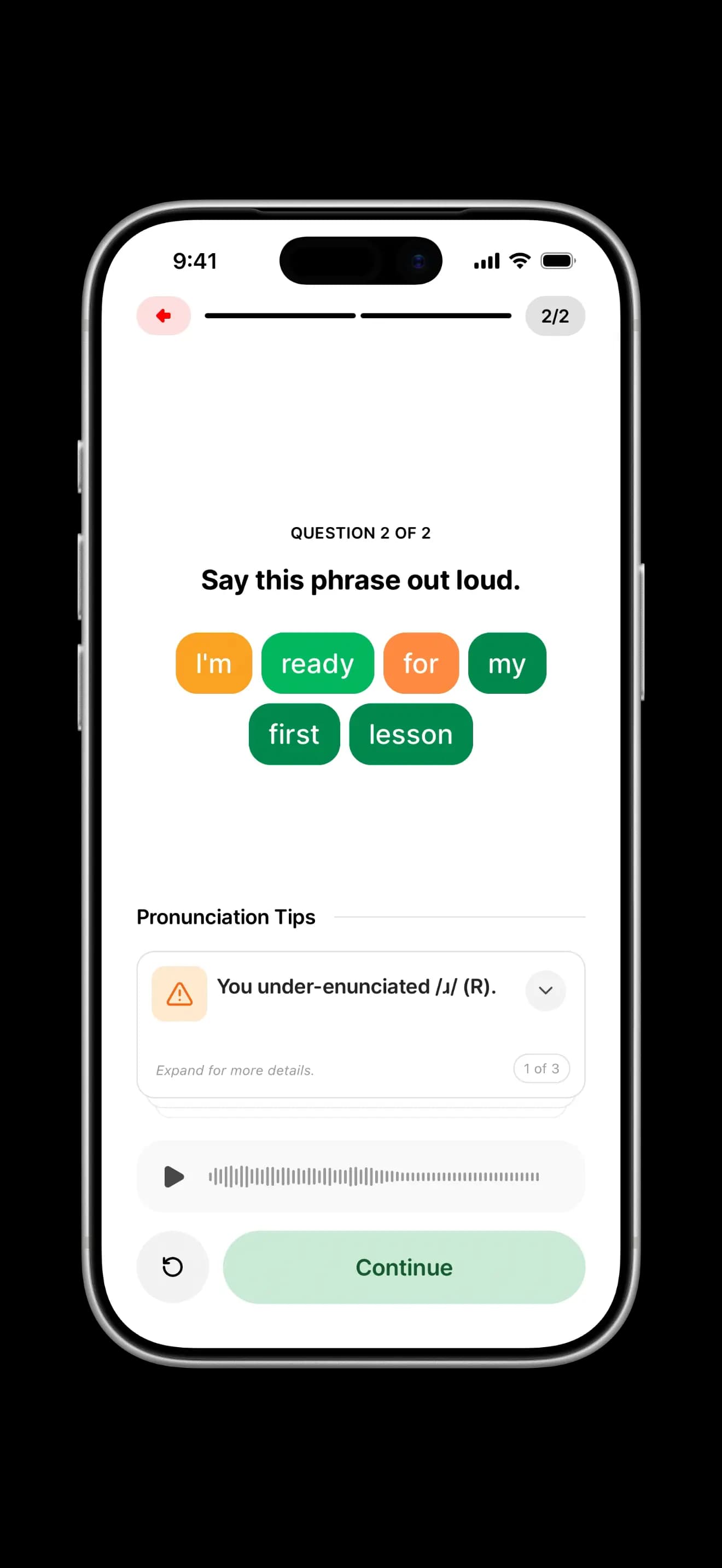
Say a sentence out loud and the words light up as you speak. Every word gets a score, so you can see at a glance which one went wrong.
It names the exact mix-up
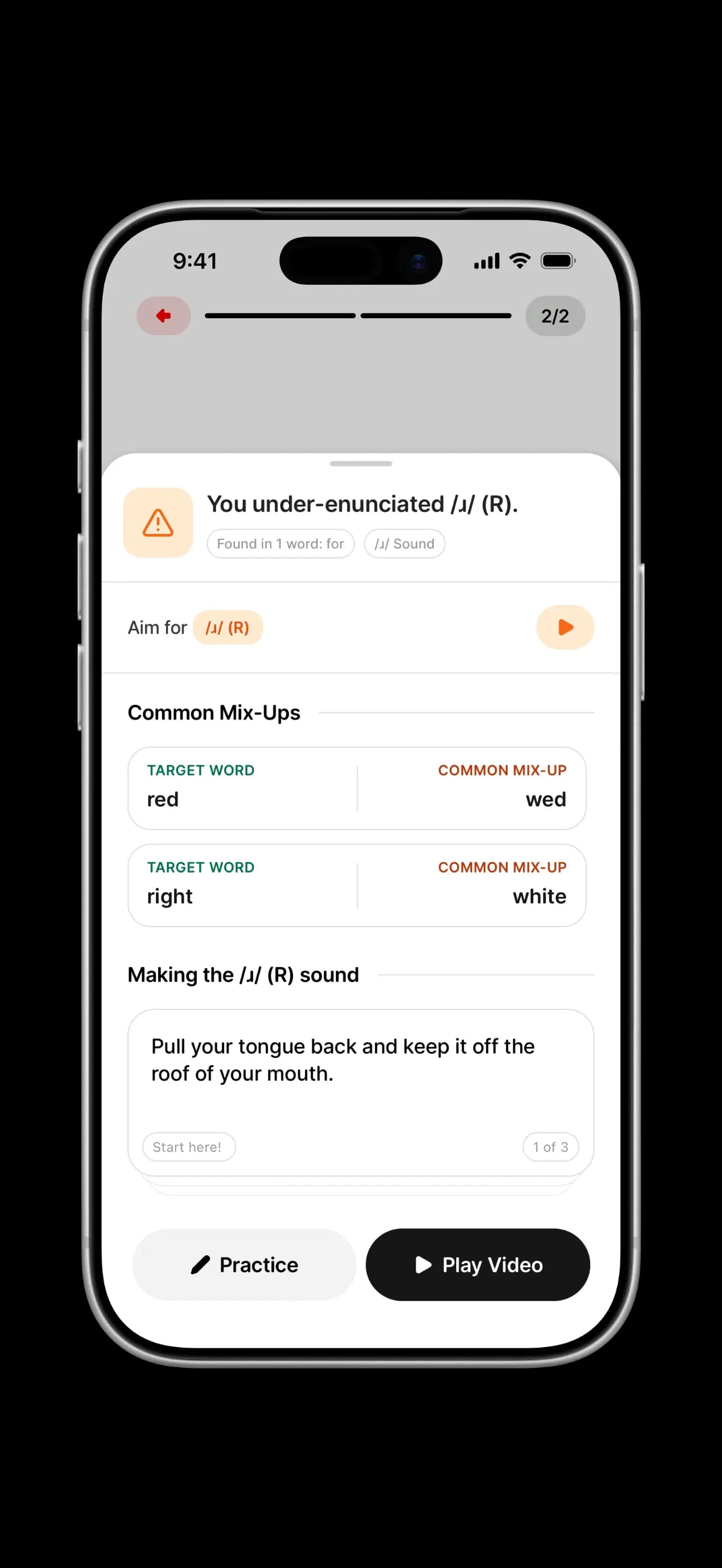
Think and sink, she and see: it catches mix-ups between similar sounds, tells you which two sounds you confused and in which words, and shows the mouth and tongue movement in a video.
Review built around your own trouble spots
Dialects differ from north to south, and everyone struggles with different sounds. The app tracks the sounds you miss across all your practice and builds your review around them.
Real situations, with explanations in Chinese
Watch video stories, practice situations like ordering food, phone calls and job interviews, or talk it through on a live voice call. Explanations, subtitles and feedback are all available in Chinese.
/ɪ/ and /i/: ship, not sheep
Mandarin 衣 (yī, "clothing") is fairly close to English /i/, but Chinese has no /ɪ/. Many people learned these as a "long" and a "short" sound (the /iː/ and /ɪ/ symbols in many textbooks reinforce that idea), so they say ship as a shorter sheep. In fact, the main difference is the shape of your mouth. Length comes second.
/i/: the front of your tongue lifts high, the corners of your mouth pull slightly outward, and your muscles are tense. /ɪ/: your tongue sits a little lower and further back, your mouth is relaxed, and it sounds roughly halfway between 衣 (yī) and 诶 (ê, like "eh"). Watch out going the other way, too: give the vowel in beach and sheet its full value, or they can turn into rude words.
Words to practice
- ship
- sheep
- sit
- seat
- liveAs a verb (to live somewhere), it's /lɪv/
- leave
Tip: Alternate sheep and ship: pull the corners of your mouth tight for sheep, then relax the corners of your mouth and your tongue for ship. Deliberately make the two words exactly the same length, so only the mouth shape tells them apart.
Chinese has no contrast like this, so it's hard to hear on your own. When ship comes out as sheep, Slay Speech flags the word and shows the exact mix-up.
/æ/: bad, not bed
Mandarin has no /æ/. The usual substitute is a vowel like 诶 (ê), so bad and bed, man and men sound the same. Others use 啊 (a, like "ah"). The a in pinyin ian (as in 天 tiān, "sky") actually sounds closer to /ɛ/, so it's no help as a reference for /æ/.
/æ/: drop your jaw noticeably, keep your tongue low, flat and toward the front of your mouth, and spread the corners of your mouth a little. Try starting with the vowel in bed, then keep your tongue where it is and just keep lowering your jaw.
Words to practice
- bad
- bagDon't let it turn into beg
- manThe plural, men, has a different vowel
- apple
- black
Tip: Put a finger under your chin and alternate bed and bad. Your jaw should be clearly lower for bad.
When bad sounds like bed, Slay Speech points out the mix-up and shows you in a video where your mouth and tongue should go.
/ʌ/: cup, not cop
Mandarin has no /ʌ/. Many people just use 啊 (a), so cup sounds like cop, luck like lock, hut like hot. Others say it too far forward and too open, and cup turns into cap. For Chinese speakers, this is one of the hardest groups of English vowels to tell apart, and it's tough to hear in your own speech.
/ʌ/ is short, central and relaxed: your jaw is half open, your lips are neither rounded nor spread, and your tongue rests flat in the middle of your mouth, like a stressed /ə/. It's the /ɑ/ in American hot and father that comes close to 啊 (a): your jaw drops lower and your tongue sits further back. Also, many textbooks teach hot the British way, with rounded lips. In American English, the vowel in hot isn't rounded.
Words to practice
- cup
- copThe vowel here is /ɑ/
- luckDon't let it turn into lock
- money
- come
- but
Tip: Alternate cot and cut: for cot, open wide as if saying "ah" for the doctor; for cut, open your jaw only halfway and relax your whole mouth.
When cup comes out as cop, Slay Speech flags the word, names the two sounds you mixed up, and shows in a video how your mouth and jaw should move.
/θ/: think, not sink
Mandarin has no /θ/. The most common substitute is s, though some people use f or t: think sounds like sink, three like free, thin like tin, mouth like mouse.
Rest the tip of your tongue lightly between your top and bottom teeth, or just against the edge of your top teeth, and push a steady stream of air through the narrow gap with no voice. Your tongue only touches lightly. Don't bite it. You can hold this sound as long as you like, which is what makes it different from t. If you usually say s instead, bring your tongue forward and flatten it, without the groove down the middle you make for s. Many people get it right in single words and slip back to s in sentences, so once the words feel solid, practice them in sentences too.
Words to practice
- think
- threeDon't let it turn into free or tree
- mouthDon't let it turn into mouse
- math
- birthday
Tip: Say think into a mirror. You should see a little of your tongue tip; for sink, you shouldn't.
If your think comes out as sink, Slay Speech flags the word, names the two sounds you mixed up, and shows in a video where your tongue should go.
/r/: lose the buzz of 日 (rì), and keep it apart from /l/
For Mandarin r (as in 日 rì, "sun," and 人 rén, "person"), the tip of your tongue comes close to the hard palate, which often adds a buzzy friction. Carry that straight into English and red and right start with an extra layer of hiss. Most Mandarin speakers can tell l and r apart, but people from Cantonese-speaking areas and parts of the south often turn r into l or w, so right sounds like light or white, and grass and glass blur together. That can cause real misunderstandings.
/r/: the tip of your tongue touches nothing, the body of your tongue pulls back and bunches up, and your lips round slightly. There's no friction. /l/ is the opposite: the tip of your tongue has to touch the ridge behind your top teeth. Mandarin 儿 (ér) is fairly close to the sound at the end of American teacher, so you can use it as a starting point, though it's only a rough match. That's why words with r after a vowel, like car and teacher, usually come more easily. Get those right first, then move on to words that start with r, like red and right.
Words to practice
- right
- red
- grass
- glassThis one has /l/
- carIn American English, say the final r
- teacher
Tip: Hold 儿 (ér), then slide into the vowel: say er-ed faster and faster and it gets close to red. Keep the tip of your tongue off the roof of your mouth the whole time.
Whether grass comes out as glass or right as light, Slay Speech points out the mix-up and tells you where to put your tongue.
/ʊ/ and /u/: full, not fool
This is the same kind of problem as ship and sheep. Mandarin 乌 (wū, "crow") is very close to English /u/ (food, pool), but Chinese has no /ʊ/, so full and fool, pull and pool, look and Luke all sound the same. Everyday words like good, book, would and should all use /ʊ/, and without targeted practice it's hard to fix on your own.
/u/: round your lips and push them forward, lift the back of your tongue high, and keep your muscles tense. /ʊ/: round your lips only loosely, without pushing them forward, keep your tongue a bit lower and more central than for 乌 (wū), relax your mouth, and keep it shorter. You can think of it as the back-of-the-tongue version of the /ɪ/ in ship.
Words to practice
- full
- foolThe vowel here is /u/
- pull
- pool
- look
- good
Tip: Alternate pool and pull: for pool, push your lips forward; for pull, relax your lips so they're only slightly rounded, and let your tongue drop a little.
When full comes out as fool, Slay Speech flags the word, shows the exact mix-up, and uses a video to show how round your lips should be.
/ð/: they, not day
/ð/ uses the same tongue position as /θ/, but with your voice on. Mandarin doesn't have this sound either. The usual substitutes are d and z, so they sounds like day and then like zen. Some northern speakers use a lip-and-teeth sound close to the start of 微 (wēi), so there sounds like where. Others get the tongue position right but forget to voice it, and it comes out as /θ/.
The, this, that and they show up in almost every sentence, and they go by so fast that your tongue often doesn't get there in time. Put the tip of your tongue between your teeth, make a buzz in your throat, then pull your tongue back into the vowel. At speed, a quick touch of your tongue tip on the edge of your top teeth is enough. The good news is that getting these little words slightly off rarely changes what people hear, so work on the earlier items first and polish this one later.
Words to practice
- they
- this
- mother
- weather
- breatheThe verb ends in /ð/; the noun, breath, ends in /θ/
Tip: Press your fingers to your throat and stretch out the first sound of think, then of they. You should feel a buzz only on the second.
Little words like the and they easily turn into d at speed. Slay Speech scores word by word, so even the words you rush past in a sentence get their own score.
/n/ and /ŋ/: thin, not thing
Mandarin already separates front and back nasals (-n and -ng), and the /ŋ/ at the end of sing and long is almost the same as the ending of 京 (jīng, as in 北京 Běijīng) or 昂 (áng, "to raise"). That gives you a head start. The trouble comes in two places. First, if you don't separate -n and -ng (common in many parts of the south), thin and thing, sin and sing, win and wing can sound the same. Second, Mandarin -n often just makes the vowel before it nasal, without the tip of your tongue ever touching the ridge behind your top teeth. Carry that into English and a final /n/ becomes hard to hear.
/n/: press the tip of your tongue against the ridge behind your top teeth, let the sound come out through your nose, and keep your tongue there when you finish. /ŋ/: drop the tip of your tongue and lift the back of it against your soft palate, just like the ending of 京 (jīng). Don't add a g or k after -ing: sing shouldn't end with an extra 个 (gè). You'll use -ing words like going and thinking every day, so they're worth practicing on their own.
Words to practice
- thin
- thing
- win
- wing
- sunAt the end, the tip of your tongue touches the ridge behind your top teeth
- song
Tip: After you say thin and thing, hold still for a moment and notice where the tip of your tongue is. At the end of thin, it's pressed against the ridge behind your top teeth. At the end of thing, it's resting behind your bottom teeth, and the back of your tongue is doing the work.
When thin comes out as thing or win as wing, Slay Speech flags the word and names the two sounds you mixed up.
/ʃ/: she isn't 西 (xī), and it isn't see
Mandarin has both sh and x, but English /ʃ/ is neither one. Some people use 西 (xī, "west") for she, then switch to the curled-tongue pinyin sh for shop. That sounds accented, but it usually doesn't get in the way. The real problem shows up in regions that don't separate flat-tongue and curled-tongue sounds (pinyin s vs. sh), where /ʃ/ easily slides into /s/, so she sounds like see and shoe like sue.
/ʃ/: the tip of your tongue comes close to the roof of your mouth, just past the ridge behind your top teeth, without touching it. The body of your tongue lifts, and your lips push slightly forward and round a little. The sound is lower and fuller than s. It's voiceless, so there's no buzz in your throat. Some people voice it without noticing, and she starts to sound like the middle of measure. /tʃ/ (cheese) and /dʒ/ (job) use the same mouth shape, so if you swap in 七 (qī, "seven") and 机 (jī, "machine") for them, change that habit at the same time.
Words to practice
- she
- shop
- fish
- sure
- cheeseDon't say it as 七斯 (qī sī)
- shoeDon't let it turn into sue
Tip: Start with 西 (xī), then push your lips forward and round them slightly, lift your tongue tip a little, and lower the middle of your tongue. When the sound turns deeper, you're close to /ʃ/.
When she turns into see, Slay Speech shows the mix-up and the words it happens in, then shows in a video how your lips and tongue should move.
What matters more than single sounds
Sometimes every sound is right and listeners still have to work to follow you. The reason is usually one of these.
Final consonants and consonant clusters
A Mandarin syllable can only end in a vowel, n or ng, so when an English word ends in a consonant, you either add a vowel or swallow the consonant. In general, short one-syllable words tend to get an extra vowel, so bike becomes something like 拜克 (bài kè). Longer words, and endings with three or four consonants in a row like asked and texts, are more likely to get swallowed. Swallowing does more damage than adding a vowel: drop the k from bike and you get buy, and once the -ed and -s in asked and books disappear, so do the past tense and the plural.
Clusters at the start of a word work the same way: street turns into something like 斯特瑞特 (sī tè ruì tè), and play grows an extra vowel in the middle. A broken-up or shortened cluster at the start of a word is more likely to be misheard than one at the end, so practice until the consonants come out in one go. You're more likely to add vowels when you read off the spelling, so listen first and then repeat. It makes a big difference.
In American English, a final p, t or k is often just the mouth shape, with no burst of air, and no vowel should follow it. A final -n also needs a real stop, with the tip of your tongue pressed against the ridge behind your top teeth, not just a nasal vowel. (For -n vs. -ng, see the /n/ and /ŋ/ section above.)
Word stress is not tone
Chinese syllables all carry about the same weight. Bring that into English and every word comes out one syllable at a time, and some people even say the stressed syllable on a high, flat first tone. In English, a stressed syllable is longer and louder and stands out in pitch, while the others get shorter. Chinese speakers often raise their pitch enough already. What needs more practice is stretching the stressed syllable and squeezing the rest.
Stress in the wrong place can make you harder to understand than one wrong sound, especially when the stress moves but the vowels don't change with it. When you learn a new word, learn its stress too: hotel is stressed at the end, develop on the second syllable, photograph at the start but photographer on the second syllable. As a noun, record is stressed on the first syllable; as a verb, on the second.
Weak forms and /ə/
Most unstressed vowels in English shrink to a short, vague /ə/, like the first syllable of about and today. Words like to, of, and, for and can usually take their weak forms in a sentence, too. Saying every word clearly and fully actually sounds less like English. Many Chinese learners even say these little words louder and higher than the content words, which makes the main point harder to catch.
The Mandarin neutral tone (the 子 zi in 桌子 zhuōzi, "table") can help you find the feel, though it's only a rough match, and how much people use the neutral tone varies a lot by region. Also note that can in I can go is /kən/, while can't in I can't go has /æ/. That difference is how listeners tell whether you can or can't.
Linking and sentence intonation
Chinese keeps clear breaks between syllables, but English links the consonant at the end of one word to the vowel at the start of the next: pick it up sounds like pi-ki-tup (and in American English, that t between two vowels often becomes a quick, light d), and an apple sounds like a-napple.
Chinese can mark a question with a particle like 吗 (ma) or 呢 (ne). English relies more on pitch: yes-no questions often rise at the end, and the most important word in a sentence gets the most noticeable pitch, peaking on its stressed syllable, while the words after it drop and flatten out. Tone habits can make your pitch jump up and down word by word, so try to say the whole sentence as one smooth line.
15 minutes a day in Slay Speech
Every day, the home screen gives you the phrase of the day and one mini-lesson on your learning path: three activities that build on each other. The whole thing takes about 15 minutes, and you're speaking the entire time.
Phrase of the day (1 minute)
Say today's phrase out loud and every word gets a score. The card also explains what it means and how people really use it.
Story video (about 6 minutes)
Today's mini-lesson starts with a story split into short clips. After each clip, answer a question, then say a sentence out loud. You can't save your progress partway through a story, so it's best to watch it in one sitting.
Topic phrases (3 minutes)
Say three phrases tied to the lesson's topic, like ordering food or checking in at a hotel, and see which words still need work.
Conversation or sound review (3 to 5 minutes)
Depending on the lesson, you'll either practice a real-life situation (pick a reply and say it, type it, or use a live voice call) or review your weakest sound, like th or v, with a few words.
The word you missed (1 minute)
Tap a low-scoring word to practice it on its own: listen to it, see its meaning in Chinese and how it splits into syllables, then record it again.