English pronunciation for Portuguese speakers
The English sounds Brazilian Portuguese speakers struggle with most, the Portuguese habits behind them, and what to do with your mouth and tongue to fix each one.


The essentials
If Brazilian Portuguese is your first language, good English pronunciation comes down to three things. First, the sounds Portuguese doesn’t have, like TH and the vowel in “cat.” Second, the sounds that seem the same but work differently, like the R in “rato” (rat), which English speakers hear as an H, and the L at the end of a word, which turns into a “u.” Third, the “i” Brazilians add after consonants, as in “Feicibúqui” for Facebook.
Your ear files each new sound under the closest Portuguese one, and spelling reinforces the habit, because English isn’t pronounced the way it’s spelled. That’s why listening more isn’t enough: you need to know what your tongue, lips, and jaw should be doing.
This guide follows standard American English and starts with what matters most for being understood. When something depends on which part of Brazil you’re from, it says so. But knowing the rule isn’t the same as hearing your own mistake, and that’s what Slay Speech is for.
The sounds that trip up Brazilians most
For each one, you’ll see what usually happens in a Portuguese speaker’s mouth and how to make the English sound instead. The ones at the top are the most likely to get you misunderstood.
The English R /ɹ/: “rat” is not “hat”
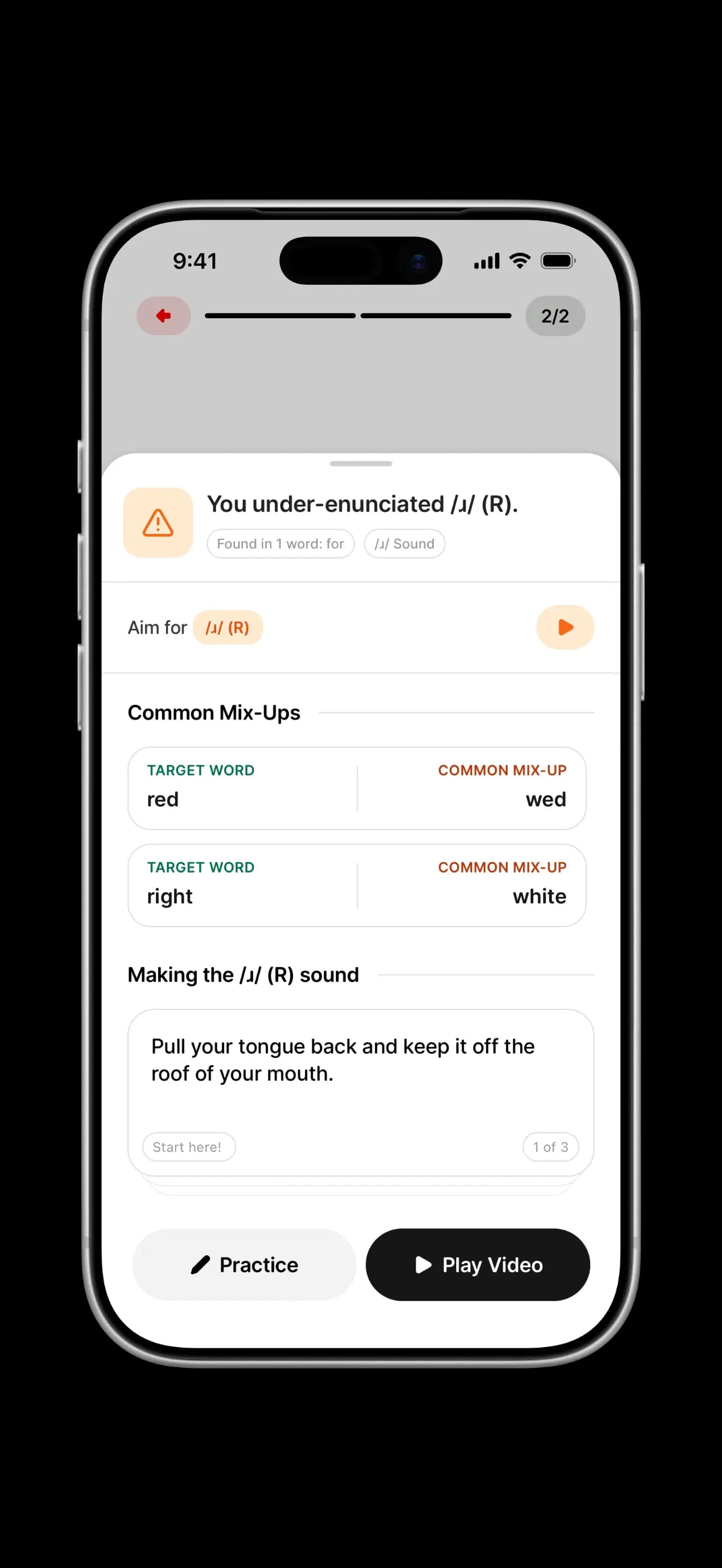
In most Brazilian accents, the R in “rato” (rat) and “carro” (car) is a breathy sound, very close to the English H. Use that R at the start of an English word and Americans hear an H: “rat” becomes “hat,” “red” becomes “head,” “right” becomes “height.” And you rarely notice, because to a Brazilian ear, that sound is an R.
After a vowel, it depends on where you’re from. In Rio, Belo Horizonte, the North, and the Northeast, the R in “porta” (door) also comes from the throat, so “car,” “hard,” and “work” pick up a scraping sound English doesn’t have. In the city of São Paulo and much of the South, it’s usually the quick tap of the R in “caro” (expensive). That tap is also the Brazilian R between vowels and after consonants (“very,” “America,” “tree,” “green”), and Americans hear it almost as the T in “water”: the word usually gets through, but it sounds foreign. Some speakers also drop a final R, as in “falá” for “falar” (to speak), so “more” turns into “mó.” The “caipira” (countryside) R in “porta,” common in inland São Paulo state, Paraná, and parts of Minas Gerais and the Center-West, is very close to the American one. If that’s your R, you can use it at the start of words too.
For the American R, your tongue doesn’t touch anything. Pull it back, raise the body of the tongue, let the tip float, and round your lips slightly. Your voice is on from the very start, because an R without voice turns into an H. After a consonant, as in “tree” and “green,” go straight into this position, without the tap of the R in “caro.” In “work,” “bird,” and “first,” there’s no Portuguese vowel before the R: your tongue is already pulled back, and the whole vowel takes on the color of the R. And don’t go by the spelling: the rr in “sorry,” “carry,” and “mirror” is the same American R, never the strong R of “carro.”
You already know how to make the English H: it’s your R from “rato,” only lighter. And unlike in Portuguese, it’s pronounced in words like “hotel,” “hospital,” and “history.” There are only a few exceptions, like “hour” and “honest.”
Words to practice
- ratnot “hat”
- rednot “head”
- rightnot “height”
- ropenot “hope”
- carno scrape in the throat; just pull your tongue back
- morekeep the R all the way to the end
Tip: Alternate the two: “hat, rat, hat, rat.” The H is just air. In the R, your voice starts right away and your tongue does the work.
If the R in “rat” comes out breathy, Slay Speech shows you the swap and a video of how to position your tongue without touching anything.
Final L: “feel” is not “fiu”
In most of Brazil, an L at the end of a syllable sounds like “u” (only some speakers in the South keep a clearer L). “Brasil” is said “Brasiu,” and “mal” (badly) sounds just like “mau” (bad). Carried into English, the habit turns “hotel” into “hotéu,” “people” into “pípou,” and “mall” into Portuguese “mau.” It sticks around even in people who already speak English very well, because to a Brazilian ear, that “u” passes for an L.
For a final L in English, the tip of your tongue has to actually touch the spot behind your upper teeth, with the back of the tongue slightly raised and your lips unrounded. Finish the word with your tongue still in place and hold it for a moment. Pay special attention to the endings “-ple,” “-ble,” and “-tle” (“people,” “table,” “little”) and to an L before a consonant (“milk,” “help,” “cold”).
It also happens the other way around. In “walk,” “talk,” “could,” “would,” and “should,” the L is silent, but if you go by the spelling, you’ll put in the “u” of “Brasiu,” and “walk” ends up sounding like “work.”
Words to practice
- feelnot “fiu”
- peopleend on a real L, not “pípou”
- hotelnot “hotéu”
- schoolend with your tongue touching
- milktouch for the L, then say the K
- walkthe L is silent here
Tip: Say “fee,” touch the tip of your tongue behind your upper teeth, and only then stop your voice: “fee-lll.” If your tongue didn’t touch, it came out as “fiu.”
Slay Speech keeps track of the sounds that give you the most trouble across all your practice, so a final L that keeps disappearing comes back in your reviews.
/æ/ in “cat”: between “é” and “a”
Portuguese doesn’t have this vowel, and Brazilians almost always use the “é” in “pé” (foot) instead: “bad” comes out as “bed,” “man” as “men,” and “sad” as “said.” The swap persists even at advanced levels, and at first it’s hard to even hear the difference. Sometimes, because of the spelling, the vowel drifts toward the “a” in “pá” (shovel).
Start from the “é” in “pé” and drop your jaw well down, keeping your tongue low and at the front of your mouth. The result lands between “é” and “a,” though that comparison is only approximate. To train your ear, listen to the pairs side by side (“bad, bed,” “man, men”) before you try saying them.
Words to practice
- cat
- badnot “bed”
- mannot “men”
- black
- apple
- happy
Tip: Rest a finger under your chin and say “bed,” then “bad.” Your chin should clearly drop on “bad.”
If “bad” comes out with the “é” of “bed,” Slay Speech points out the swap and shows you in a video how to open your mouth for this sound.

Why practice with Slay Speech
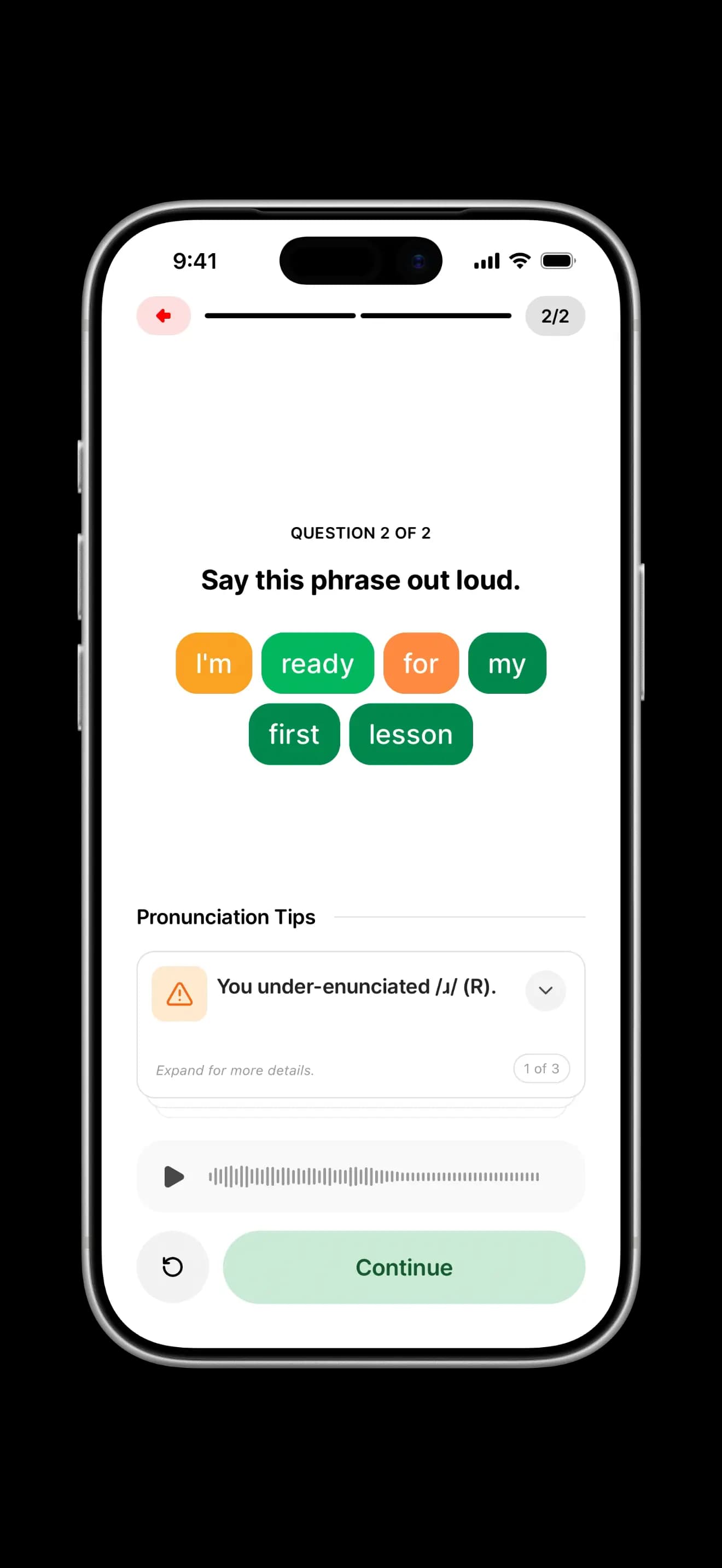
While you’re speaking, it’s hard to notice what your mouth actually did, because your ear is used to the sounds of Portuguese. In Slay Speech, you speak out loud and get feedback on every word.
A score for every word
You say the sentence out loud, the words light up as you speak, and each one gets its own score.
The exact swap and where it happened
If “rat” turned into “hat,” you see the mix-up, the words where it showed up, and a video of how to position your mouth and tongue.
Reviews built around your hardest sounds
The app keeps track of the sounds that give you the most trouble across all your practice and builds your reviews around them.
English for real situations
Practice ordering food, making a phone call, or getting through a job interview by choosing answers, typing, or talking on a live voice call, with guidance in Portuguese.
/ɪ/ and /i/: “ship” and “sheep” are different words
Portuguese has just one i in stressed syllables, and it’s close to the English /i/ in “sheep.” So the /ɪ/ in “ship” tends to come out the same way: “ship” and “sheep,” “live” and “leave,” “fill” and “feel” all merge into one word. The good news is that if you already have some experience with English, you can usually hear the difference. The hard part is producing it, so the work happens in your mouth.
/ɪ/ is lax: your tongue sits a little lower, your jaw opens a little more, and your lips stay relaxed. A rough reference is the final “e” in “sabe” (knows) or “tarde” (afternoon) in many Brazilian accents; carry that vowel into the stressed syllable of “sit.” Just don’t overdo it and land on “ê” (the closed e in “você”), or “sit” starts to sound like “set.” The /i/ in “sheep” is tense, with your lips slightly spread.
Words to practice
- shipnot “sheep”
- sitnot “seat”
- livenot “leave”
- fillnot “feel”
- big
- rich
Tip: Say “sheep” and slowly let the tension drain from your face until the vowel turns loose, almost lazy. That’s where the /ɪ/ in “ship” lives.
When “ship” comes out as “sheep,” Slay Speech points out the mix-up between the two vowels and the words where it happened.
Final M and N: don’t let them turn into nasal vowels
In Portuguese, an M or N at the end of a syllable marks a nasal vowel, and your mouth never quite closes: “bom” (good), “sim” (yes), “tem” (has). In English, these letters are full consonants. Without the closure, “Ben” sounds like “bem” (well), “him” like “rim” (kidney, which with the breathy Brazilian R sounds like a nasal “hee”), and “sun,” “sum,” and “sung” become hard to tell apart.
A final M is the trickiest. Portuguese words that end in M or N almost always end in M, as in “bem,” “bom,” and “fim” (end), and that M never closes your lips. So when you see “him,” “them,” or “from,” the habit takes over. Bring your lips all the way together and hold them there for a moment.
For /n/, touch the tip of your tongue behind your upper teeth and hold it, like the n in “tanto” (so much) or “onda” (wave), which is already a full consonant. In -ing endings, the closure is far back, with the back of your tongue against the roof of your mouth, like the n in “banco” (bank). End right there, without adding a “g” or an “i.”
Words to practice
- himlips closed at the end; not “rim”
- thema real M, not a nasal vowel
- fromclose your lips on the M
- roomhold the M with your lips together
- sunnot “sum” or “sung”
- morningend on the -ng, with no “i”
Tip: Say “him” in front of a mirror and hold the end for a second: your lips need to stay closed. Then do the same with “sun,” this time with your tongue touching behind your teeth.
If the end of “him” or “sun” stays a nasal vowel, the word’s score in Slay Speech shows it, and the video shows you how to close your mouth for this sound.
/ʌ/ in “cup” and /ɑ/ in “hot”: neither “u” nor “ó”
/ʌ/ is usually spelled with a u (“cup,” “but,” “much”) or an o (“love,” “money,” “come”), so Brazilians pronounce it the way it’s spelled: “búti,” “lóvi,” “cômi.” If you already know it isn’t a u, you probably use a very open “a” instead, and “cut” ends up sounding like “cot.” This is the vowel pair Brazilians find hardest to hear, so it’s best learned by feel, from the position of your mouth.
/ʌ/ is short and relaxed, made in the middle of the mouth, with your jaw half open and your lips neutral. A good rough reference is the unstressed final “a” in “casa” (house) or “mesa” (table). Then give that vowel the full weight of a stressed syllable.
The other half of the pair is the /ɑ/ in “hot,” “stop,” “job,” and “doctor.” Because of the letter o, Brazilians tend to use the “ó” in “pó” (dust), with rounded lips. In American English, this vowel is very close to the “á” in “pá”: jaw wide open, lips loose, no pout.
Words to practice
- cupshort and relaxed, not “u”
- butnot “búti”
- lovespelled with o, but the vowel of “cup”
- moneyspelled with o, but the vowel of “cup”
- sonsounds the same as “sun”
- hotwith the “á” in “pá,” not “ó”
Tip: Don’t trust the spelling. “Mother,” “come,” and “son” have the vowel in “cup,” short and relaxed. “Hot,” “stop,” and “job” have the “á” in “pá,” open, with no pout.
Since this mistake comes from the spelling, tap the word in Slay Speech to see how it splits into syllables and hear it said with the right vowel.
The voiceless TH /θ/ in “think” and “three”
Portuguese doesn’t have this sound, so your ear swaps in the nearest neighbor. In Brazil, that’s most often /t/: “thank you” becomes “tenkiu,” “thin” sounds like “tin,” and “three” sounds just like “tree.” Some people use /f/ (“three” as “free”) or /s/ (“think” as “sink”). It’s one of the slips native speakers notice most in a Brazilian accent, but it usually causes fewer misunderstandings than the sounds above.
Put the tip of your tongue between your teeth, or just behind the edge of your upper teeth, and blow without using your voice. Unlike /t/, it’s a continuous sound: you can hold it for as long as your breath lasts.
Words to practice
- thinknot “sink”
- threenot “tree”
- thinnot “tin”
- thank
- mouthTH at the end too, not T
- birthdayTH in the middle
Tip: Say “tin,” then “thin.” In “tin,” your tongue taps and lets go. In “thin,” the tip shows between your teeth and the air keeps flowing. Check in a mirror.
When “thin” comes out as “tin” or “think” as “sink,” Slay Speech flags that word and shows you exactly which sound got swapped.
/ʊ/ and /u/: “pull” is not “pool”
Just as with i, Portuguese has a single u in stressed syllables, and it does the job of both English vowels: “pull” and “pool,” “full” and “fool,” “look” and “Luke” become the same word. The short /ʊ/ shows up in everyday words like “good,” “book,” “look,” “put,” “could,” and “should,” so the swap happens all the time, and almost nobody notices it.
/ʊ/ is short and lax: lips only slightly rounded, tongue a little lower, face relaxed. A rough reference is the final “o” in “livro” (book) or “bolo” (cake), which in most of Brazil sounds like a weak “u”; carry that vowel into the stressed syllable. The /u/ in “pool” is close to the “u” in “tudo” (everything), longer and with well-rounded lips.
Words to practice
- goodshort and relaxed
- book
- looknot “Luke”
- fullnot “fool”
- pullnot “pool”
- could
Tip: Say “pool” with your lips pushed forward, then slowly relax them and shorten the vowel until it turns lazy: that’s the /ʊ/ in “pull.” Then use the same relaxed vowel in “good” and “book.”
When “pull” comes out as “pool,” Slay Speech points out the mix-up between the two vowels and shows you in a video how the lip and tongue positions differ.
T and D before /i/: “tea” is not “tchi”
In most of Brazil, “ti” and “di” sound like “tchi” and “dji,” as in “tia” (aunt) and “dia” (day). Some accents, in much of the Northeast and parts of the South, keep T and D crisp, and people who speak that way rarely carry the habit into English. For everyone else, “tea” becomes “tchi,” “tip” becomes “chip,” and “dinner” becomes “djíner.” The same thing happens at the end of a word, especially once the phantom “i” sneaks in (more on that below): “night” becomes “náitchi,” and “good” becomes “gúdji.”
Keep the tip of your tongue behind your upper teeth and release it cleanly, with no hiss, even before /i/ and /ɪ/. The exception is a T between vowels before a weak syllable, as in “city” and “water.” There, the American T turns into a quick tap, almost the same as the R in “caro.”
Words to practice
- teaa clean T, not “tchi”
- tipnot “chip”
- teama clean T, no hiss
- differentno “dj”
- nightend on the T, with no “tchi”
- citythe T sounds almost like the R in “caro”
Tip: Say “ta, ta, ta” and, without moving your tongue, switch to “ti, ti, ti.” If a hiss creeps in, go back to “ta” and start over.
When “tip” comes out as “chip,” Slay Speech flags the word and shows what your tongue should do to release the T without a hiss.
CH: “chip” is not “ship”
In Portuguese, ch is pronounced like x, as in “chuva” (rain) and “chave” (key), which is the English SH sound, and the habit carries over: “chip” becomes “ship,” “cheap” becomes “sheep,” “chair” becomes “share,” and “watch” becomes “wash.” These are different words, and context won’t always save you.
You already make the right sound every day: the English CH is the “tch” in “tchau” (bye), and the T in “tia” if you say it with a hiss. Your tongue touches the roof of your mouth just behind your upper teeth, blocks the air, and releases it with a short hiss. The SH in “she” and “ship,” on the other hand, is the x in “xícara” (cup): continuous, with no tongue contact.
J needs the same care. In “job,” “just,” and “June,” it’s the “dj” in “dia,” which is the “tch” of “tchau” with your voice on, not the j in “janela” (window), which sounds like the s in “measure.” The G in “general,” “age,” and “page” has this sound too.
Words to practice
- chipnot “ship”
- cheapnot “sheep”
- chairnot “share”
- check
- watchnot “wash”
- jobwith the “dj” in “dia,” not the j in “janela”
Tip: Before each word with ch, quietly say “tchau” and keep the same start: “tch-ip,” “tch-eap.” If your tongue didn’t touch, it came out as “sh.”
When “chip” comes out as “ship,” Slay Speech points out the swap between the two sounds and shows the words where it happened.
P, T, and K with a puff of air: “pin” is not “bin”
In Portuguese, P, T, and K come out dry, with no air after them. In English, at the start of a stressed syllable, they come with a small puff of air, and that puff is what an American ear uses to tell “pin” from “bin,” “time” from “dime,” and “coat” from “goat.” Without it, your P can be heard as a B. It’s also one of the slips Brazilians are least likely to notice in their own speech.
Release the P, T, or K with a little burst of air before the vowel, like a very light h right after the consonant: “p-hen.” After S, the puff disappears. In “spin,” “stop,” and “sky,” these sounds stay dry, just like in Portuguese.
Words to practice
- pennot “Ben”
- peoplea puff of air after the first P
- park
- timenot “dime”
- tena puff of air after the T
- keya puff of air after the K
Tip: Hold a sheet of paper in front of your mouth and say “pen”: it should move. On “spin,” it barely moves.
When “pat” is heard as “bat,” Slay Speech shows you the mix-up between P and B and the words where it happened.
The voiced TH /ð/ in “the” and “they”
It’s the same movement as /θ/, now with your voice on. Brazilians almost always replace it with /d/: “they” comes out the same as “day,” and “this” becomes “dis.” Many people keep the habit even after years of speaking English, but it rarely changes the meaning, because /ð/ shows up mostly in small words like “the,” “that,” and “there,” and there are few pairs like “they” and “day.” Since those words are in almost every sentence, though, getting this sound right makes your accent noticeably lighter.
Your D is already made with your tongue against your teeth, so start from there. Lightly touch the tip of your tongue to the edge of your upper teeth, turn your voice on, and loosen the contact so the air keeps flowing. In /d/, your tongue blocks the air and lets it go; in /ð/, the sound never stops.
Words to practice
- theynot “day”
- thisnot “dis”
- mother
- brother
- weathervoiced TH in the middle
- breathevoiced TH at the end
Tip: Say “dá, dá, dá” with the tip of your tongue on your teeth and, without stopping your voice, loosen the contact until the sound becomes a steady buzz. That’s how “that” starts.
In a full sentence, every word gets its own score in Slay Speech, so a “they” that came out as “day” doesn’t slip by.
Beyond individual sounds
Even with every sound in place, four habits carried over from Portuguese can make you harder to understand.
The phantom “i” after consonants
In Portuguese, syllables almost always end in a vowel, S, or R; as we saw above, a final L, M, or N isn’t really a consonant at all. When any other consonant shows up, Brazilians finish it off with an i: “Facebook” becomes “Feicibúqui,” “big” becomes “bígui,” and “hot” becomes “hótchi.” The same thing happens in the middle of a word (“advice” becomes “adivaice”), and before S plus a consonant, the i goes in front: “school” becomes “iscul.” The silent final e often gets pronounced too: “come,” “make,” and “phone” end on the consonant, without the “i” of “cômi,” “meiqui,” and “fôni.”
Each i is an extra syllable, which changes the rhythm and sometimes the word itself: said as “cúqui,” “cook” becomes “cookie.” Stop on the last sound and don’t let your voice keep going after it. In “book,” bring the back of your tongue up to the roof of your mouth and end right there. If, at first, a light puff of air slips out instead of the i, that’s fine: a whispered i gets in the way much less than a full one.
The habit is strongest in one-syllable words ending in P, B, K, or G, like “stop,” “club,” “book,” and “big,” so start with those. Pairs like “cop” and “copy” or “pick” and “picky” show the difference that i makes. In a sentence, link the consonant to the next vowel: “book is” sounds like “boo-kis.”
For an S at the start of a word, start hissing right away: “sss-tudy.” Keep that S voiceless before M, N, and L too (“small,” “snow,” “slow”), where Brazilians tend to use the z sound of the s in “mesmo” (same). And if your S comes out as “sh,” as it does in Rio, make sure “school” and “first” don’t turn into “ishcul” and “fêrsht.”
The -ed ending is almost never a syllable
It’s tempting to read “worked” as “uórquedi” and “played” as “pleiédi,” but both words have just one syllable. The -ed ending only adds a syllable after /t/ or /d/, as in “wanted” and “needed.” Otherwise, it’s just a consonant: /t/ after a voiceless sound (“worked,” “stopped,” “watched”) and /d/ after a voiced one (“played,” “called,” “lived”).
The extra syllable shows up most after sounds like /k/, /p/, /s/, and “ch” (“worked,” “stopped,” “missed,” “watched”), and even people who know the rule slip when they read aloud. Practice those verbs first and link the ending to the next word: “worked at” sounds like “work-tat.”
Stress in words that look like Portuguese
“Hospital,” “animal,” “natural,” and “popular” are spelled the same in both languages, but Portuguese stresses the end and English stresses the beginning: HOS-pital, AN-imal, NAT-ural, POP-ular. The trickiest ones put the stress before the third-to-last syllable, a position Portuguese never uses: “comfortable” (COMF-), “vegetable” (VEG-), “interesting” (IN-), and “category” (CAT-). Another trap is “develop” (de-VEL-).
English doesn’t mark stress in writing, and stress in the wrong place can make a word unrecognizable. Learn the stress along with the word and let the other syllables shrink: “comfortable” sounds almost like “COMF-tə-bəl.” When you practice, clap on the stressed syllable.
Weak vowels and small words
In English, unstressed syllables shrink. In “banana,” the first and last a are a quick /ə/, and only the middle one has any weight. Portuguese reduces vowels too, but mostly after the stress, as in “casa” and “leve” (light). Before it, the vowel stays much fuller, and Brazilians tend to stretch the stressed syllable instead of shortening the weak ones. A good reference for /ə/ is the final “a” in “casa”: short, central, and weak. Use it in “about,” “problem,” and “chocolate” too.
Small grammar words almost always come out weak in the middle of a sentence: “to” becomes /tə/, “of” becomes /əv/, and “can” becomes /kən/. Put the weight on the words that carry the meaning and let the small ones go by quickly.
Fifteen minutes a day with Slay Speech
Every day, the home screen has the phrase of the day and one section of your learning path: three activities that build on each other. Altogether, it takes about 15 minutes, and you speak out loud the whole time.
The phrase of the day (1 minute)
Say the phrase of the day out loud. Each word gets a score, and the card explains what the phrase means and when you’d actually use it.
The story video (about 6 minutes)
Today’s section starts with a story split into short clips. After each clip, you answer a question and say a sentence out loud. The story doesn’t save your place halfway through, so watch it in one go.
Topic phrases (3 minutes)
Say three phrases tied to the section’s topic, like ordering food or checking in at a hotel, and see which words need work.
A conversation or a sound review (3 to 5 minutes)
Depending on the section, you either practice a real situation (choosing answers and saying them, typing, or talking on a live voice call) or review your weakest sound with a few words. For many Brazilians, that’s TH or R.
The word you missed (1 minute)
Tap a word with a low score to practice it on its own: listen to it, see its meaning in Portuguese and how it splits into syllables, and record it again.