Speaking English clearly when your first language is French
Word stress, the vowels French doesn't tell apart, and the h, th, and r sounds: where each of these difficulties comes from, and how to place your mouth and tongue to get past it.


The short version
To pronounce English well as a French speaker, you need to work on three things: the sounds French doesn't have (h, the two th sounds, the English r, and the puff of air after p, t, and k), the vowels French doesn't tell apart (ship and sheep, cat and cut), and where the stress falls in each word. Stress is often the most neglected of the three, yet it matters most for being understood, far more than th does.
French keeps a full vowel in almost every syllable and puts its stress on the last syllable of each group of words, which it lengthens. English picks one syllable in each word, lengthens that one, and weakens the rest. That habit of stretching out the end is exactly the one you need to break. On top of that, spelling is misleading: lots of words look alike in the two languages but are pronounced differently.
This guide uses General American English as its model, the accent where you hear every r. Keeping a French accent isn't a problem in itself: the goal is to be understood without effort, not to pass for an American.
Knowing the rule is one thing; hearing your own mistake is another. The mistakes that cause the most trouble (word stress, h, and vowels that sound alike) are exactly the ones you can't hear yourself making. That's what Slay Speech is for.
The sounds to work on first
These sounds are ranked by how much they affect whether people understand you: first the ones that can turn one word into another, then the ones that mostly come across as an accent. Word stress, which matters even more, is covered further down. Depending on where you're from and what other languages you speak, some of these will come more easily: if you also speak Arabic or Berber, for example, h will already feel familiar. Comparisons with French sounds are rough reference points, rarely exact matches.
The schwa /ə/: the vowel that fades away
French does have its so-called silent e (e muet), as in petit (small) or demain (tomorrow), but the resemblance only goes so far. The schwa is the most common vowel in English and fills most unstressed syllables, whatever letter is written: the a in about, the o in today, the u in support. It's what makes the stressed syllable stand out by contrast. Without it, the stress gets washed out and the word becomes harder to recognize.
The French reflex is to give every vowel its full written value: a-bout, to-day. Instead, relax your jaw, lips, and tongue, and make a very short sound. It's a bit like a very short French eu (as in peu) said without rounding your lips, but that's only an approximation.
Words to practice
- about
- today
- problem
- support
- bananatwo schwas around a single full a
- photographerstress on -tog-, schwas all around it
Tip: Tap your finger on the table for each stressed syllable: one firm tap on -bout, nothing on a-. If both syllables take the same amount of time, the schwa isn't there yet.
Tap a word like about in Slay Speech to see it split into syllables, hear it, and catch where the vowel should fade.
The h /h/: a real breath
In French, h is never pronounced, not even in les héros (the heroes), where it blocks the liaison, the usual linking of the s to the next word. So it tends to vanish in English (hair becomes air, hungry drifts toward angry), or, when you're trying hard, it gets added in front of a vowel, especially a stressed one, and I ate becomes I hate. The mistake is stubborn because it's inconsistent: the same word comes out with its h one time and without it the next, and a French-speaking ear doesn't notice the difference.
Shape your mouth for the vowel that follows, then breathe out gently, as if you were fogging up a window, without scraping your throat. To avoid adding an h, run the previous consonant straight into the vowel, with no breath and no catch in your throat: an apple sounds like “a-napple.” The h does stay silent in hour, honest, heir, and, in American English, herb.
Words to practice
- hold≠ old
- hair≠ air
- heat≠ eat
- hungrywithout the h, it drifts toward angry
- behindthe h is heard in the middle of the word
- whothe w is silent
Tip: Hold your palm in front of your mouth and say hair, then air: you should feel a warm puff of air on hair and almost nothing on air.
When your h disappears and hair becomes air, the word's score drops, and Slay Speech shows you a video of how to make that breath.
Ship or sheep: /ɪ/ and /i/
French has only one i, a very tense one, and uses it everywhere. English has two: /i/ in sheep, close to the French i, and /ɪ/ in ship, which doesn't exist in French. With only one i, live and leave, fill and feel blur together.
/ɪ/ sits between French i and é (as in été) without being either one: your tongue is a little lower and a little further back, your lips are relaxed with no smile, and above all there's no tension. Don't go all the way down to é, though, or sit starts to sound like set. Relaxing matters more than length: a ship that's a bit shorter but still tense is still a sheep. If you speak Quebec French, the short, relaxed i in vite (fast) or petite (small) is a good starting point.
Words to practice
- ship≠ sheep
- sit
- live≠ leave
- fill≠ feel
- busythe u is pronounced /ɪ/
- womenthe o is pronounced /ɪ/
Tip: Say sheep with a smile, lips tight, then relax your whole face for ship.
When ship comes out as sheep, Slay Speech flags the word and shows you the exact mix-up, even when your ear struggles to hear the difference.

Why practice with Slay Speech
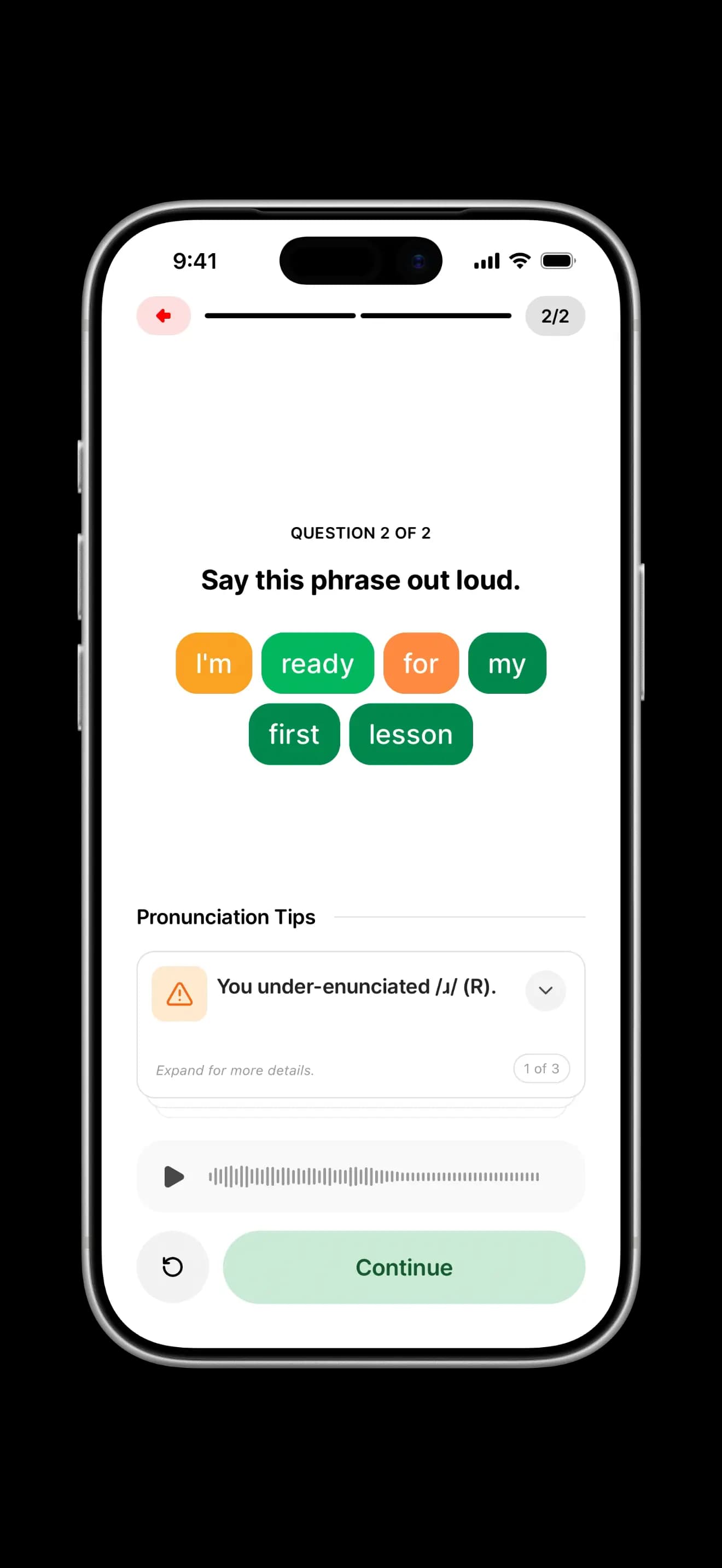
It's hard to hear yourself clearly while you speak: a French-speaking ear fills in what it expects to hear. Slay Speech listens to you and shows you, word by word, what still needs work.
A score for every word
Say a sentence out loud: the words light up as you speak, and each one gets a score. You see right away which ones to go back to.
The exact mix-up
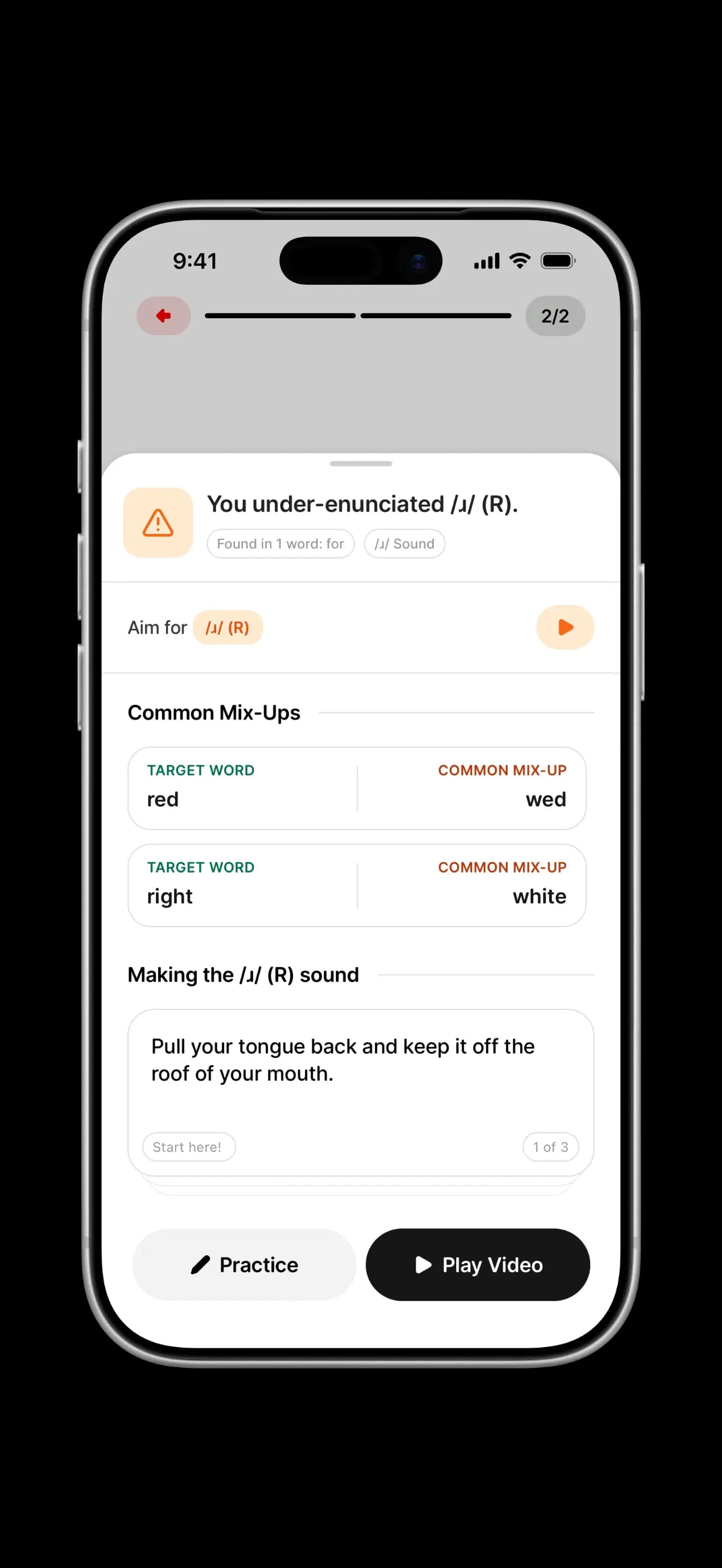
Ship instead of sheep, sink instead of think: the app shows you the mix-up, the words where it came up, and a video of the movement to make.
Every word up close
Tap any word to see it split into syllables, hear it, and check what it means.
Reviews built around you
The app keeps track of the sounds that trip you up across your sessions and builds your reviews around them.
The /æ/ in cat: neither a nor è
French has an a and an è (as in père), but nothing in between. The natural move is to put a French a in cat. But that same a often stands in for the u in cup too, so cap and cup, hat and hut, cat and cut end up sounding alike. Less often, when you're trying hard, you slide toward è, and bad starts to sound like bed.
Start from a French è, then drop your jaw noticeably, letting your tongue go down with it while keeping it well forward, lips slightly spread. Before n or m (man, plan, hand), American English says it a bit higher, with a slight glide, almost like “é-a.”
Words to practice
- cat≠ cut
- cap≠ cup
- bad≠ bed
- manthe plural men has /ɛ/
- apple
- happy
Tip: Put a finger under your chin and say cap, then cup: your jaw drops noticeably for cap, lips slightly spread, and stays halfway down, completely relaxed, for cup.
When your cap starts to sound like cup, Slay Speech shows you the mix-up and every word where it came up.
The /ʌ/ in cup: hiding behind u and o
This is where spelling plays tricks on you: you read u as a French eu, and o like the o in bonne (good). Cup becomes “keup,” love becomes “lov,” and money “mo-né.” The same trap is waiting in the o of hot, job, or stop: in American English, that's a wide-open /ɑ/, not a French o. And cut and cot, luck and lock differ only in those two vowels.
/ʌ/ is a short, central sound, with your mouth half open and your lips relaxed, not rounded. It's a bit like a very short French a pulled toward the eu in peur (fear), but that's only an approximation. For the /ɑ/ in hot, open your mouth wide, tongue low and back, and whatever you do, don't round your lips: it's closer to an a said at the back of your mouth than to the o in bonne.
Words to practice
- cup
- love
- money
- sonsounds just like sun
- cut≠ cot
- hot/ɑ/, mouth wide open
Tip: Imagine a light punch to the stomach: the short, effortless “uh” that escapes you is very close to /ʌ/.
When your cut comes out as cot, Slay Speech flags the word, shows you the exact mix-up, and keeps this sound in your reviews.
The voiceless th /θ/: think, three
French doesn't have this sound, so your ear swaps it for one it knows. In France, you mostly hear /s/ (think becomes sink) or /f/ (three becomes free); in Quebec, it's more often /t/, which gives you “tink” and turns three into tree. The same word can even come out right one time and wrong the next. It's the best-known feature of a French accent, but context usually clears up any ambiguity, so it causes fewer misunderstandings than word stress or h.
Place the tip of your tongue against the edge of your top front teeth, or slightly between them, and blow air out without using your voice. Don't tap with your tongue, or you'll get a t, and keep your bottom lip off your teeth, or you'll get an f: the sound comes from air flowing between your tongue and teeth.
Words to practice
- think≠ sink
- three≠ free, tree
- thin≠ tin
- thank
- mouth≠ mouse
- health
Tip: In front of a mirror, say think and hold the th for two seconds: the tip of your tongue should stay visible and your bottom lip well away from your teeth. You can't hold a t like that, and for sink, your tongue stays hidden.
When your think comes out as sink, Slay Speech flags the word and shows you the exact mix-up, along with a video of what your tongue should do.
P, t, k: the missing puff of air
In French, p, t, and k are said without any breath. In English, at the start of a stressed syllable, they come with a small puff of air. Without it, an American ear may hear b, d, or g: pat drifts toward bat, time toward dime, cold toward gold. Since French never uses this puff of air to tell two words apart, you almost never notice the mistake yourself.
Keep your usual p, t, or k, and just let a breath escape before the vowel, as if a very light h slipped in between. After s, though, the puff disappears (spin, stop, sky): there, your French habit is already right.
Words to practice
- pat≠ bat
- park
- time≠ dime
- two
- cold≠ gold
- coffee
Tip: Hold a sheet of paper in front of your mouth: it should move on pie and stay almost still on spy or buy.
When your pat comes out as bat, Slay Speech flags the word and shows you the exact mix-up, even if you can't hear any difference.
The voiced th /ð/: the, this, mother
It's the same movement, but with your voice on, so your throat vibrates. You hear it in the, this, that, and they. In France, it often turns into /z/ (the famous “zis is ze”), so then sounds like zen, and sometimes into /v/; in Quebec, it's more often /d/, and they gets mixed up with day. Because these little words come up constantly, the habit shows in every sentence, even though it rarely stops people from understanding you.
Start with a long z and slide your tongue forward to your teeth without cutting off your voice: the hiss softens into a light buzz. If you tend to say d instead, leave your tongue resting against your teeth and let the sound flow instead of tapping. On the, your tongue barely brushes your teeth.
Words to practice
- the
- this
- they≠ day
- mother
- brother
- breathethe noun breath has /θ/
Tip: Rest two fingers on your throat and hold the th: you should feel a vibration on the th in the and none on the th in think.
If your then sounds like zen, Slay Speech catches it in the sentence and points out the words where the mix-up happened.
The English r /ɹ/: nothing at the back of the throat
The most common French r is made at the back of the throat, near the uvula; in several African countries and some regions, it's rolled with the tip of the tongue instead. Neither one works: the American r is made in the middle of the mouth, without touching the roof of it. A French r stands out right away, but it rarely stops people from understanding you. Two other traps are subtler but also more common, even at an advanced level: rounding your lips so much that red sounds like wed, and dropping the r after a vowel.
Raise your tongue while pulling it back slightly, with its sides pressed against your upper back teeth and the tip free. Your lips round only a little, and the sound stays continuous. In American English, you also hear it after a vowel: car, hard, four. In bird, work, or her, it isn't a French eu followed by an r: the whole vowel is colored by the r, from start to finish.
Words to practice
- red≠ wed
- right
- very
- carthe final r is pronounced
- birda single vowel, colored by the r
- worksame vowel as bird
Tip: Make a long j sound, as in French je (I), the same sound as the s in measure. Then pull your tongue back a little, away from the roof of your mouth, until the friction disappears, and relax your lips without pushing them forward: you're now very close to the American r.
Every word gets a score, and if your r keeps its French color or slides toward a w, Slay Speech shows you a video of where to put your tongue.
Pull or pool: /ʊ/ and /u/
It's the same story as ship and sheep: French has only one ou (as in tout), where English has two. /u/, in pool or food, is close to the French ou; /ʊ/, in pull, book, or good, is shorter and more relaxed. With only one ou, full and fool, pull and pool blur together, and very common words like could, would, and should end up with an ou that's far too tense.
Start from the French ou and relax everything: lips barely rounded, tongue a little lower and more central, sound very short. If you speak Quebec French, the relaxed ou in poule (hen) or coupe (cut) is already close.
Words to practice
- book
- good
- look
- couldthe l is silent
- put
- full≠ fool
Tip: Say pool with your lips pushed well forward, then pull with your lips almost at rest: you should be able to see the difference in a mirror.
When your pull sounds like pool, Slay Speech flags the word and shows you the exact mix-up.
No nasal vowels: let the n be heard
When you read an, en, in, or on, the reflex is to make a nasal vowel, as in blanc (white), vin (wine), or bon (good), without pronouncing the n. Plan, important, and engine then sound like French words.
In English, those two letters make two sounds: a vowel, at most slightly nasal, then a real consonant. For /n/, the tip of your tongue touches the ridge behind your top front teeth; for /m/, your lips actually close.
Words to practice
- planthe a in cat, then a clear n
- friend
- important
- train/eɪ/ then /n/
- enginestarts with /ɛn/
Tip: Hold the final n of plan for two seconds, with the tip of your tongue pressed behind your top teeth. If your tongue isn't touching anything while the sound lasts, you made a nasal vowel, not an n.
If the n in plan or friend goes missing, you'll see it in the word's score, and a video shows you where to put your tongue.
Beyond sounds: stress, rhythm, and spelling
Getting the sounds right isn't enough if a word has the wrong stress or a sentence has the wrong rhythm.
Word stress: one syllable takes the lead
In French, the stress falls at the end of a group of words. In English, every word has one syllable that's longer and stronger than the others, where your voice changes pitch, and which syllable it is can change the word: a DEsert and a desSERT, a REcord (the noun) and to reCORD (the verb).
The French reflex is to shift the weight onto the last syllable: interesTING for INteresting, compuTER for comPUter, impossiBLE for imPOSsible. With the wrong stress, a word can become unrecognizable even if every sound in it is right. Learn every new word with its stress, the way you learn the gender of a French noun. Of all pronunciation mistakes, this is the one that does the most to make you hard to understand.
The trap is even trickier at the end of a sentence and in questions: your voice rises or stretches on the last syllable, as it does in French, and drags the stress along with it. In Is that your computer?, the rise starts on -pu-, not -ter. Keep the stressed syllable the strongest and longest (that's where the rise starts), and clip the last one short, even if that's where your voice ends up highest.
Weak words and linking
In a sentence, the words that carry meaning stand out and the little grammar words fade: I can go is said /aɪ kən ɡoʊ/, a cup of tea is said /ə kʌp əv ti/. Pronounce every word carefully, the way you would in French, and they all sound stressed.
French links words all the time (il a, “he has”; elle arrive, “she's arriving”), but the habit doesn't carry over into English on its own: when you're concentrating, you tend to slip in a little catch in your throat, or even an h, before words that start with a vowel. Instead, attach the final consonant to the next vowel, as in turn off, pick it up, or an apple.
Intonation: let your voice fall
In French, your voice rises at the end of each group of words until the sentence is over. Carried over into English, all those rises make you sound as if you're asking a question or hesitating, and they pull the stress toward the end of words.
In a statement, let your voice fall on the last important word. To highlight a piece of information, English raises the voice on the stressed syllable of that word (I said BLUE, not green), where French would more likely reword the sentence: c'est bleu que j'ai dit (literally “it's blue that I said”).
Word endings: -s and -ed should be heard
French leaves a lot of final letters silent: the t in petit (small), the ps in temps (time), the plural -s. In English, final consonants are almost always pronounced, and some of them carry grammar: the s in books (plural), the s in works (third person), the -ed in asked (past tense). Make sure they're clearly heard, especially when several consonants pile up at the end of a word (asked, months).
Another reading trap: the -ed ending only forms its own syllable after t or d (wanted, needed). Everywhere else, it shrinks to a single consonant: walked ends in /t/, lived in /d/, and each one has just one syllable.
Words that look like French
Information, restaurant, table, nature: the spelling pulls you toward the French pronunciation. The ending -tion is said /ʃən/, -ture is said /tʃɚ/, and some words lose a syllable in speech: vegetable and comfortable are usually said with three syllables, chocolate with two. Above all, their stress doesn't fall at the end the way it does in French (REStaurant, CHOcolate, imPORtant, deVElop).
These words also have vowels that glide, while French vowels hold steady: the a in table or nation is said /eɪ/, and the o in photo or radio is said /oʊ/. Some letters change sound too: ch is usually said “tch” (cheap, much, chocolate), and j is said “dj” (job, just), like the tch in tchèque (Czech) and the dj in djembé (the West African drum). With a French ch, which sounds like English sh, cheap becomes sheep and watch becomes wash.
The same trap catches the English words French has borrowed for everyday use, like parking, meeting, week-end, and shopping. You learned them the French way, with French vowels and the stress at the end. In English, they're stressed on the first syllable: PARking, MEEting, WEEKend, SHOPping.
Fifteen minutes a day in Slay Speech
Every day, the home screen gives you the phrase of the day and a section of your learning path: three activities, one after another. The whole thing takes about fifteen minutes, always out loud.
Phrase of the day (1 minute)
Say the phrase of the day out loud. Every word gets a score, and the card explains what the phrase means and when people actually use it. Your streak keeps going.
The story video (about 6 minutes)
The day's section starts with a story split into short clips. After each clip, you answer a question and then say a sentence out loud. Your progress isn't saved partway through the story, so watch it in one sitting.
Theme phrases (3 minutes)
Say three phrases tied to the section's theme, like ordering at a restaurant or checking into a hotel, and spot the words that need more work.
A conversation or a sound review (3 to 5 minutes)
Depending on the section, you either act out a real-life situation (choose a reply and say it, type your own, or talk it through on a live voice call) or review your weakest sound with a few words. For many French speakers, that's th.
The word you missed (1 minute)
Tap a word with a low score to work on it on its own: listen to it, see what it means in French and how it splits into syllables, then record it again.