English pronunciation for Japanese speakers: where you stumble and how to fix it
R and L, vowels that all sound like ア (a) to you, katakana habits, and the vowels you slip in without noticing. This guide walks through the sounds and rhythms Japanese speakers find hardest, using the sounds of Japanese as a starting point.


What to know first
Most of the trouble Japanese speakers have with English pronunciation comes down to three features of Japanese: it has only five vowels (あ い う え お, a i u e o), it doesn't separate R from L, and no syllable ends in a consonant other than ン (n) and ッ (the small tsu, which doubles the next consonant). On top of that, there's something unique to Japanese: a huge number of English loanwords written in katakana. “Light” and “right” are both ライト (raito), “bus” and “bath” are both バス (basu), and “hat” and “hut” are both ハット (hatto). Any word you first learned in its katakana form needs to be relearned with its English sound.
Japanese also gives you plenty of footholds. The ら row of the kana chart (ら り る れ ろ, ra ri ru re ro) is almost exactly the American t between vowels in “water” and “city.” The ン in あんない (annai, “guidance”) uses nearly the same tongue position as English n, and the ン in りんご (ringo, “apple”) nearly the same as English ng. Say カップ (kappu) but stop at カッ, just before the プ (pu): at that moment your lips are already closed, and that is exactly how English “cup” ends. And the instinct that makes you write “cap” as キャップ (kyappu) but “cup” as カップ (kappu) is a head start on telling /æ/ from /ʌ/.
This guide uses standard American English (General American) as its model and explains why each problem happens. But knowing the rules is one thing, and hearing your own mistakes is another, because while you speak, your ears are still listening through a Japanese filter. That's where Slay Speech helps.
The 10 sounds that trip up Japanese speakers most
They're ordered by how much they affect whether people understand you, so it's best to work from the top down. TH is very noticeable, but it's less likely to cause real misunderstandings, so it sits near the end. Adding extra vowels after consonants isn't tied to any single sound, so it's covered later, in the section on rhythm.
R and L: neither one is the Japanese ら (ra)
The consonant in the Japanese ら row is made by flicking the tip of your tongue once against the ridge behind your upper teeth. English R and L are both different from that sound, yet to a Japanese ear both sound like ら, so “light” and “right,” “glass” and “grass,” and “collect” and “correct” often end up sounding the same. Katakana gives you no reason to separate them either: “light” and “right” are both ライト (raito), and “rice” and “lice” are both ライス (raisu).
For R, your tongue tip touches nothing. Pull the whole tongue back a little and bunch it up (or curl the tip slightly upward), and round your lips a little. Since there's no flick, you can hold the sound as long as you like. L is the opposite: press your tongue tip firmly against the ridge just behind your upper front teeth, keep it there while you use your voice, and let the air flow out along both sides of your tongue. The key is to hold the contact for a moment instead of letting go instantly the way you do for ら.
R gets most of the attention, but don't neglect L. R is so obviously missing from Japanese that you know to practice it, but L sounds close enough to ら that it's easy to let ら stand in for it. And if you round your lips too much for R, “red” can sound like “wed.” R and L right after another consonant, as in “play” and “glass,” are especially easy to blur, so practice those separately.
Words to practice
- rightCompare with “light”
- grassCompare with “glass”
- prayCompare with “play”
- readCompare with “lead”
- correctCompare with “collect”
- really
Tip: In front of a mirror, first hold an L, “llll,” with your tongue tip on the ridge. Then hold an R, “rrrr,” with your tongue tip touching nothing. You can stretch out both, but you can't stretch out a flicked ら. If you can't hold it, you're making a ら sound. Then alternate “light” and “right,” “glass” and “grass.”
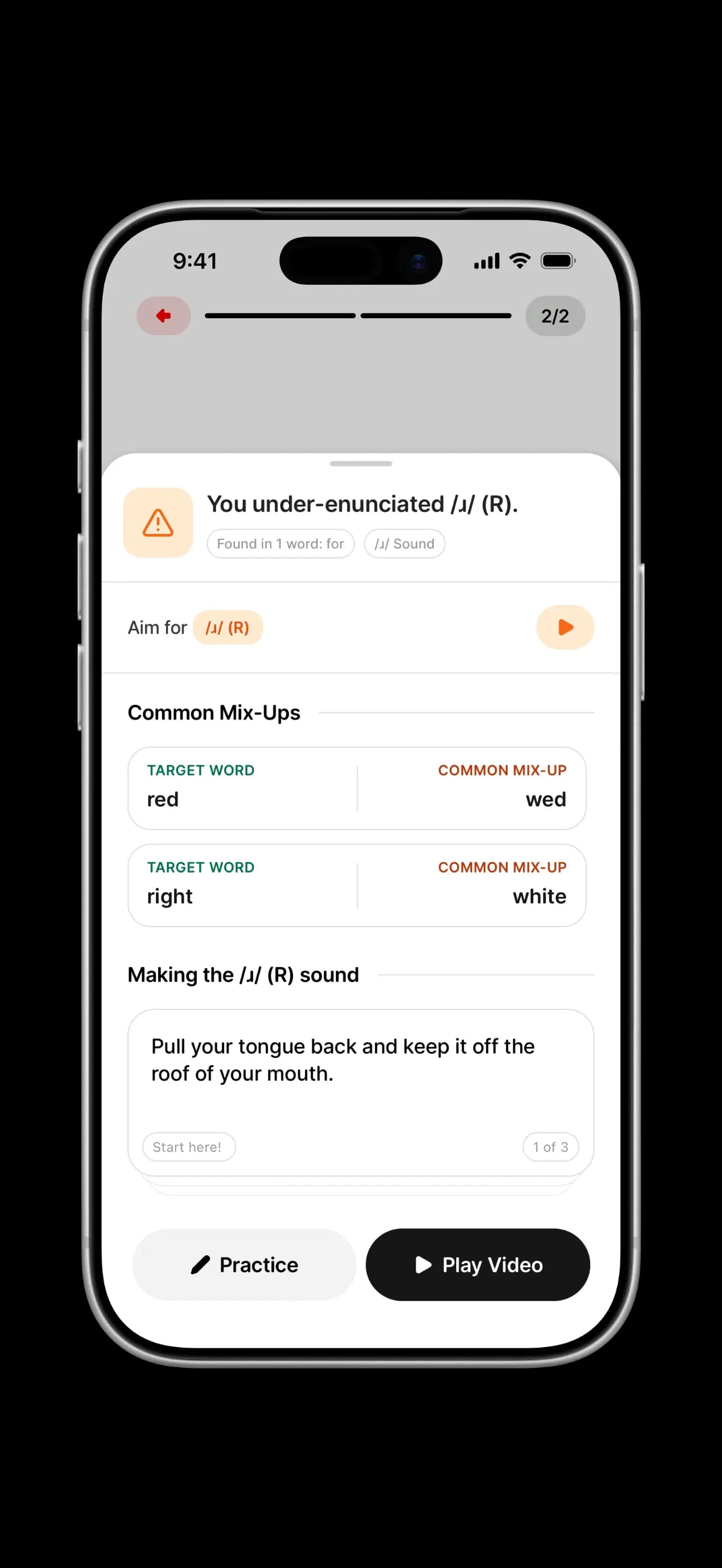
R and L are hard to tell apart with your own ears. Slay Speech catches words where you meant “right” but it came out as “light,” and shows you the mix-up clearly.
Cat, cup, and hot: one Japanese ア isn't enough
At least three English vowels sound close to Japanese ア (a): /æ/ in “cat” and “cap,” /ʌ/ in “cup” and “bus,” and /ɑ/ in “hot” and “stop.” Say them all as ア and you lose the difference between “hat” and “hut,” “cap” and “cup,” and “bag” and “bug.” In katakana, “hat” and “hut” are both ハット (hatto).
The clue is hidden in katakana itself. You write “cap” as キャップ (kyappu) but “cup” as カップ (kappu), right? That bright キャ (kya), ringing at the front of your mouth, is your shortcut to /æ/. For /æ/, start from the mouth shape for エ (e), drop your jaw a lot, keep your tongue forward, and spread your lips slightly. It's a slightly sharp sound, somewhere between ア and エ. For /ʌ/, a short Japanese ア is almost right: open your mouth about halfway, relax, and say it short, like the あっ (a!) you make when you're surprised.
Watch out for the /ɑ/ in “hot,” “stop,” “doctor,” and “job.” Katakana writes these with オ (o), as ホット (hotto) and ストップ (sutoppu), but in American English your lips stay unrounded and your mouth opens wide from top to bottom, closer to a long アー (ā). Picture opening wide at the doctor's and saying あーん (ān), the Japanese “aah.”
Words to practice
- catWith the bright ring of キャ (kya)
- capCompare with “cup”
- bagCompare with “bug”
- hatCompare with “hut”
- apple
- fanCompare with “fun”
Tip: Practice in sets of three: “cap,” “cup,” “cop” and “hat,” “hut,” “hot.” For the first, drop your jaw and spread your lips; for the second, relax and keep it short; for the third, open wide from top to bottom without rounding your lips. Put a finger under your chin and you'll feel your jaw drop a lot for the first and third, but not much for the second.
Slay Speech catches mix-ups word by word, like “cup” coming out as “cap,” and shows you the mouth shape in a video.
Bird and work: not アー (ā), but a vowel that is itself an R
Katakana writes “bird” as バード (bādo), “work” as ワーク (wāku), “first” as ファースト (fāsuto), and “teacher” as ティーチャー (tīchā), all with アー. But in American English this vowel isn't ア at all. It's a muffled-sounding vowel made with your tongue held in the R position. Say it as アー and “work” can sound like “walk,” and “first” like “fast.” In katakana, “hurt” and “heart” are both ハート (hāto), and “heard” and “hard” are both ハード (hādo).
Don't open your mouth as wide as for ア; keep your jaw half closed. Pull your tongue back and bunch it up the way you do for R, keep the tip touching nothing, and round your lips slightly. Hold that shape and stretch the sound out without letting an ア slip in. The -er in “teacher” and the -or in “doctor” are short, weak versions of the same sound, so there's no need to open your mouth for チャー (chā) or ター (tā).
Words to practice
- bird
- workCompare with “walk”
- firstCompare with “fast”
- girl
- word
- heardCompare with “hard”
Tip: Start by holding just the pulled-back “rrr,” then add consonants around it: b-rrr-d, w-rrr-k. Check in a mirror: if your mouth opens into an ア shape, it's too open. Compare “work,” with a small mouth and your tongue pulled back, and “walk,” with your mouth wide open and your tongue low.
Slay Speech scores every word, so you can check whether the vowel in “bird” or “work” has slipped back to アー. Tap any word to hear it and practice it syllable by syllable.

Why practice with Slay Speech
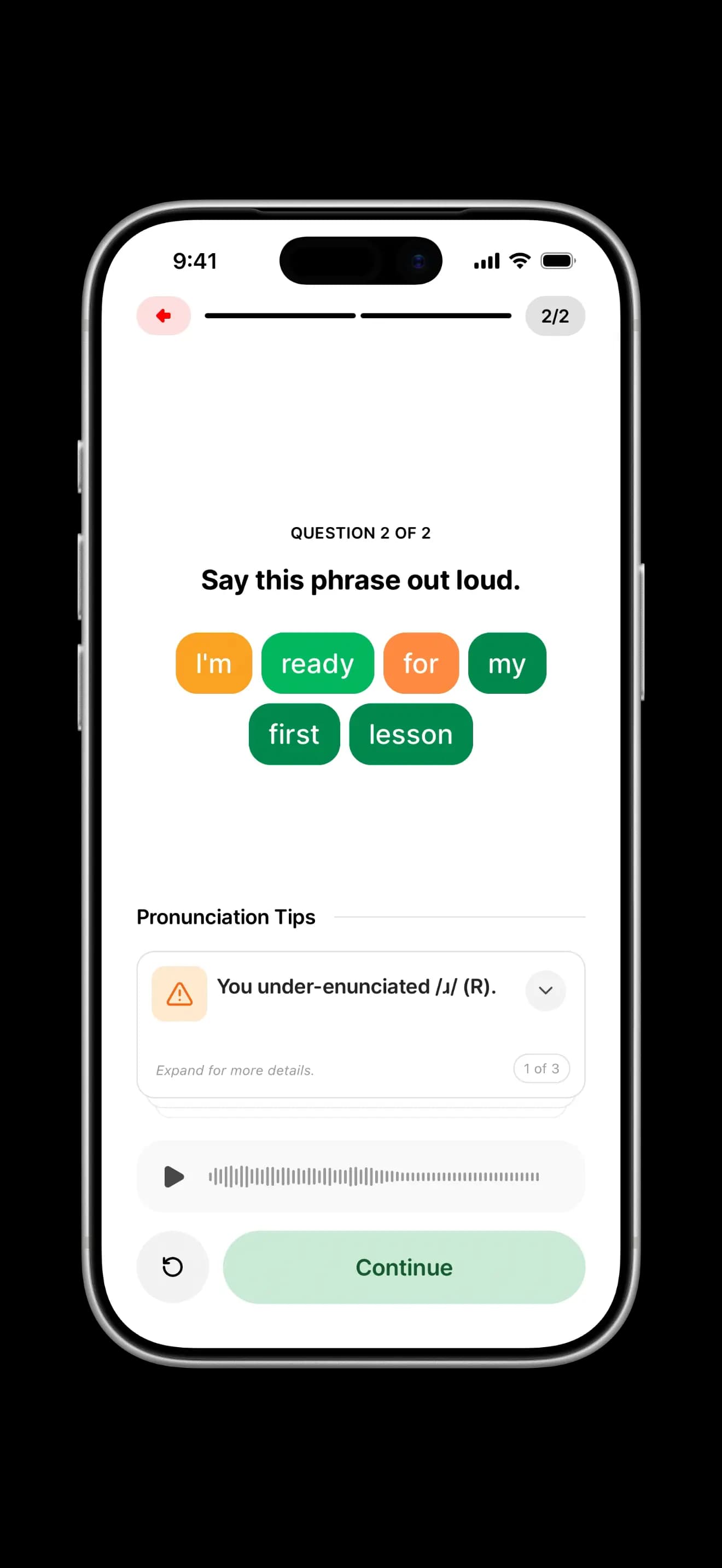
When you speak, your ears hear the sound you meant to make. Slay Speech listens to every word and points out the mistakes you'd have a hard time catching on your own.
See which words tripped you up
Say a phrase out loud and every word gets a score. Words light up one by one as you speak.
See exactly which sounds you mixed up
If “right” sounded like “light” or “very” like “berry,” it shows you the mix-up, the word where it happened, and a video of how to move your mouth and tongue.
It remembers your weak sounds
It keeps track of the sounds you tend to trip over across all your practice and builds your review around them.
Practice for real situations
Speak your way through video stories and situations like ordering food, phone calls, and job interviews, with explanations and feedback in Japanese.
Ship and sheep: the difference is the sound, not the length
Many people were taught at school that “sheep” has a long イー (ī) and “ship” a short イ (i). Japanese tells いい (ii) from い (i) by length, so it's natural to separate “sheep” and “ship” by length alone. But in English, the quality of the vowel matters more than its length. English vowels also get longer or shorter depending on the consonant that follows: the vowel in “seat” is much shorter than the one in “seed,” and the /ɪ/ in “bid” can even be longer than the /i/ in “beat.” Rely on length alone and both your listening and your pronunciation will be off.
The /i/ in “sheep” is made with your lips spread wider than for Japanese イ (i) and your tongue high and tense. The /ɪ/ in “ship” doesn't exist in Japanese: relax your face, lower your tongue slightly, and open your jaw just a little. It sits between イ and エ, but it shouldn't turn into エ. Be careful with words like “sheet” and “beach,” which turn into embarrassing words when said with /ɪ/.
“Full” and “fool,” “pull” and “pool” work the same way. The /u/ in “fool” is made with your lips much more rounded and pushed forward than for Japanese ウ (u); the /ʊ/ in “full” uses loosely rounded lips and comes out relaxed and short.
Words to practice
- shipCompare with “sheep”
- sitCompare with “seat”
- liveCompare with “leave”
- big
- womenThe o is pronounced /ɪ/
- fillCompare with “feel”
Tip: Practice by stretching the vowel on purpose. If you can hold the vowel in “ship” for a long time and it still doesn't sound like “sheep,” you've got the sound right. Check in a mirror that your lips spread for “sheep” and relax for “ship.”
Even when you think you're keeping them apart by length, Slay Speech shows you any word where your /ɪ/ came out as /i/.
V and F: upper teeth on your lower lip
Japanese has no V sound, and katakana writes it with the ば (ba) row. “Very” is ベリー (berī), “vest” is ベスト (besuto), and “video” is ビデオ (bideo). Said that way, “very” sounds like “berry,” “vest” like “best,” and “vote” like “boat.” Katakana does have the spelling ヴ (vu), but most people still pronounce it as a ば sound.
For V, rest your upper front teeth lightly on the inside of your lower lip and push air through the gap while using your voice. It's a buzzing sound you can hold as long as you like. If your lips touch each other, that's B. F uses the same mouth shape with air only, no voice. Japanese フ (fu) is made with both lips, so just touch your lower lip to your upper teeth instead and it becomes F. If you keep the two-lip フ, F and H blur together too, so “food” and “hood” both come out as フード (fūdo).
Words to practice
- veryCompare with “berry”
- video
- voteCompare with “boat”
- seven
- haveDon't add ブ (bu) at the end
- loveNot ラブ (rabu): end with your teeth still on your lip
Tip: Check in a mirror. In “very,” “vote,” and “seven,” you should see your upper teeth resting on your lower lip; in “berry” and “boat,” your lips should close completely. Put a finger on your throat and you'll feel it vibrate on V.
When “very” comes out as “berry,” Slay Speech shows you the mix-up and a video of where your teeth and lip go.
See and she: watch your シ (shi) habit
In the Japanese さ row, サ, ス, セ, and ソ (sa, su, se, so) all start with /s/, but シ (shi) uses a different sound, close to English sh. Because of that habit, “see” sounds like “she,” “seat” like “sheet,” and “city” becomes シティ (shiti). Some words, like “sit,” turn into something embarrassing when said with シ, so this one is worth fixing early.
It's not that your mouth can't make the sound. Japanese speakers can say スィ (si) and シ (shi) as distinct sounds just fine. The bigger cause is a reading habit: reading the letter s as シ. Simply relearning words one by one, スィ for “see,” “sit,” and “city” and シ for “she,” “ship,” and “sheet,” goes a long way. Watch out for overcorrecting, too: turning “she” and “ship” into “see” and “sip.”
For English s, keep your tongue where it is for ス (su), bring the tip close to the back of your upper front teeth, and push out a thin, sharp stream of air. Then move into the イー (ī) without raising the middle of your tongue. English sh is close to Japanese シ, but rounding your lips and pushing them forward makes it sound more English.
Words to practice
- seeCompare with “she”
- sitStart with スィ (si), not シ (shi)
- city
- seatCompare with “sheet”
- single
- sister
Tip: Say スー (sū), then change only the vowel to イー (ī) without moving your tongue tip. That gives you the スィー (sī) of “see.” Alternate “she,” “see,” “she,” “see,” and check in a mirror that your lips push forward for sh and spread for s.
Slay Speech flags words where “see” sounded like “she,” so you know exactly which words let シ slip in.
Final N and NG: ン isn't just one sound
Japanese ン changes shape depending on the sound that follows. In あんない (annai, “guidance”) it's /n/, with your tongue tip on the ridge behind your upper teeth; in りんご (ringo, “apple”) and ぎんこう (ginkō, “bank”) it's /ŋ/, with the back of your tongue against the back of the roof of your mouth; in さんぽ (sanpo, “walk”) it's /m/, with your lips closed. But at the very end of a word, ン usually doesn't bring the tongue tip to the ridge at all; it's made farther back in the mouth. That makes English “sin” and “sing,” “thin” and “thing,” and “win” and “wing” hard to tell apart.
The other habit comes from katakana's ング (ngu). “King” is キング (kingu) and “morning” is モーニング (mōningu), so it's easy to tack a g and a vowel onto the end. In English “sing” and “king,” you raise the back of your tongue to the roof of your mouth, let your voice out through your nose, and stop there. There's no グ (gu).
Words to practice
- singCompare with “sin”
- thingCompare with “thin”
- king
- morningNo g sound at the end
- long
- wingCompare with “win”
Tip: Start to say あんない (annai) and stop on the ン: your tongue tip is on the ridge. That's the n in “sin.” Start to say りんご (ringo) and stop on the ン: the back of your tongue is raised. That's the ng in “sing.” With those two ン sounds in mind, alternate “sin” and “sing,” “thin” and “thing.”
When “sin” sounds like “sing,” or “sing” like “sin,” Slay Speech shows you the mix-up and the word where it happened.
Voiceless TH: moving on from サンキュー (sankyū)
Japanese has no sound made by pushing air between the tongue and teeth, and katakana writes th with the さ (sa) row. “Thank you” is サンキュー (sankyū), “think” is シンク (shinku), and “three” is スリー (surī). So “think” sounds like “sink,” “mouth” like “mouse,” and “bath” and “bus” both become バス (basu). It's a very noticeable sound, but context usually carries the meaning, so it's fine to work on the sounds above first.
Let the tip of your tongue peek out lightly between your upper and lower teeth, or touch it lightly to the edge of your upper front teeth, and let air flow out without using your voice. There's no need to bite your tongue hard; what matters is keeping the air flowing. If your tongue pulls back the way it does for the シ (shi) in シンク (shinku), you're back to an s sound.
Words to practice
- think
- thank you
- three
- mouthCompare with “mouse”
- bathCompare with “bus”
- birthday
Tip: Watch yourself in a mirror. In “think” you can see a little of your tongue tip; in “sink” you can't. Try holding the sound for a few seconds: if the air keeps flowing, it's TH.
If “think” comes out as “sink,” Slay Speech shows you the mix-up and the word, even when you thought you said it right.
Voiced TH: “the” is not ザ (za)
This is the voiced TH in “the,” “this,” “that,” “they,” and “mother.” Katakana writes it with the ざ (za) row, as ザ (za), ジス (jisu), and マザー (mazā), but at the start of a word the Japanese ざ row tends to begin with a brief stop, like ヅ (dzu), so “this” sounds like ズィス (zisu) and “then” like “zen.” Words like “the” and “this” come up constantly in English, so fixing this one changes how your whole English sounds.
Your tongue goes in the same place as for voiceless TH. Keep the tip lightly against your teeth while using your voice, and feel the buzz around your teeth. There shouldn't be a moment at the start where the sound stops, like the catch of a ッ.
Words to practice
- the
- this
- they
- mother
- brother
- breatheEnds in a voiced TH too
Tip: Start with a Z you can hold without stopping, “zzzz,” then keep your voice going as you slide your tongue tip forward onto your teeth. When the sharp buzz turns softer, that's TH. Go straight on into “this,” “that,” and “they.”
If “this” sounds like “zis,” Slay Speech shows you the mix-up and a video of your tongue touching your teeth.
Go and make: don't stretch them into ゴー (gō) and メーク (mēku)
In Japanese, おう and えい are usually pronounced as a long オー (ō) and エー (ē), as in 東京 (Tōkyō) and 英語 (eigo, “English,” said ēgo). Katakana does the same: “go” is ゴー (gō), “boat” is ボート (bōto), “make” is メーク (mēku), and “game” is ゲーム (gēmu). But English /oʊ/ and /eɪ/ are diphthongs: your mouth changes shape partway through. People usually understand a stretched vowel, but it sounds very Japanese, and “boat” can even be heard as “bought.”
For /oʊ/, start from オ (o) and finish by rounding your lips into a small circle, moving toward ウ (u). For /eɪ/, start from エ (e) and raise your tongue as you move toward イ (i). The second half can be short and light, but don't drop it.
Words to practice
- go
- no
- home
- boatRound your lips at the end
- showNot a long ショー (shō): round your lips at the end
- roadDon't stretch it into ロード (rōdo)
Tip: Say “go” in front of a mirror and check that your lips move forward at the end. If they stay still, you're saying ゴー (gō). On “make,” feel your jaw rise a little.
Slay Speech scores every word, so you can check whether the vowel in “go” or “home” has flattened into a stretched-out オー (ō).
After the sounds: rhythm, stress, and katakana words
Even when every sound is right, rhythm or stress that's off can make you hard to understand.
Don't add vowels after consonants
Japanese syllables end in a vowel, except for ン and ッ. So it's natural to add a vowel after English consonants too: “bed” becomes ベッド (beddo), “milk” ミルク (miruku), “desk” デスク (desuku), and “street” ストリート (sutorīto). The basic katakana pattern is オ (o) after t and d, イ (i) after ch and j, and ウ (u) after everything else.
This is a habit of the ear as much as the mouth. Wherever consonants cluster, a Japanese ear fills in a ウ that isn't really there, so it's hard to notice that you're adding vowels. Every extra vowel adds a syllable. “Strike” is one syllable in English, but ストライク (sutoraiku) is five beats; “McDonald's” is three syllables, but マクドナルド (makudonarudo) is six beats. English speakers will struggle to follow either one. Put a vowel into “blow” and it sounds like “below.”
The fix starts with ッ. Stop カップ (kappu) at カッ (kap) and the sound ends with your lips still closed. That's how English “cup” ends. Finish a final consonant by holding your tongue or lips in place, with no vowel after it. But for words that end in a voiced consonant, like “bed” and “bag,” cutting the vowel off abruptly the way ッ does can make them sound like “bet” and “back.” Hold the vowel a little longer, then close. In American English, the final t in “cat” and “that” often isn't fully released. The L in “feel,” “school,” and “milk” shouldn't turn into ル (ru) either; end with your tongue tip still on the ridge. For clusters like “street,” start with just a breathy “sss” and carry on from there. Counting syllables on your fingers helps too: “street” and “desk” are both one.
Once you can end on a consonant, English linking happens naturally. “An apple” becomes a-napple, and “pick it up” becomes pi-ki-tup, with each word's final consonant running into the next word's vowel. As long as you keep adding vowels, this linking can't happen.
Set aside the katakana pronunciation
Katakana words aren't English pronunciation. They're something else entirely. They add vowels, merge R and L into the ら row, turn th into the さ row and v into the ば row, stretch out diphthongs, and replace the R-colored vowel with アー. Combinations Japanese doesn't have disappear too. “Wood” and “woman” are written ウッド (uddo) and ウーマン (ūman), so the w, with its rounded, pushed-forward lips, drops out, and “year” becomes イヤー (iyā), the same as “ear.” For w, purse your lips as if to whistle before moving into the vowel; for y, first raise your tongue even closer to the roof of your mouth than for イ (i). Almost every problem in this guide is packed into katakana words.
Katakana is handy for remembering what a word means, but it's no model for pronunciation. And the better you know a word, the faster its katakana version jumps out. Familiar words like “hotel,” “energy,” “image,” and “vitamin” are exactly the ones to relearn with their English sound, stress included.
Stress means longer and stronger, not just higher
Japanese tells words apart by pitch, as with 箸 (hashi, “chopsticks”) and 橋 (hashi, “bridge”). So it's natural to mark English stress with pitch alone. But a stressed English syllable isn't just higher: it's also longer, stronger, and clearer. You're already good at moving your pitch, so keep that, and add length and strength to the stressed syllable.
Learn every new word together with its stress. Be especially careful with words you know from katakana, and check in English where the stress falls: ho-TEL, ca-REER, EN-er-gy, VI-ta-min. In some words the stress moves with the form or the part of speech, like PHO-to-graph and pho-TOG-ra-pher, or the noun REC-ord and the verb re-CORD.
Schwa and weak little words
In Japanese, every vowel is pronounced clearly. The three ア sounds in バナナ (banana) are all the same. In English, though, many unstressed vowels become a short, vague /ə/, called schwa. In “banana,” only the middle vowel sounds like ア: /bəˈnænə/. And “chocolate” isn't the five beats of チョコレート (chokorēto); it's normally two syllables, /ˈtʃɑklət/.
To make /ə/, relax your mouth, don't open your jaw much, and say it short and weak. It sounds even weaker than a short, relaxed ア. Little words like “to,” “for,” “and,” “of,” and “can” are usually weak inside a sentence too: “to” is /tə/, “for” is /fɚ/, “and” is /ən/, and “of” is /əv/.
“Can” and “can't” matter most. In “I can go,” “can” weakens to /kən/; in “I can't go,” “can't” has a clear /æ/. If you always say “can” strongly, like キャン (kyan), people may hear “can't.”
Make the important word stand out
In a Japanese sentence, the voice naturally rises near the start and then gradually falls. Carry that pattern into English and the start of the sentence stands out most. In English, the biggest pitch movement goes on new information or on a word you're contrasting, and that word often comes later in the sentence.
In “I don't want the red one, I want the BLUE one,” for example, “blue” stands out. If someone asks, “Do you like coffee?” the natural answer is “I LOVE coffee,” with “coffee” said lightly because it's already been mentioned. Where you put the emphasis tells people what you actually mean.
A 15-minute daily routine with Slay Speech
Every day, your home screen shows the phrase of the day and one section of your learning path. Each section is made of three connected activities. It all takes about 15 minutes, and you practice out loud from start to finish.
Phrase of the day (1 minute)
Say the day's phrase out loud. Every word gets a score, and the card explains what it means and when people actually use it.
Story video (about 6 minutes)
The day's section starts with a story split into short clips. After each clip, you answer a question and say one phrase out loud. You can't save a story partway through, so watch it to the end in one go.
Theme phrases (3 minutes)
Say three phrases that fit the section's theme, like ordering at a restaurant or checking in at a hotel, and see which words need a little more polish.
Conversation or sound review (3–5 minutes)
Depending on the section, you either practice a real-life situation (choose a reply and say it, type your own, or talk on a live voice call) or review your weakest sounds with a few words. For Japanese speakers, that's often R and L.
Words you missed (1 minute)
Tap a low-scoring word to practice just that word. Listen to it, check its meaning in Japanese and how it splits into syllables, then record it again.