English pronunciation for Korean speakers
The sounds, rhythm and loanword habits that trip up Korean speakers most, explained through sounds you already know from Korean.


What matters most
Korean speakers tend to get stuck in three places. The first is sounds where Korean has one and English has two. A single ㅣ (i) has to cover the vowels in both ship and sheep; if you don't distinguish ㅐ (ae) from ㅔ (e), bad and bed come out the same; and one ㄹ (r/l) has to do the work of both L and R. The second is sounds Korean doesn't have at all. The big ones are f, v, z and th, which easily turn into ㅍ (p), ㅂ (b), ㅈ (j) and ㅅ (s). The third is stress. Standard Seoul Korean has no word stress, so it feels natural to give every syllable about the same length and pronounce every vowel in full.
On top of that, there's one more trap: loanwords. You already know countless English words in their Korean form, like 커피 (keopi, coffee), 비디오 (bidio, video), 버스 (beoseu, bus) and 바나나 (banana). In Korean spelling, fork and pork are both 포크 (pokeu), and file and pile are both 파일 (pail). Your brain has stored each pair as a single sound, so that's exactly how they tend to come out when you speak English. Korean also gives you a head start on a few sounds. The ㄹ between vowels in 나라 (nara, country) and 사랑 (sarang, love) is almost the same as the American t in water and city, and the double ㄹㄹ in 빨래 (ppallae, laundry) is a great starting point for English L. Final ㅇ (ng) is exactly the ng in sing.
This guide is based on General American English and explains the reason behind every rule. But knowing the rules is one thing; hearing your own mistakes is another. You've probably never noticed that the ㅅ in 사 (sa) and the ㅅ in 시 (si) are different sounds, and many Korean habits are just as inaudible to the person speaking. That's where Slay Speech comes in.
The ten English sounds Korean speakers need to get right
They're ordered by how much they affect whether people understand you, so start at the top and work your way down. TH is the first thing most people associate with a Korean accent, but it rarely changes the meaning, so it comes last. The Hangul spellings in this guide are only rough approximations of the English sounds, not exact matches.
Ship and sheep: one Korean ㅣ isn't enough
Korean has only one ㅣ (i), so it's easy to use it for both the /i/ in sheep and the /ɪ/ in ship. Then sit sounds like seat, live like leave and fill like feel. For native listeners, this vowel is one of the hardest parts of Korean-accented English to follow.
If you learned these in school as "long and short vowels," be extra careful, because native speakers tell them apart more by mouth shape than by length. The /i/ in sheep is ㅣ with your lips pulled a little further to the sides and your tongue a bit tenser. The /ɪ/ in ship isn't a short ㅣ; it's a different vowel altogether. Drop your jaw slightly, relax your tongue and lips, and aim for somewhere between ㅣ (i) and ㅔ (e). Just don't go all the way to ㅔ, or sit turns into set.
Words to practice
- ship
- sit
- liveThe verb; not leave
- richNot reach
- big
- womenThe o is pronounced /ɪ/
Tip: In front of a mirror, say seat, sit, set in a row. On seat, the corners of your mouth pull to the sides; on sit, your face relaxes and your jaw drops just a little. Sit isn't a shorter seat, and it isn't set either. It falls between the two.
These two vowels are hard to tell apart by ear, so Slay Speech points out the words where /i/ took the place of /ɪ/ and shows you which sounds you mixed up.
Bad and bed: if ㅐ and ㅔ sound the same to you, /æ/ needs a place of its own
Most Koreans today pronounce ㅐ (ae) and ㅔ (e) exactly the same way. If 개 (gae, dog) and 게 (ge, crab) sound identical when you say them, you're one of them. As a result, English /æ/ and /ɛ/ merge into one vowel, and bad and bed, man and men, sad and said, pan and pen become impossible to tell apart. Even if you write them differently in Hangul, as 배드 (baedeu) and 베드 (bedeu), they can easily end up sounding the same.
For the /ɛ/ in bed, your Korean ㅔ works just fine. The problem is the /æ/ in bad. Keep your tongue forward, as for ㅔ, but drop your jaw much lower, about as far as for ㅏ (a), and pull the corners of your mouth slightly to the sides. In American English this vowel is often fairly long, especially before a voiced consonant or before n or m, as in bad, man and bag. Still, don't rely on length to make the difference; make sure your jaw really drops.
Words to practice
- badNot bed
- manNot the plural men
- sadNot said
- bag
- apple
- happy
Tip: Put a finger under your chin and alternate between bed and bad. Your jaw should drop noticeably further on bad. In a mirror, you should see your mouth open wider from top to bottom on bad.
If your bad sounds like bed, Slay Speech points out the mix-up in the exact word and shows you the mouth position in a video.
V: don't let very turn into berry
Korean has no v, so loanwords spell it with ㅂ (b): 비디오 (bidio, video), 밴 (baen, van), 베스트 (beseuteu, vest). Carry that habit into English and very becomes berry, vote becomes boat, vest becomes best and van becomes ban. Because the meaning changes completely, this mix-up makes you genuinely hard for native speakers to understand.
For V, rest your upper teeth lightly on the inside of your lower lip, push air through the gap, and turn on your voice at the same time. Your lips shouldn't touch each other. If you feel a slight, tickling buzz on your lower lip, you've got it. In other words, stretch out an f, switch on your voice, and it becomes v. Keep the buzz going at the end of a word too, as in love, five and have, and don't add an extra 으 (eu) the way 러브 (reobeu) and 파이브 (paibeu) do.
Words to practice
- veryNot berry
- voteNot boat
- videoNot the ㅂ in 비디오 (bidio)
- seven
- loveNo 으 (eu) at the end
- fiveHas both f and v
Tip: Watch yourself in a mirror. On very, vote and seven, your upper teeth should rest on your lower lip; on berry and boat, your lips should press fully together and then open. You can hold a v for several seconds, but a b is over the moment your lips part.
If you say very like berry, Slay Speech catches it right away and shows you in a video where to put your upper teeth and lip.

Why practice with Slay Speech
When you speak, your ear hears the sound you meant to make. Slay Speech listens to you word by word and points out what's hard to catch on your own.
See which word went wrong
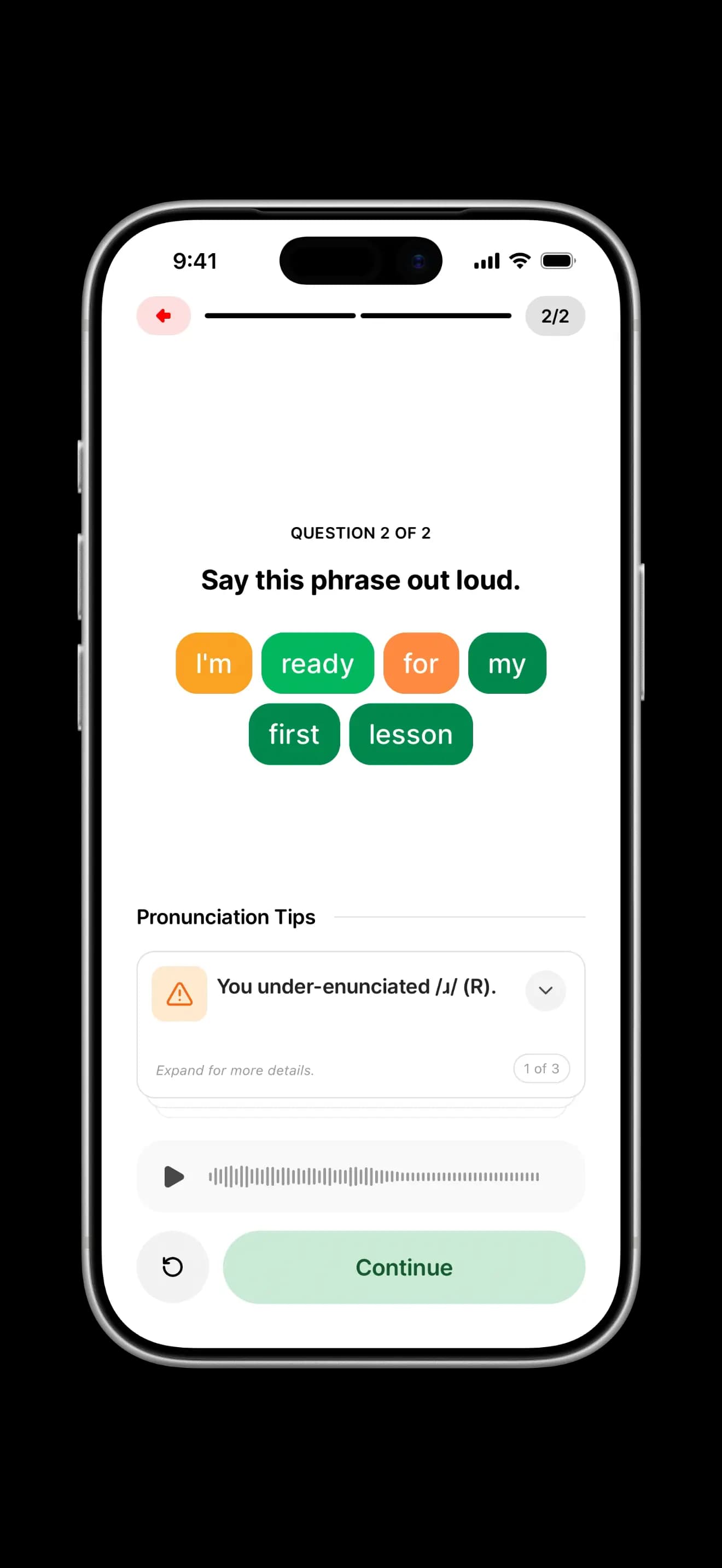
Say a sentence out loud and every word gets a score. Words light up as you speak.
See exactly what you mixed up
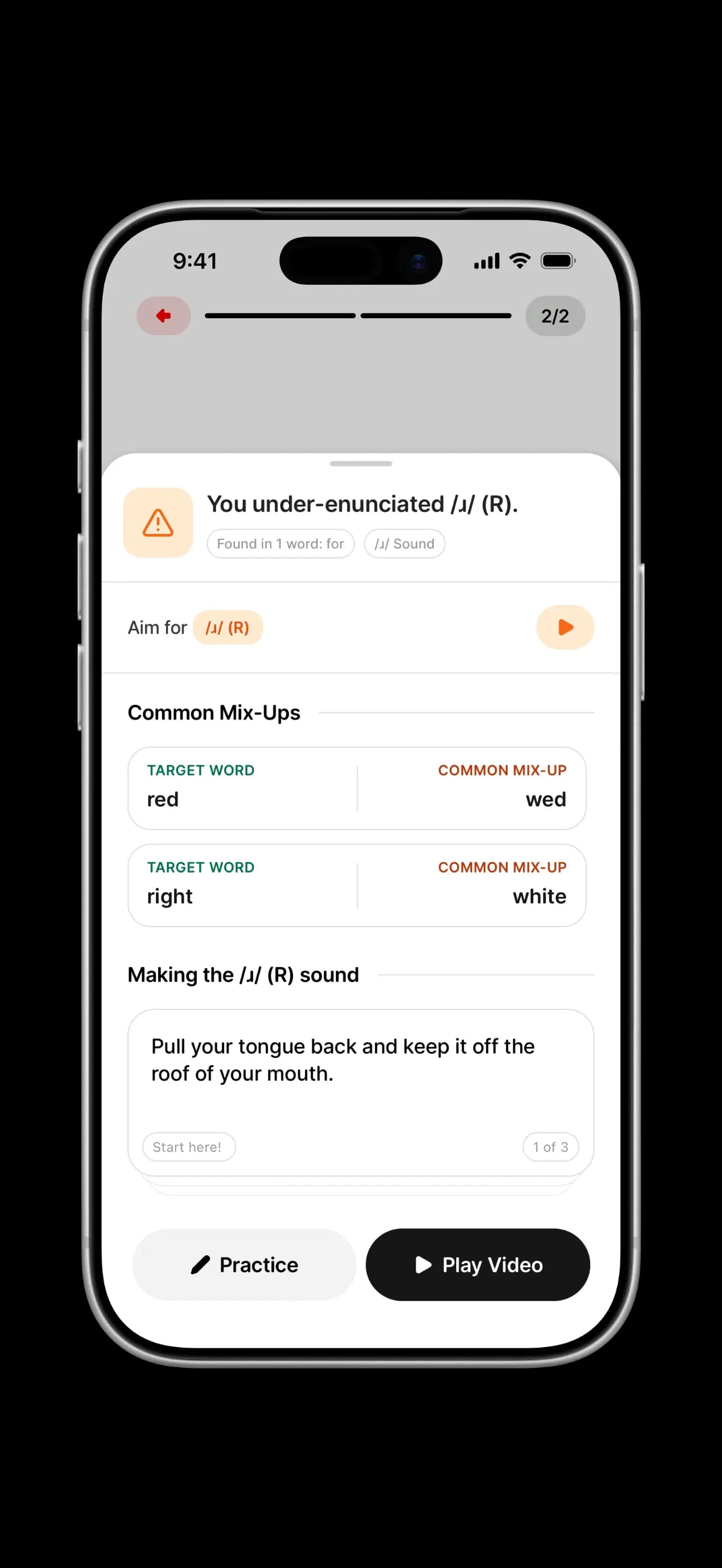
If you say ship like sheep or very like berry, the app shows you the mix-up and the word it happened in, with a video of how your mouth and tongue should move.
It remembers what's hard for you
Across all your practice, the app keeps track of the sounds that keep tripping you up and builds your reviews around them.
Practice that feels like real life
Video stories and real situations like ordering food, making a phone call or going to a job interview, with guidance and corrections in Korean.
L: when light and right are both 라이트 (raiteu)
Korean treats ㄹ as a single sound, but its shape changes depending on where it falls. Between vowels or at the start of a word, as in 나라 (nara, country), the tip of your tongue flicks the roof of your mouth and moves on. At the end of a syllable, as in 말 (mal, horse), or doubled, as in 빨래 (ppallae, laundry), the tip stays on the ridge behind your teeth and the sound flows out along the sides of your tongue. If you use the flicked ㄹ for both L and R at the start of English words, light and right, long and wrong sound identical. Most people assume R is the harder one, but in practice more mistakes happen with L: at the start of a word, between vowels as in alive and belly, and at the end of a word as in feel and people.
Your starting point for L is the ㄹㄹ in 빨래 (ppallae, laundry) and 몰라 (molla, I don't know). Put the tip of your tongue on the ridge just behind your upper teeth, keep it there while you voice the sound for a moment, then move into the vowel. Don't flick it off. Think of light as starting with the ㄹ already in place, as if there were a silent 을 (eul) in front: (을)라이트, (eul)laiteu. For L at the end of a word, as in feel, call and people, keep the tip touching and lift the back of your tongue a little, so feel sounds less like 필 (pil) and more like 피-얼 (pi-eol). For L after a consonant, as in blue, play and class, don't slip in an 으 (eu) the way 블루 (beullu) and 플레이 (peullei) do; go straight from the consonant to the L.
Words to practice
- lightNot right
- longNot wrong
- aliveNot arrive
- helloTongue tip stays on the ridge, as in ㄹㄹ (ll)
- feelKeep your tongue tip in place at the end
- playNo 으 (eu), unlike 플레이 (peullei)
Tip: Say 빨래 (ppallae) slowly and notice how the tip of your tongue stays on the ridge for the second ㄹ. Hold it there, stretch out an llll sound, then move into light, long and love. If you feel your tongue flick the roof of your mouth, start over.
If your light sounds like right, or your right like light, Slay Speech points out which word it happened in and which sounds got mixed up.
R: the tip of your tongue doesn't touch anything
If you say R like the ㄹ in 라 (ra), the tip of your tongue taps the roof of your mouth, so a native speaker hears an L, or sometimes a quick d. That's why right can sound like light and road like load. When R comes after a consonant, as in pray, tree and free, it's also easy to slip in an 으 (eu), as in 프레이 (peurei) and 트리 (teuri).
For R, the tip of your tongue doesn't touch the roof of your mouth anywhere. Pull your tongue back a little and bunch it up, and round your lips slightly, as if you were starting to say 우 (u). It helps to begin with a tiny 우 (u) in front, like 롸잇 (rwait) for right. Don't push your lips out too far, though, or red starts to sound like wed; rely more on your tongue than your lips. In American English, R after a vowel is pronounced too, as in car, bird and work. The loanword 워크 (wokeu) is used for both work and walk, but in work you pull your tongue back and color the vowel with R from the moment it starts, while walk has no R at all. And teacher doesn't end in ㅓ (eo) as in 티처 (ticheo); it ends in a short R sound.
Words to practice
- rightNot light
- roadNot load
- really
- treeNo 으 (eu), unlike 트리 (teuri)
- workNot walk
- bird
Tip: Unlike the tapped ㄹ, R can be stretched out. Start with a short 우 (u), keep your tongue tip in the air, and hold an rrrr sound. From that exact position, say right, road and really. If you feel the tip touch anything, try again.
Slay Speech scores every word, so a weak R in right or work shows up in that word's score, and you can pick the word out to practice on its own.
S before an ee sound: why see turns into she
In Korean, the ㅅ in 사 (sa) and the ㅅ in 시 (si) are actually different sounds. Before ㅣ (i), your tongue rises toward the roof of your mouth and the sound moves close to English sh. It happens automatically, so almost nobody notices it. Carry that habit into English and see sounds like she, seat like sheet and sip like ship. It's also why seat and sheet are both spelled 시트 (siteu) in Korean. And sit can come out sounding like an English swear word, so this one is well worth fixing.
The s in see, sit, city and single has to stay thin and sharp, even before an ee sound. Keep the tip of your tongue near the ridge behind your upper teeth, and don't let the middle of your tongue rise toward the roof of your mouth. Don't round your lips; spread them slightly instead. Be careful not to overcorrect and start turning she into see as well. For she, push your lips out a little, as for 쉬 (swi), and pull your tongue slightly back.
Words to practice
- seeNot she
- seatNot sheet
- sit
- city
- single
- sick
Tip: Stretch ㅅ out into a long ssss, then add ee without moving your tongue. Join s and ee quickly from that position and you get a sound that's different from 시 (si). If the hiss turns lower, softer and more spread out partway through, you've slid into sh.
This is a mistake you'll almost never catch by ear, so Slay Speech finds the words where your see sounded like she and shows you the mix-up right away.
F: don't let fork sound like pork
Korean has no sound made with the upper teeth and lower lip, so loanwords spell f with ㅍ (p). That makes fork and pork both 포크 (pokeu), file and pile both 파일 (pail), and fan and pan both 팬 (paen). Many people get f right when they speak slowly and carefully, then slip back to ㅍ when they speed up or hit a familiar loanword like coffee. Using ㅎ (h) instead, as in 화이팅 (hwaiting, a cheer that comes from "fighting") or 후라이 (hurai, from "fry"), is far from English f too.
For F, rest your upper teeth lightly on the inside of your lower lip and keep air flowing through the gap. Your lips don't touch each other. ㅍ is made by pressing your lips together and releasing them, so it can't be stretched out, but you should be able to hold an f (ffff) for three seconds.
Words to practice
- coffeeNot the ㅍ in 커피 (keopi)
- forkNot pork
- fileNot pile
- fine
- phoneph is also an f sound
- laughgh is an f sound here
Tip: Alternate between pork and fork in front of a mirror. On pork your lips press together; on fork your upper teeth should rest lightly on your lower lip. Then hold ffff for about three seconds and slide straight into the vowel: fffine, fffork.
Even if your f slips back to ㅍ when you speed up, Slay Speech scores every word, so you can see exactly where it happened.
Z: zoo isn't 주 (ju)
Korean has no z, so loanwords spell it with ㅈ (j): 제로 (jero, zero), 존 (jon, zone), 지퍼 (jipeo, zipper). But ㅈ starts with your tongue pressed against the roof of your mouth and then released, so to an English ear it sounds close to j. That's why Zack can sound like Jack and zone like Joan. At the end of a word, z easily turns into s, or picks up an 으 (eu), as in 즈 (jeu). The s in is, was and dogs is actually a z sound, and what separates eyes from ice and prize from price is whether the last sound is z or s.
Z doesn't stop and burst; it flows without a break. Put the tip of your tongue near the ridge behind your upper teeth, make a long ㅅ (s), then switch on your voice without moving your tongue. You should hear a steady buzz, zzzz, like a bee. If you feel your tongue stick to the roof of your mouth at the start, it's turned into ㅈ. The same goes for the /ʒ/ in measure, usually and television: it's a 쉬 (swi) sound with voice added, not the ㅈ in 메저 (mejeo).
Words to practice
- zoo
- zeroNot the ㅈ in 제로 (jero)
- easy
- musicNot 뮤직 (myujik); the middle is a z sound
- busyThe s is a z sound
- eyesNot ice
Tip: Put a finger on your throat and switch from ssss to zzzz. You should feel a buzz only on the z. For zoo, don't say 주 (ju) either: start with the zzzz buzz, then move into the vowel. At the end of a word, as in eyes and prize, stretch the vowel before it a little.
If the z in easy or eyes comes out as s, Slay Speech shows you the mix-up in the exact word and adds the sound to your reviews.
Full and fool, and the missing w: woman isn't 우먼 (umeon)
Just as with ship and sheep, English has two vowels where Korean has one ㅜ (u). The /u/ in fool is close to Korean ㅜ, but the /ʊ/ in full, pull, look, good and book is a different vowel. Say both with ㅜ and full sounds like fool, pull like pool and look like Luke. /ʊ/ is a short sound with your lips only slightly rounded and your tongue relaxed, somewhere between ㅜ (u) and ㅡ (eu).
A second Korean habit makes this worse. Korean has no w sound before 우 (u), so woman easily becomes 우먼 (umeon), wood and would both become 우드 (udeu), and wool becomes 울 (ul). The w disappears completely. The w is its own movement, separate from the vowel that follows: round your lips more tightly than for the vowel, then open them as you push them forward. Year and ear work the same way. Year starts with your tongue raised even higher than for ㅣ (i) and glides into the vowel, and that's what makes it different from ear.
Words to practice
- fullNot fool
- pullNot pool
- good
- book
- wouldStarts with a w
- womanRound your lips tightly first
Tip: Think of would and wood as two lip movements. First round your lips tightly, as if to whistle (that's the w), then immediately relax them into a short /ʊ/. In a mirror, you should see your tightly rounded lips loosen.
If your full sounds like fool, Slay Speech shows which word it happened in and which sounds you mixed up, with a video of the mouth position.
TH: easy to notice, but last on the list
Korean has no th sound, so /θ/ usually turns into ㅅ (s) or ㅆ (ss), and sometimes ㄸ (tt). As a result, think sounds like sink, three becomes 쓰리 (sseuri), and thank you becomes 땡큐 (ttaengkyu) or 쌩큐 (ssaengkyu). The voiced /ð/ turns into ㄷ (d), so this becomes 디스 (diseu) and they sounds like day. It's the first thing people associate with a Korean accent, but most of the time the context makes the meaning clear. So there's no need to worry about it more than the vowels, v or l above.
Rest the tip of your tongue lightly against the edge of your upper teeth and keep air flowing between them. You don't need to bite down, and sticking your tongue out too far actually makes it harder to move on to the next sound. In short words like the, this, that and they, it's enough for your tongue tip to touch your upper teeth briefly and pull straight back. For /ð/, keep the same position and just add your voice.
Words to practice
- thinkNot sink
- three
- thanks
- math
- mouth
- birthday
Tip: Use a mirror. On think, the tip of your tongue should show slightly at the edge of your upper teeth; on sink, it shouldn't show at all. Then try holding th for a few seconds. You can't stretch out ㄸ or ㄷ, but th keeps going.
If your think comes out as sink, even when it sounds right to you, Slay Speech points out the word where the mix-up happened.
Just as important as the sounds: stress, rhythm and loanwords
Even when every sound is right, listeners can have a hard time following you if your stress and rhythm are off.
Word stress: relearn your loanwords first
Standard Seoul Korean has no word stress, so Korean speakers tend to say every syllable with about the same length and force. In English, the stressed syllable is longer, louder and higher in pitch. The pitch usually follows on its own, so focus on making the stressed syllable long and loud and keeping the rest short and quiet. Word stress is one of the biggest factors in how easily people understand you.
Be especially careful with words you already know as loanwords. The Korean versions have no stress, so you need to learn the English stress separately. Some words are stressed toward the end, like com-PU-ter, ba-NA-na, ho-TEL, e-VENT and ca-REER, and some at the start, like VI-ta-min and EN-er-gy. The vi in vitamin isn't 비 (bi) but 바이 (bai), and image isn't the three syllables of 이미지 (imiji) but two: IM-age. And chocolate isn't three careful syllables like 초콜릿 (chokollit); it's usually just two, CHOC-late.
Weak syllables and schwa /ə/
In English, most unstressed vowels weaken into a short, relaxed /ə/. Banana isn't said like 바나나 (banana) with all three vowels clear; only the middle one is clear, and the ones on either side are weak: /bəˈnænə/. The same goes for the weak syllables in about, today, problem and support. Pronouncing a crisp ㅏ (a), ㅗ (o) or ㅓ (eo) just because of the spelling actually makes your English sound less natural.
Schwa isn't ㅡ (eu). It's closer to a short, completely relaxed 어 (eo), with your mouth a bit more open than for ㅡ. Small words like to, of, for, and and can also weaken this way in a sentence. In I can go, can weakens to /kən/; in I can't go, can't keeps its full /æ/. If you say can clearly, the listener may hear can't.
Stress just one or two words in a sentence
Korean speakers tend to put force on too many words in an English sentence. In English, the one or two words that bring new information or a contrast stand out the most, and the rest pass by lightly around them: I don't want the red one, I want the BLUE one. If every word gets the same force, the listener has a hard time finding what matters.
The pitch at the end matters too. Korean speakers often raise their pitch at the end of each chunk of speech, and when that habit shows up in the middle of an English sentence, it can sound as if you're asking a question or haven't finished. For ordinary statements, let your voice clearly fall on the last important word.
Final sounds and the extra 으 (eu): where it really sneaks in
People often say Koreans add 으 (eu) after every final consonant, but that's not quite true. For words ending in p, t or k, like top, cat and book, closing the sound without releasing it, as you would a Korean final consonant, is perfectly natural in English. Watch out for familiar loanwords like cake and seat, though: habits from 케이크 (keikeu) and 시트 (siteu) can easily add an 으 at the end. Beyond that, the extra vowel shows up most after s, z, sh, ch, j, f, v and th. These sounds can't end a Korean syllable, so bus easily becomes 버스 (beoseu), page 페이지 (peiji) and bridge 브리지 (beuriji), with an 으 or 이 (i) tacked on. When a word ends in one of these sounds, don't open your mouth again; just let the air or the buzz fade out on its own. When consonants come together, as in street, desk and Christmas, don't slip an 으 in between them either; say them in one breath.
What matters more is whether the final sound is voiced or voiceless. Korean final consonants don't make that distinction, so bag and back, bad and bat, rise and rice easily come out the same. English listeners hear this difference mostly in the length of the vowel before it. Make the vowel clearly long before b, d, g, z and v (bag, bad, eyes) and short before p, t, k, s and f (back, bat, ice).
Korean sound rules carry over between English words
In Korean, sounds change automatically: 국물 (broth) is pronounced 궁물 (gungmul), and the n in 신라 (Silla, an ancient Korean kingdom) turns into l, making it 실라. These rules sneak in between English words too, so good morning becomes 군모닝 (gunmoning), pick me becomes 핑 미 (ping mi), online becomes 올라인 (ollain) and only becomes 올리 (olli). Most of the time this doesn't cause real misunderstandings, but it's one of the most noticeable parts of a Korean accent, and sometimes it produces different words, as when bad news sounds like ban news. For good morning, hold the tip of your tongue on the ridge for the d and pause silently before moving into the m. For online, let the air out through your nose on the n, then move into the l.
Korean also makes some things easier. The ㄹ between vowels in 나라 (nara, country) and 사랑 (sarang, love) is almost the same as the American t in water, city and better. Saying water as 워러 (woreo) and city as 시리 (siri) sounds perfectly natural in American English. Linking a final consonant to the next vowel works the same way in English as in Korean, so go ahead and run words together: an apple like 어내플 (eonaepeul), pick it up like 피키럽 (pikireop), check it out like 체키라웃 (chekiraut).
Spelling and loanword traps: o isn't always 오 (o)
In American English, the o in hot, stop, shop, model, concert and body is closer to 아 (a) than to 오 (o). Open your mouth wide and don't round your lips. The loanword 닥터 (dakteo, doctor) already sounds this way. On the other hand, the o in go, no, so, phone and home isn't a single 오 but 오우 (ou): not 고 (go) but 고우 (gou), not 폰 (pon) but 포운 (poun), with your lips rounding toward 우 (u) within the same syllable. Coat is closer to 코우트 (kouteu), while court has an R in it. Be careful, because the loanword 코트 (koteu) is used for both.
For the /ʌ/ in cup, love and money, start from Korean ㅓ (eo). You already tell ㅓ and ㅏ (a) apart, so you can tell cut and cot apart too. Just open your mouth a little more than for ㅓ and keep the sound short and relaxed.
Your 15-minute routine in Slay Speech
Every day, the home screen gives you the phrase of the day and one section of your lesson path: three activities, each building on the one before. Altogether it takes about 15 minutes, and you speak out loud the whole time.
Phrase of the day (1 minute)
Say today's phrase out loud. Every word gets its own score, and the card tells you what the phrase means and when you'd use it in real life.
Story video (about 6 minutes)
Today's section starts with a story split into short clips. After each clip, you answer a question and say a sentence out loud. Your progress isn't saved partway through the story, so watch it all in one go.
Topic phrases (3 minutes)
Say three phrases tied to the section's topic, like ordering at a restaurant or checking in at a hotel, and see which words need more work.
Conversation or sound review (3 to 5 minutes)
Depending on the section, you either practice a real-life situation (by choosing a reply and saying it, typing, or talking on a live voice call) or review your weakest sound with a handful of words. For Korean speakers, that's often f and v, or l and r.
Retry the words you missed (1 minute)
Tap a low-scoring word to practice it on its own: listen to it, see its meaning in Korean and its syllables, and record it again.