English pronunciation for Indonesian speakers
The English sounds Indonesian speakers most often get wrong, why they slip, and how to shape each one with your mouth and tongue.


The short version
You don’t need to overhaul your whole accent to speak clear English. Most Indonesian speakers only need to focus on a handful of things: vowel pairs like ship and sheep or bad and bed, the o in hot, final consonants that get dropped or softened, SH turning into S, V turning into F, the TH sounds Indonesian doesn’t have, and word stress.
The cause is simple. Indonesian has six vowels and doesn’t distinguish long from short ones, while American English has far more. Indonesian spelling also almost always matches the sound, so you’re used to reading words exactly as they’re written. That habit carries over into English, where spelling is often misleading.
This guide uses American English as its reference. You don’t need to lose your Indonesian accent: the goal is simply that your words don’t get mistaken for other words. The catch is that knowing the rules isn’t the same as hearing your own mistakes, because your ear is tuned to Indonesian sounds. You’ll usually notice when your TH or V is off, but vowels like the ones in ship and sheep or bad and bed, and a d or g at the end of a word, usually slip past your own ear. That’s where Slay Speech helps: every word you say gets a score.
The sounds that cause the most trouble
You don’t have to master everything at once. The list below is roughly ordered by how often each sound turns one word into another. TH gets all the attention, but vowels like the ones in ship and bad change meaning more often, and they’re the hardest to catch in your own speech.
/ɪ/ and /i/: ship, not sheep; seat, not sit
Indonesian has only one i. English has two: a tense /i/ (sheep, seat, leave) and a relaxed /ɪ/ (ship, sit, live). Indonesian speakers tend to use the same i for both, and the mistake can go either way. When you speak slowly and carefully, ship often comes out as sheep. At the same time, the Indonesian i already loosens in closed syllables (ones that end in a consonant), as in kecil (small) and titik (dot), especially among Javanese speakers. So seat can sound like sit, and feel like fill. Be careful with sheet and beach: said with /ɪ/, both turn into swear words.
For /i/, spread your lips slightly as if smiling, raise your tongue high, and hold that position all the way to the final consonant in seat, beach, or feel. For /ɪ/, relax everything: your tongue sits lower and your jaw opens a little more. Just making the vowel shorter isn’t enough, since you probably already vary the length. What’s usually missing is the change in mouth shape. As a starting point, the i in the last syllable of kecil is already close to /ɪ/, though not identical.
Words to practice
- shipnot sheep
- sitnot seat
- livethe verb; not leave
- fillnot feel
- richnot reach
- big
Tip: Put a finger under your chin and say seat, then sit. Your jaw should drop slightly on sit. If only the length changes, your mouth shape isn’t changing yet.
These pairs are hard to tell apart by ear, so when your ship comes out as sheep, or your seat as sit, Slay Speech flags the word and shows you which sound got swapped.
/æ/ in bad: between a and e
Indonesian doesn’t have this sound, so Indonesian ears usually hear it as e. That’s why you see slang spellings like “hepi” for happy and “tengkyu” for thank you. As a result, bad sounds like bed, man like men, and sad like said.
Open your jaw wider than you would for e, keep your tongue low at the front of your mouth, and spread your lips slightly.
Words to practice
- badnot bed
- mannot men
- happynot “hepi”
- apple
- black
- family
Tip: Say the e in nenek (grandmother) or bebek (duck), then slowly lower your jaw until it almost becomes a, keeping your tongue at the front. The sound in between is /æ/.
If your bad comes out as bed, Slay Speech shows you which sound got swapped and plays a video of how to shape /æ/ with your mouth and tongue.
/ɑ/ in hot: an o that sounds like a
To an Indonesian reader, the letter o says o, so hot, stop, job, and problem come out with a round o, like the one in botol (bottle). In American English, the o in these words is /ɑ/, an open vowel with no lip rounding that’s closer to a. It shows up in a huge number of everyday words: not, got, want, job, college. If your mouth isn’t open enough, hot can sound like hut, and not like nut. If you stretch the o out, not ends up sounding like note.
Open your jaw wide, lower your tongue and pull it back slightly, and keep your lips relaxed, not rounded. The sound is close to an Indonesian a held a little longer, so hot sounds roughly like “haht,” not like “hot” with the o in botol.
Words to practice
- hotnot hut
- notnot nut
- stop
- job
- problemthe first o is /ɑ/
- doctorthe first o is /ɑ/
Tip: Open your mouth the way you do when a doctor asks you to say “ahh,” then say hot and stop with your jaw still open. If you see your lips rounding in the mirror, you’re still saying o.
If your hot or stop still comes out with an o, Slay Speech flags the word, shows you which sound got swapped, and plays a video of how to shape /ɑ/.

Why practice is more focused in Slay Speech
This guide can explain where your tongue goes, but it can’t hear you. Slay Speech can: every word you say gets a score, and any sound that got swapped is clearly pointed out.
Every word gets a score
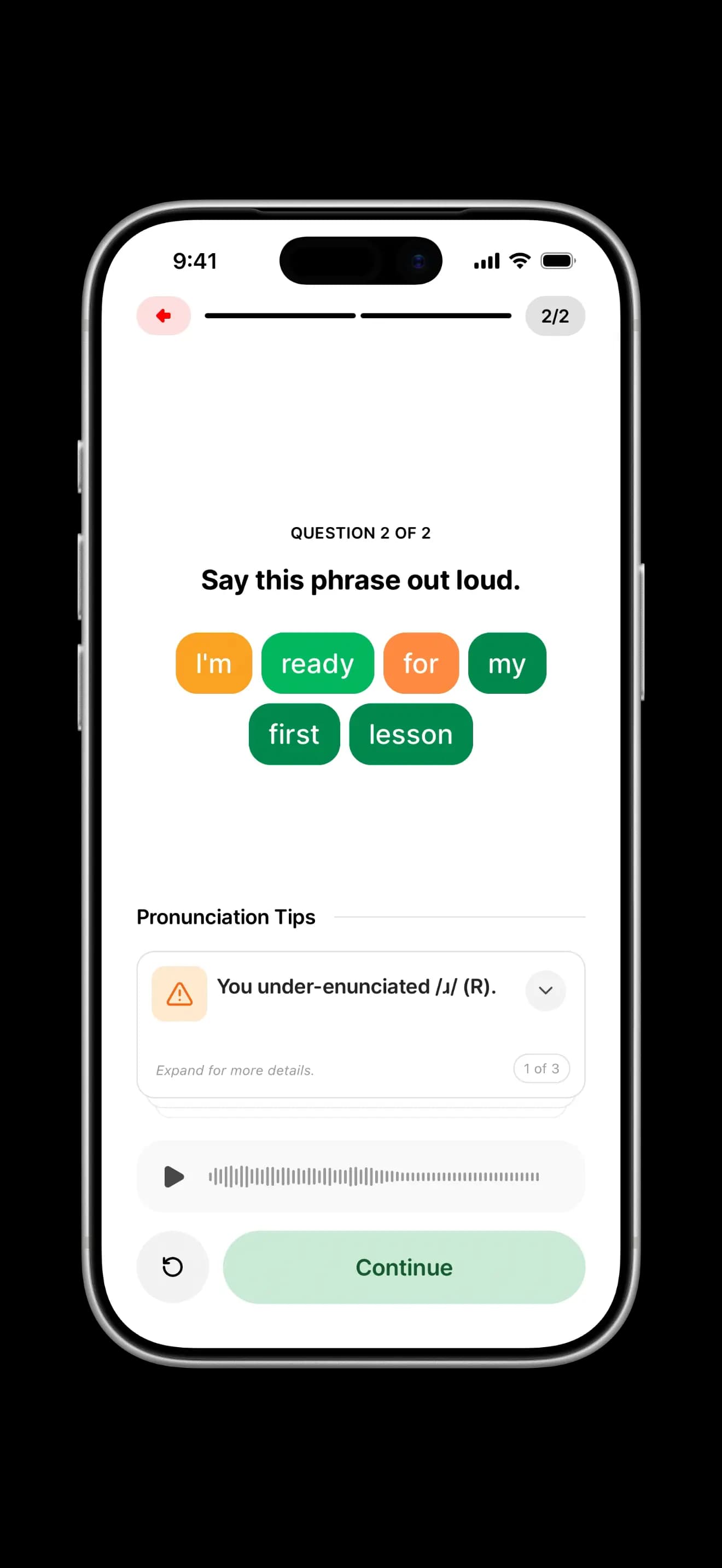
Say a phrase out loud and the words light up one by one as you speak, so you can see which words you’ve already got right and which still need work.
Swapped sounds are pointed out
If very comes out as “feri,” you can see which sound got swapped and in which word, then watch a video of how to shape the sound with your mouth and tongue.
Review built around your hardest sounds
Slay Speech keeps track of the sounds you struggle with across all your practice, then builds your review around them.
Practice for real situations
Practice conversations for situations like ordering food, making a phone call, or going to a job interview, with guidance and feedback in Indonesian.
/ʌ/ in cup: a u that isn’t u
This sound can be spelled u, o, or ou, and that’s the trap. In Indonesian, u always says u, so cup gets read as “koop” and bus sounds like the Indonesian word bus. Words like love, money, and come often get a full o, too. For some speakers, especially Sundanese speakers, cup drifts toward cap instead.
Keep your mouth relaxed, with your jaw half open and your tongue in the middle, and don’t round your lips. The closest Indonesian sound is a short a, as in dan (and), but /ʌ/ is a little more closed and more relaxed, so treat this as an approximation. Don’t open your jaw too wide or push your tongue forward, or you’ll end up close to the /æ/ in cap.
Words to practice
- cupnot cap
- busnot the Indonesian u
- lovethe o here is /ʌ/
- moneythe o here is /ʌ/
- youngspelled ou, same /ʌ/
- comethe o here is /ʌ/
Tip: Try it in front of a mirror. If your lips push forward when you say cup or love, you’re still saying u or o.
In Slay Speech, words like love and money get their own score. If the score is low, tap the word to see its syllable breakdown and hear the audio, so you don’t have to guess from the spelling.
/ʃ/ in she: don’t let it become s
Indonesian actually has this sound, spelled sy as in syarat (requirement), but in everyday speech many people say it as s. So she sounds like see, ship like sip, shop becomes “sop,” and fish becomes “fis.” The -tion ending in station is also /ʃən/, not “si-on” as in Indonesian stasiun (station).
Raise the front of your tongue toward the roof of your mouth, just past the gum ridge behind your upper teeth, and push your lips slightly forward and round them. The airflow is wider and softer than for s. If you’ve studied tajwid (the rules of Quran recitation), the letter syin (ش) has the same sound.
Words to practice
- shenot see
- shopnot “sop”
- fishnot “fis”
- wish
- station-tion is /ʃən/
- surespelled s, sounds like /ʃ/
Tip: Push your lips forward a little, as if you’re shushing someone, and make a long shhh. Hold it, then move into the vowel: shhh-ee, shhh-op. If your lips are flat, it usually still comes out as s.
When your she sounds like see, Slay Speech flags the word and plays a video of how to shape /ʃ/ with your tongue and lips.
/v/ in very: don’t let it become f
In Indonesian, v is almost always read as f, so visa and video come out as “fisa” and “fideo,” and nobody is confused. English is a different story: very becomes “feri,” which sounds like ferry, the boat; van becomes fan; and have becomes “hef.” Some speakers whose first language is Sundanese or Javanese sometimes even turn f and v into p, as in “pilem” for film. That’s riskier, because fan can sound like pan, fine like pine, and very like “peri” or berry.
Rest your upper teeth lightly on your lower lip, just as you would for f, and then turn on your voice. Don’t let your lips touch each other, or the sound becomes b or p.
Words to practice
- verynot ferry
- vannot fan
- havenot “hef”
- love
- fiveboth f and v
- leavenot leaf
Tip: Hold an fff for three seconds, then turn on your voice without moving your lips until it becomes vvv. Put a finger on your throat: you should feel it buzz.
If your very still sounds like “feri,” Slay Speech shows you that your v got swapped for f, and in which words it happened.
/p/, /t/, /k/ at the start of a word: add a puff of air
This one almost always goes unnoticed. In Indonesian, p, t, and k are said without a puff of air. In English, p, t, and k at the start of a stressed syllable come with a small puff, and that puff is exactly what listeners use to tell them apart from b, d, and g. Without it, pin can sound like bin, time like dime, and cold like gold.
Say p, t, or k as usual, then let a little air out before the vowel, as if a tiny h slipped in right after it. There’s no puff after s (spin, stop, sky), and you don’t need it at the end of a word either.
Words to practice
- pinnot bin
- pearnot bear
- timenot dime
- ten
- coldnot gold
- come
Tip: Hold a tissue in front of your mouth and say pin, then spin. The tissue should move on pin and stay almost still on spin.
If your pin sounds like bin, Slay Speech flags the word and shows you which sound got swapped, so you know which words need a stronger puff.
/θ/ in think: tongue at the teeth, not t or s
Indonesian doesn’t have this sound, so speakers swap in the closest one. Most often that’s t: thanks becomes “tengkyu,” three sounds like tree, and thin like tin. Some people use s instead, the same way the Arabic letter ث (tsa) became s in Selasa (Tuesday), so thin sounds like sin.
Rest the tip of your tongue lightly between your upper and lower teeth, or just behind the edge of your upper teeth. Then blow air out without using your voice. The key difference from t is that the air keeps flowing, so you can hold the sound for as long as your breath lasts.
Words to practice
- thinknot “tink”
- threenot tree
- thing
- monthTH at the end
- mouthTH at the end
- bothTH at the end
Tip: If you’ve studied tajwid, you already have a head start: the Arabic letter tsa (ث) uses the same tongue position.
If your think comes out with a t or s, Slay Speech flags the word, shows you which sound got swapped, and plays a video of the tongue position for /θ/.
/ð/ in this: the TH that buzzes
This is the voiced version of /θ/, and it shows up in the most common words of all: the, this, that, they, there. Indonesian speakers usually replace it with d, so they sounds like day and this becomes “dis.” Some use t, so that becomes “tet.” Others use z, the same way the Arabic letter ذ (dzal) became z in azan (the call to prayer), so then sounds like zen.
Your tongue goes in the same position as for /θ/, but your voice stays on. Put a finger on your throat: you should feel the buzz continue right into the next vowel. In a sentence, your tongue has to move fast, so just touch the tip to your teeth briefly. There’s no need to stick it far out.
Words to practice
- thisnot “dis”
- theynot day
- there
- mother
- brother
- breathethe verb; breath has /θ/
Tip: The letter dzal (ذ) in tajwid has the same sound. If it doesn’t feel natural yet, start by drilling these five words: the, this, that, they, there.
When your this or they comes out with a d, Slay Speech flags that word within the phrase, so you know exactly where your /ð/ went missing, even in a word as short as the.
/z/: the s that’s really a z
Many people say “jaman” and “ijin” instead of zaman (era) and izin (permission), and that habit makes zero sound like “jiro.” The bigger problem is the letter s, which always says /s/ in Indonesian but often says /z/ in English: is, was, because, easy, music. At the end of a word, the difference can change the meaning: price and prize, rice and rise. The most important clue is actually the vowel before it, which is slightly longer in prize and rise.
The -s ending works the same way. After a voiced sound, meaning one where your vocal cords vibrate, it’s /z/ (dogs, rooms, plays). After a voiceless sound, it’s /s/ (books, cats). The exception: after hissing sounds like s, z, sh, ch, and j, it becomes its own syllable, /ɪz/: buses, watches, pages. For /z/, put your tongue where it goes for s, then turn on your voice. Your tongue shouldn’t touch the ridge behind your teeth or the roof of your mouth, because if it does, the sound turns into j.
Words to practice
- isends in /z/, not /s/
- wasends in /z/
- becausethe s is /z/
- easythe s is /z/
- zeronot “jiro”
- musicthe s is /z/
Tip: Make a long sss, then turn on your voice without moving your tongue until it sounds like a buzzing bee: zzz. Then try it at the end of is and was.
Because every word gets a score, even an /s/ that slips into is or because gets caught, and Slay Speech shows you which sound got swapped.
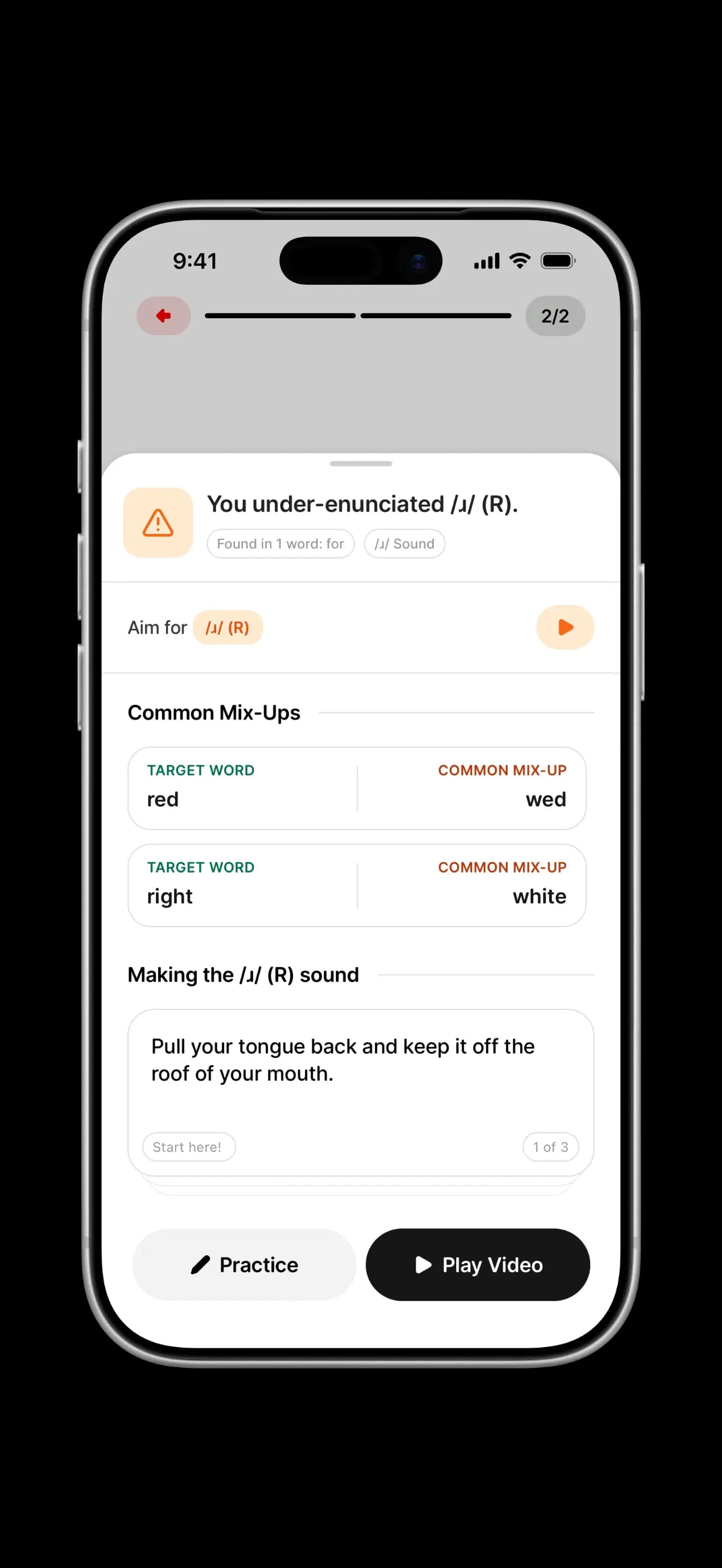
/ɹ/ in red: no trilling
The Indonesian r is made by trilling or tapping the tip of your tongue against the ridge behind your upper teeth. With the American r, the tip of your tongue doesn’t touch anything at all. If you carry the Indonesian r straight into English, words like car and work are still understood, but they sound stiff.
Pull your tongue back slightly, raise the middle of it toward the roof of your mouth, let the tip float free, and round your lips a little. In American English, an r after a vowel is still pronounced, as in car, teacher, and world, but with no trill at all. In her, bird, and work, the vowel and the r even merge into a single sound, /ɝ/, so don’t say an e first and then a trilled r. The same goes for the weak -er and -or endings in teacher and doctor.
Words to practice
- red
- right
- carr after a vowel, no trill
- workone merged sound, /ɝ/
- teacherweak -er ending
- world
Tip: Here’s an easy check: if you feel the tip of your tongue trilling or tapping the ridge behind your teeth, that’s still the Indonesian r. Try holding the err in her with the tip of your tongue floating free, not touching anything.
Slay Speech scores words like car and work and plays a video of how to shape /ɹ/. If this sound keeps giving you trouble, the app keeps track of it and adds it to your review.
Beyond individual sounds
Getting each sound right isn’t enough if the ends of your words disappear or the stress lands in the wrong place.
Consonants at the end of a word
In Indonesian, final consonants aren’t released strongly, and a b, d, or g at the end of a word usually sounds like p, t, or k: sebab (because) becomes “sebap,” and abad (century) becomes “abat.” A final k, as in anak (child) and tidak (no), turns into a catch in the throat, much like a hamzah (a glottal stop). That’s why bad sounds like bat, bag like back, and need like neat.
You don’t need to release the consonant with force, since American speakers often hold it back too. Two things matter more. First, make the vowel before a voiced consonant longer: the vowel in bad is longer than the one in bat. Second, for /k/, the back of your tongue has to actually close against the soft palate, instead of the sound stopping in your throat, so that book and back sound complete.
Consonant clusters and the -ed and -s endings
You can see the habit of trimming consonant clusters at the end of a word in Indonesian loanwords: test became tes, export became ekspor, and passport became paspor. But in English, the sound you trim often carries meaning. I walk and I walked differ only by the /t/ at the end, and since Indonesian verbs don’t change form for tense, that sound is easy to skip.
The -ed ending has three sounds: /t/ after a voiceless sound (walked, stopped), /d/ after a voiced sound (played, called), and /ɪd/ only after t or d (wanted, needed). So walked isn’t “wal-ked.” Clusters at the end of a word are the ones that get cut most often: test becomes “tes,” asked becomes “as,” and months becomes “mons.” One trick helps: link the final sound to the vowel of the next word, so walked out sounds like “walk-tout” and the /t/ doesn’t disappear. At the start of a word, some speakers slip in an extra e, so stress becomes “setres” and school becomes “sekul.” If you already say stasiun (station) or skripsi (undergraduate thesis) without an e, just apply the same habit here.
Word stress and the schwa
Stress in Indonesian is light, doesn’t change meaning, and varies from region to region. In English, a stressed syllable is louder, longer, and higher in pitch. Where it falls can even change the meaning: REcord (the noun) and reCORD (the verb). If you give every syllable the same weight, listeners lose that clue. The biggest trap is words that look like Indonesian ones, because the Indonesian rhythm comes along with them: ekonomi but eCONomy, fotografi but phoTOGraphy, universitas but uniVERsity, televisi but TELevision, kalender but CALendar, and hotel but hoTEL.
Stress goes hand in hand with the schwa, /ə/, a short, “lazy” vowel that shows up in unstressed syllables: about, banana, today. The good news is that Indonesian already has something similar, the e pepet (the weak e) in besar (big) or kecil (small), though it’s not identical. Function words like and, to, and of are usually weakened in a sentence too, so don’t pronounce each one in full. Knowing these weak forms also helps you understand native speakers, because they weaken those words all the time.
Spelling and loanwords
Indonesian spelling almost always matches the sound, so you’re used to trusting what’s written. English doesn’t work that way: some letters are silent (island, walk, know, hour), and one letter can make many different sounds (the o in go, do, hot, and love).
The sneakiest traps are words that look like Indonesian ones. Radio is /ˈreɪdioʊ/, video is /ˈvɪdioʊ/, focus is /ˈfoʊkəs/, bus is /bʌs/, and data is usually /ˈdeɪtə/. Notice the gliding vowels /eɪ/ and /oʊ/ in those words, too: Indonesian speakers tend to flatten them into a plain e and o, so make sounds like “mek” and go comes out with a flat o like the one in toko (shop). Finish both with a small glide, toward i for /eɪ/ and toward u for /oʊ/. Whenever you come across a new word, listen to how it’s pronounced before you trust the spelling, even if it looks like a word you already know.
15 minutes a day in Slay Speech
Every day, the home screen shows today’s phrase and one section of your learning path, made up of three activities that build on each other. It takes about 15 minutes in total, and you say everything out loud.
Today’s phrase (1 minute)
Say the daily phrase out loud. Every word gets a score, and the card explains what the phrase means and when people actually use it.
Story video (about 6 minutes)
Today’s section starts with a story split into short clips. After each clip, answer a question and then say a sentence. Your progress in the story isn’t saved if you stop partway through, so watch it to the end in one sitting.
Topic phrases (3 minutes)
Say three phrases on the section’s topic, like ordering food or checking in at a hotel, and see which words still need work.
Conversation or sound review (3–5 minutes)
Depending on the section, you either practice a real situation (picking a reply and saying it, typing, or talking on a live voice call) or review your weakest sound with a few words. For Indonesian speakers, that’s usually a vowel pair like ship and sheep or bad and bed, or a sound like V or TH.
Missed words (1 minute)
Tap any word with a low score to practice it on its own: listen to it, see its meaning in Indonesian and its syllable breakdown, then record it again.